
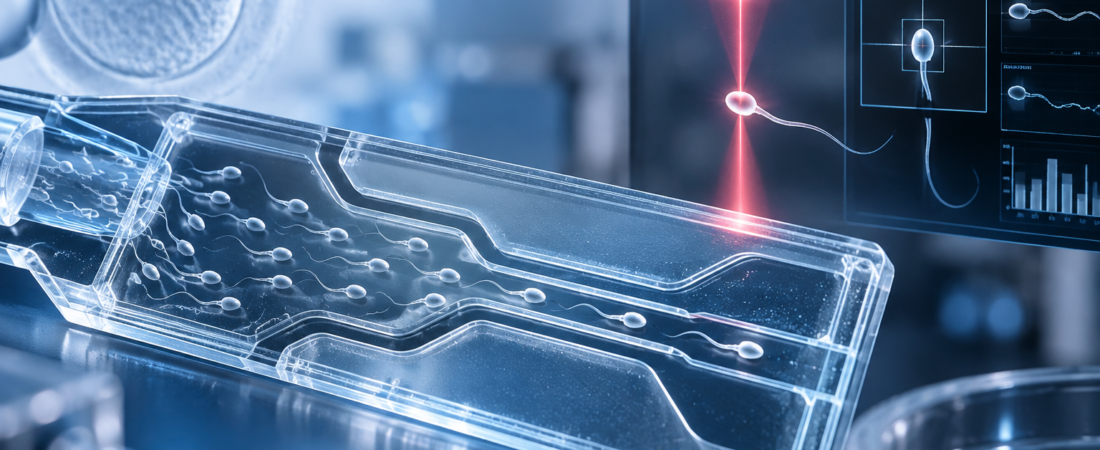
IVF sperm selection could become more precise through microfluidic chips and optical tweezers. One technology sorts sperm through tiny channels; the other uses laser light to measure the movement and force of individual cells.
Researchers at the University of Sydney in Australia and the University of Pavia in Italy reviewed advances in these approaches in Reproduction, Fertility and Development.
Their literature review suggests that combining the technologies could improve the precision of assessment and potentially reduce damage during processing. It does not demonstrate improved pregnancy or live-birth rates.
Selecting sperm through tiny channels rather than centrifugation
Density-gradient centrifugation and swim-up are commonly used to separate motile sperm in IVF. Concerns have been raised that centrifugation may expose cells to physical stress or reactive oxygen species that could increase DNA damage.
Microfluidic technology controls very small amounts of fluid in narrow channels, on the scale of a human hair. Channel geometry and fluid flow can help separate sperm with favorable motility.
Using sperm's natural movement may reduce reliance on centrifugation. Some earlier studies suggest potential reductions in DNA damage and oxidative stress, but those possibilities depend on the method and evidence.
Laser light measures the force of a single sperm
Optical tweezers use focused laser light to hold or move microscopic particles or cells. They do not physically grip sperm with a mechanical tool; they use tiny forces generated by light.
Applied to sperm assessment, they can quantify swimming force and movement characteristics at the single-cell level.
Conventional semen analysis centers on count, motility and morphology. Optical tweezers add information about the forces involved in movement.
The review also discusses combining the approach with Raman spectroscopy and fluorescence imaging to assess cell condition and function from several perspectives.
From sorting to detailed assessment on one chip
Combining microfluidics and optics could produce an optofluidic chip that sorts sperm and evaluates individual cells within a compact device.
Microfluidics would separate motile sperm, while optical methods would measure movement and physical characteristics.
Such systems could eventually help assess sperm for IVF or intracytoplasmic sperm injection, known as ICSI.
They may offer additional assessment approaches for men with low sperm counts or poor motility.
However, strong swimming ability does not guarantee fertilizing capacity or genetic normality. How physical measurements relate to embryo development and birth outcomes requires separate study.
Greater precision does not yet mean more pregnancies
This was a literature review of existing microfluidic and optical research, not a clinical trial comparing pregnancy outcomes with a new device.
It cannot establish that using these technologies increases fertilization, blastocyst formation, clinical pregnancy or live-birth rates.
Standardization, cost, processing speed, laser safety and practicality in embryology laboratories remain challenges.
Nevertheless, the review illustrates a shift from selecting fast-moving sperm toward measuring the physical and cellular characteristics of individual cells in greater detail.
As embryo assessment becomes more sophisticated, research is also expanding on the sperm used for fertilization. Whether these approaches improve pregnancy and birth remains the key clinical question.
Study source
This article is based on the October 2026 review “Assisted reproductive technologies on-chip: the application of microfluidics and optics to sperm assessment and sorting,” in Reproduction, Fertility and Development. Authors include Katherine R. Seymour, Yuze Guo, Melissa Cannarozzo, Daniele Vigolo, Stefano Palomba and Simon P. de Graaf, with the University of Sydney and University of Pavia. DOI: 10.1071/RD26043. PMID: 42843648.
Related reading
Korean Male Infertility Guidelines: Why Treatment Must Look Beyond Sperm Counts
The image was created using generative AI (ChatGPT, OpenAI); any people depicted are fictional.
Copyright © 2026 Fertility Information TokTok | THE FERTILITY NOTES. All rights reserved. Unauthorized republication, reproduction, redistribution, scraping, AI training and data use of any content, including articles, photographs and images, are strictly prohibited. Violations may result in legal liability.