
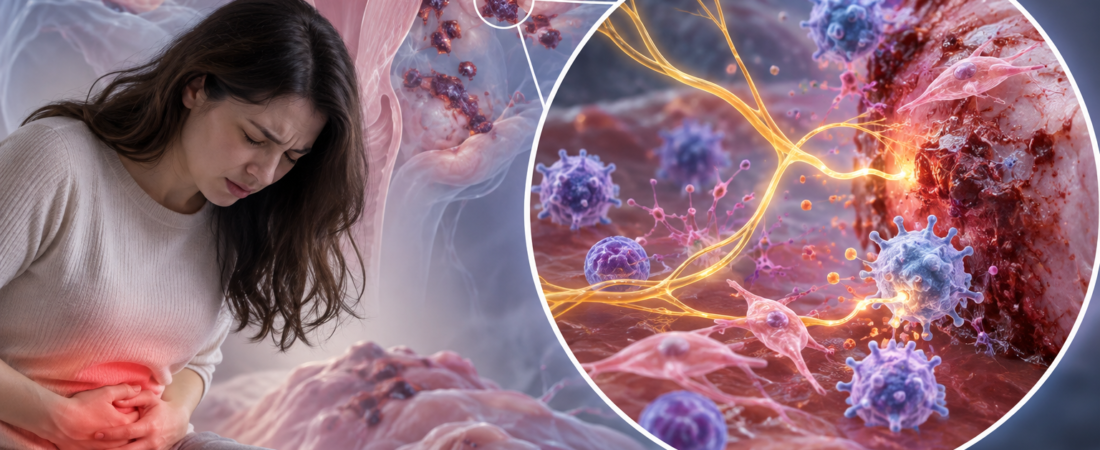
A new study offers a possible explanation for severe period pain and chronic pelvic pain in endometriosis: pain-sensing nerves and inflammatory immune cells may interact within lesions in ways that amplify pain signals.
Pain has long been linked to lesion location, tissue invasion and surrounding inflammation. Yet small lesions can cause severe symptoms, and pain can persist after surgery, making its mechanisms difficult to unravel.
Researchers at The Jackson Laboratory in the United States mapped cells inside endometriosis lesions and identified microenvironments in which nerve and immune cells cluster. The findings were published in Nature Communications.
Their work examines pain through interactions among cells inside lesions, rather than treating it solely as a consequence of tissue injury or inflammation.
Mapping the cells surrounding pain-sensing nerves
The team used high-resolution spatial transcriptomics on ovarian and peritoneal lesions. This technique measures gene activity while preserving information about where cells sit in tissue.
Cells were not distributed randomly. Different populations formed organized layers around epithelial glands.
MME-positive fibroblasts, activated macrophages and pain-sensing nerves clustered close to the glands. Fibroblasts help maintain tissue structure and influence neighboring cells; macrophages are immune cells involved in inflammation and repair.
Farther from the glands, OGN-positive fibroblasts, B cells and mast cells were relatively more abundant. Similar patterns appeared in ovarian and peritoneal endometriosis.
The findings suggest that lesions in different locations can share features of cellular organization.
A possible link between nerves, macrophages and chronic pain
The investigators focused on nociceptive neurons, which detect harmful stimuli or tissue injury and transmit pain signals.
These nerves were concentrated around lesion glands, near activated macrophages and particular fibroblast populations.
The team proposed that this arrangement may support a neuroimmune feedback circuit that reinforces pain and inflammation.
Pain-related signaling was stronger near the glands and decreased farther away.
That pattern suggests that specific cellular neighborhoods, rather than every part of a lesion equally, may be important in generating pain.
Spatial relationships alone do not fully establish the mechanisms determining how severe or persistent an individual patient's pain will be.
Laboratory nerve models test the lesion-cell effect
To explore the tissue findings, the researchers created sensory nerve organoids from human induced pluripotent stem cells, or iPSCs. Organoids are three-dimensional models reproducing some features of human tissues.
When epithelial cells and fibroblasts from patients' lesions were cultured together with these models, the combined environment induced pain-sensing and inflammation-related states in the neurons.
This suggests that lesion cells may influence nerve function, rather than merely sit nearby.
The team plans to add different immune cells to the model to examine nerve–inflammation interactions more closely and explore ways to interrupt them.
Could pain treatment move beyond removing lesions?
Endometriosis is a chronic condition in which tissue resembling the uterine lining grows outside the uterus. It can cause severe menstrual pain, chronic pelvic pain, pain during sex or bowel movements, and is associated with infertility in some patients.
Pain medicines, hormonal treatment and surgery are used, but they do not provide adequate relief for everyone. Symptoms can persist or recur after treatment.
The study suggests that future targets could include interactions among nerves, immune cells and fibroblasts within lesions.
Caroline M. Haney, a researcher involved in the study who also has endometriosis, emphasized in an institutional statement that this pain reflects biological nerve signaling, rather than merely a subjective complaint.
This was basic research using human lesion tissue and laboratory cell models. It was not a clinical trial demonstrating a new drug's effectiveness or reduced pain in patients.
Its contribution is a more detailed picture of the cellular environment in which pain may arise. Treatments that modify those interactions might eventually offer options for people whose symptoms remain inadequately controlled, but that prospect still needs testing.
Study source
This article is based on “High-resolution spatial transcriptomics reveals fibroblast and neuroimmune microenvironments in endometriosis lesions,” by researchers including Caroline M. Haney and Elise T. Courtois at The Jackson Laboratory. Published in Nature Communications on October 9, 2026; also covered by EurekAlert! on October 13, 2026. DOI: 10.1038/s41467-026-78453-5.
Related reading
Endometriosis and Adenomyosis: Longer Periods, but Not Necessarily More Pain
The image was created using generative AI (ChatGPT, OpenAI); any people depicted are fictional.
Copyright © 2026 Fertility Information TokTok | THE FERTILITY NOTES. All rights reserved. Unauthorized republication, reproduction, redistribution, scraping, AI training and data use of any content, including articles, photographs and images, are strictly prohibited. Violations may result in legal liability.