
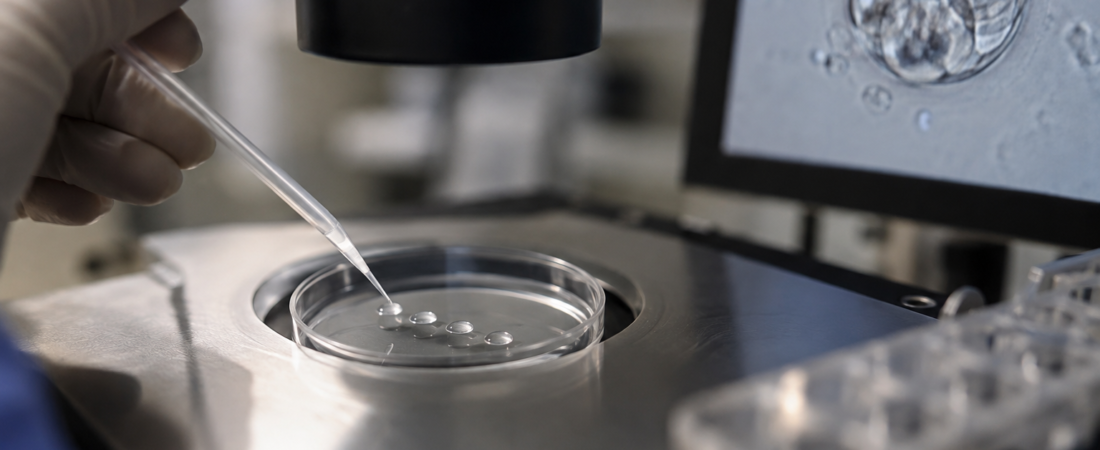
Using three times as much IVF culture medium did not produce a clear improvement in embryo development or pregnancy outcomes in a Korean study. More medium was not necessarily better for obtaining good-quality embryos.
The study, published on September 29, 2026, compared 10 μL and 30 μL of culture medium for 6,173 embryos from 859 women. The good-quality day-5 embryo rate was 18.0% in both groups, with no statistically significant difference in embryo utilization or clinical pregnancy rates.
The findings address a practical question about the volume of medium used during in vitro embryo culture, a central stage of IVF.
What does the tiny drop of culture medium do?
In IVF, eggs and sperm are brought together and the resulting embryos are grown in an incubator. Culture medium supplies nutrients and energy sources needed for development.
It contains substances such as glucose, lactate, pyruvate and amino acids. In this environment designed to resemble conditions inside the body, embryos divide and can develop to the blastocyst stage.
The volume may influence the total nutrients available, concentrations of metabolic products around the embryo, and the medium's physical and chemical stability.
Very small volumes may be more vulnerable to evaporation-related osmolality changes. Larger volumes may dilute substances secreted by embryos. How much these possibilities affect development or pregnancy depends on the culture conditions.
The same 18.0% good-quality day-5 embryo rate
The researchers compared development in 10 μL and 30 μL, focusing on morphologically good-quality embryos at the day-5 blastocyst stage.
The rate was 18.0% in each group. A threefold difference in medium volume did not change that measured proportion.
Embryo utilization also did not differ significantly. This refers to the proportion of cultured embryos usable for transfer or cryopreservation.
Clinical pregnancy rates likewise showed no significant difference.
These results mean that no clear performance difference was observed under the two conditions studied. A statistically nonsignificant result does not establish that the conditions are identical in every setting.
Stable conditions may matter more than simply adding medium
Increasing volume alone may not be a solution for improving embryo quality or pregnancy chances.
Culture outcomes depend on many interacting factors, including medium composition, temperature, oxygen, carbon dioxide, pH, osmolality and the incubator environment.
Embryos are sensitive to changes, making consistent conditions important.
The findings should not be interpreted as a recommendation for every IVF clinic to reduce its medium volume to 10 μL. Appropriate conditions can differ with culture methods, equipment and medium formulations.
Nor does the absence of a difference in clinical pregnancy establish equal live-birth rates. Birth outcomes and long-term safety require separate evidence.
The practical implication is to maintain conditions validated for the laboratory's own culture system, rather than assume that a greater volume will improve results.
Optimizing volume also matters for laboratory operations
Culture medium is an essential material used repeatedly in IVF. Understanding suitable volumes can support standardization and efficient resource use.
The large number of embryos makes the comparison informative. However, embryos from the same woman are related observations, so the study design and statistical handling of that clustering remain important.
Ultimately, the goal is to provide stable conditions for embryo development, rather than use as much medium as possible.
Source and verification limitation
The Korean source article reports a study of 6,173 embryos from 859 women published in JBRA Assisted Reproduction on September 29, 2026. DOI: 10.5935/1518-0557.20260050. PMID: 42808759.
The source article explicitly states that the full paper, authors, affiliations and English title were not independently verified, and that its account was based on a supplied research summary. That limitation is retained here. PubMed record: https://pubmed.ncbi.nlm.nih.gov/42808759/
Related reading
Obesity and IVF Embryo Development: Does Metabolic Health Tell the Whole Story?
The image was created using generative AI (ChatGPT, OpenAI); any people depicted are fictional.
Copyright © 2026 Fertility Information TokTok | THE FERTILITY NOTES. All rights reserved. Unauthorized republication, reproduction, redistribution, scraping, AI training and data use of any content, including articles, photographs and images, are strictly prohibited. Violations may result in legal liability.