
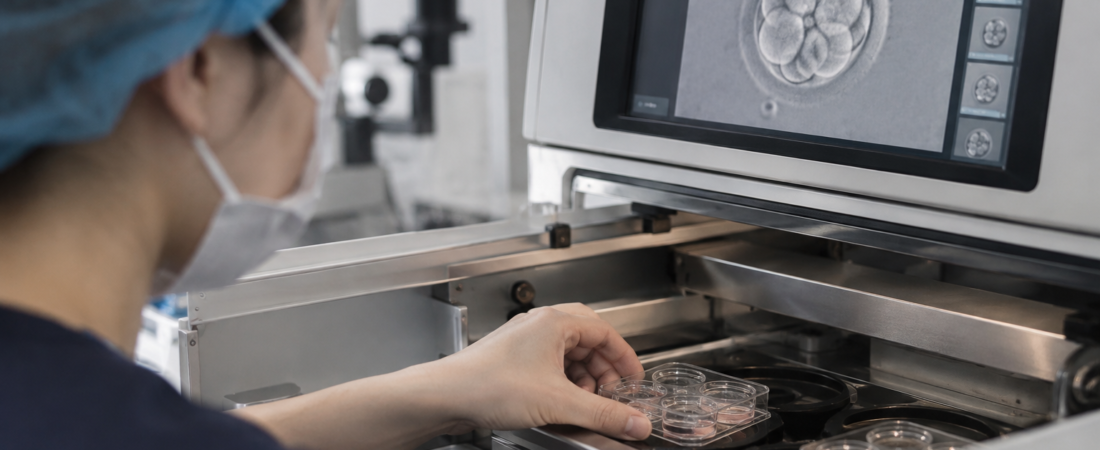
IVF incubator humidity may influence early embryo development. Japanese researchers found that adding moisture locally inside a dry incubator was associated with more good-morphology day-3 embryos, although clinical and ongoing pregnancy rates did not significantly improve.
The study compared development under dry conditions with a simple approach to local humidification. It suggests that the environment in which early embryos grow may be improved without replacing the incubator itself.
The findings were published on October 2, 2026, in Clinical and Experimental Reproductive Medicine.
Why humidity matters in embryo culture
During IVF, fertilized eggs are cultured in an incubator for several days. Temperature, oxygen and carbon dioxide are carefully controlled to provide conditions resembling those in the reproductive tract.
Humidity can also matter. If the incubator is very dry, water may gradually evaporate from the culture medium, concentrating dissolved substances and raising its osmolality.
Osmotic pressure is related to the movement of water across differences in concentration. Changes in the culture medium can affect the water balance of embryo cells, making environmental stability important.
Some IVF laboratories use dry incubators to reduce contamination risks and simplify management. Evaporation of culture medium under dry conditions remains a challenge.
Adding 4 mL of medium outside the embryo wells
Mako Goto, Osamu Okitsu and colleagues at Kusuhara Women's Clinic in Japan investigated local humidification as a way to address this drawback.
They first retrospectively compared embryo development and pregnancy outcomes in conventional dry and humidified incubators.
They then added 4 mL of human tubal fluid medium outside the wells containing embryos in culture dishes inside a dry incubator, increasing local humidity.
The researchers compared three environments: conventional dry culture, locally humidified dry culture and conventional humidified culture.
This allowed them to assess whether local moisture could improve culture conditions without changing the incubator.
More good-morphology day-3 embryos
Conventional humidified culture produced significantly higher rates of good-morphology day-3 embryos, blastocyst formation and good-morphology blastocysts than conventional dry culture.
A blastocyst is a developmental stage generally reached around five to six days after fertilization and is used for embryo transfer or cryopreservation.
In multivariable analysis accounting for potentially influential factors, dry culture conditions were independently associated with poorer developmental outcomes.
Local humidification in a dry incubator was associated with a significantly higher rate of good-morphology day-3 embryos than conventional dry culture (P=0.011).
For that outcome, the locally humidified dry group did not differ significantly from the conventional humidified group.
The researchers interpreted this as evidence that local humidification may improve the early developmental environment in a dry incubator.
Better embryo measures did not translate into higher pregnancy rates
An improvement in developmental measures does not establish an improvement in pregnancy success.
Clinical pregnancy and ongoing pregnancy rates did not differ significantly among the three groups.
The researchers suggested that osmotic stress in dry culture might compromise early embryo quality, while implantation potential after an embryo reaches a transferable blastocyst stage may depend more on its intrinsic developmental competence.
Improving culture conditions might therefore help laboratories obtain usable embryos without necessarily increasing each embryo's chance of producing a pregnancy.
The study combined retrospective comparisons with prospective observation of the locally humidified group. Further validation is needed to establish the effect of humidification itself.
Humidity joins the IVF laboratory quality checklist
The study adds another consideration to the development of IVF culture systems.
Laboratories have long focused on temperature, gas concentrations, medium composition and embryo observation. Small amounts of evaporation and resulting changes in osmolality may also influence environmental stability.
Applying local humidification to an existing dry incubator has practical appeal. However, results may vary with incubator design, culture dishes and media; the same method cannot automatically be applied to every system.
Further research should refine humidity standards for individual incubators and examine how stable medium osmolality relates to embryo development and ultimately live birth.
The findings suggest that efforts to improve IVF outcomes should include the microscopic environment in which embryos grow, alongside embryo selection and artificial intelligence.
Study source
This article is based on “Humidified culture in a dry incubator improves culture performance,” by Mako Goto, Osamu Okitsu, Kohei Mizuno, Atsuko Kusuhara and Koji Kusuhara of Kusuhara Women's Clinic, Japan. Published in Clinical and Experimental Reproductive Medicine on October 2, 2026. DOI: 10.5653/cerm.2025.08844. PMID: 42823191. https://pubmed.ncbi.nlm.nih.gov/42823191/
Related reading
Obesity and IVF Embryo Development: Does Metabolic Health Tell the Whole Story?
The image was created using generative AI (ChatGPT, OpenAI); any people depicted are fictional.
Copyright © 2026 Fertility Information TokTok | THE FERTILITY NOTES. All rights reserved. Unauthorized republication, reproduction, redistribution, scraping, AI training and data use of any content, including articles, photographs and images, are strictly prohibited. Violations may result in legal liability.