
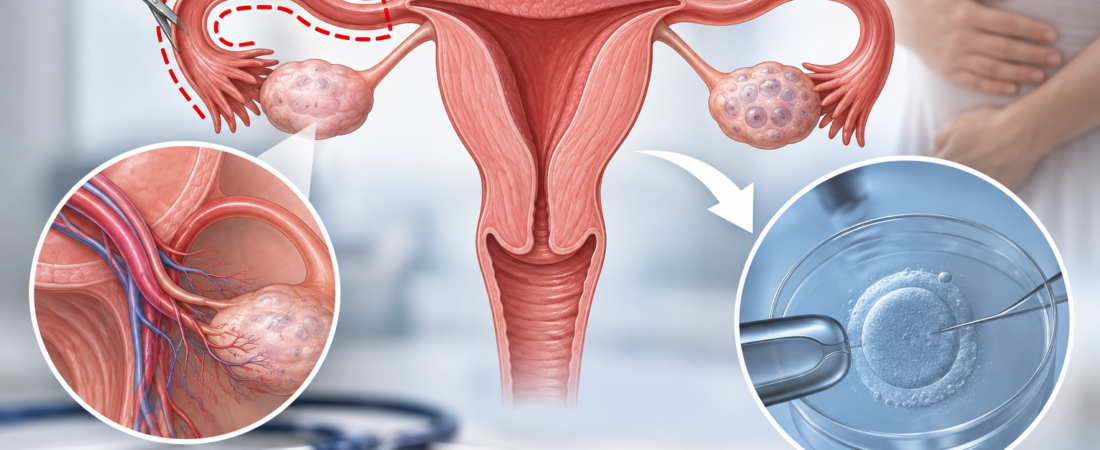
Salpingectomy before IVF can be helpful when a hydrosalpinx interferes with implantation. But removing a fallopian tube is not automatically harmless or necessary: ovarian blood supply, ovarian reserve and the specific tubal condition all need consideration.
Pregnancy through IVF is possible without fallopian tubes. Why, then, do some fertility specialists advise against rushing into tube removal simply because a problem is identified?
The concern often involves the nearby ovary and the small vessels supplying it, rather than the tube alone.
The fallopian tube is where egg and sperm meet and where the fertilized egg travels toward the uterus. It is important for natural conception and insemination. IVF bypasses that route by fertilizing eggs outside the body and transferring an embryo directly into the uterus.
However, the possibility of IVF without tubes does not establish that removing them has no implications for later treatment, particularly in women with reduced ovarian function or low egg yields.
The tube and ovary share nearby vascular connections
The fallopian tube and ovary are anatomically close. The ovary receives blood mainly from the ovarian artery and branches of the uterine artery; small vessels from these systems also supply tissue around the tube.
During salpingectomy, vessels in surrounding tissue must be divided or sealed to control bleeding. Depending on surgical technique and extent, some blood supply toward the ovary could be affected.
Blood brings oxygen, nutrients and hormones to the ovary. Damage to adjacent vessels has therefore raised concerns about follicular development and ovarian function.
This does not mean every salpingectomy reduces ovarian blood flow or function. Clinical studies have also found no clear change in ovarian function after surgery.
AMH findings are mixed
Anti-Müllerian hormone (AMH) is an indirect marker of the pool of ovarian follicles and is used to assess ovarian reserve.
Some studies found lower AMH after salpingectomy or lower values in women who had undergone surgery than in those who had not. Bilateral removal has attracted particular attention.
Other studies comparing the same women before and after surgery did not find a significant AMH decline. Differences in age, underlying disease, technique and follow-up make a single interpretation difficult.
A decrease in AMH does not mean egg quality or natural-conception prospects fall by the same proportion. Ovarian reserve and actual pregnancy or birth outcomes are distinct.
Hydrosalpinx can change the balance in favor of treatment
Preserving every tube is not necessarily the best approach. Hydrosalpinx—a blocked tube distended with fluid—is an important exception.
Fluid can flow back into the uterus and create an unfavorable environment for implantation. Evidence indicates that IVF pregnancy outcomes can improve when the affected tube is removed or its connection to the uterus is blocked before embryo transfer.
Salpingectomy can therefore be a treatment intended to improve pregnancy prospects. The extent and location of hydrosalpinx, surgical risk and ovarian reserve should inform the choice between removal and alternatives such as proximal tubal occlusion.
A blocked tube does not always need removal
Simple tubal blockage without hydrosalpinx may offer less reason for surgery.
ASRM’s 2021 guidance on tubal disease notes that isolated unilateral proximal tubal obstruction without other abnormalities does not necessarily require treatment.
Apparent obstruction can also reflect temporary muscular contraction during testing rather than a true blockage, making accurate diagnosis important.
Low ovarian reserve makes preoperative assessment especially important
Older women, those with low AMH and those who have retrieved few eggs in previous IVF cycles need careful consideration of potential benefit and risk.
A 2022 systematic review and meta-analysis by researchers at Gunma University in Japan examined 21 studies. Comparisons within the same women before and after surgery did not show a significant AMH decline.
In comparisons between women with and without surgery, however, AMH was on average 0.31 ng/mL lower in the surgical group. In the bilateral-salpingectomy group it was 0.71 ng/mL lower.
Those differences cannot establish whether surgery itself, underlying tubal disease or other patient characteristics were responsible. The authors cautioned against definitive interpretation.
The decision is about reproductive benefit, not preserving anatomy at any cost
The key question is whether the tube is interfering with pregnancy and whether the expected benefit of removing it outweighs surgical risk.
If hydrosalpinx is compromising implantation, surgery may help IVF. Without hydrosalpinx or another clear medical reason, avoiding unnecessary surgery may be reasonable.
Removing both tubes prevents the usual pathway for eggs and fertilization, leaving future pregnancy dependent on IVF. Natural-conception prospects, ovarian reserve, the tubal condition and future plans therefore need discussion before surgery.
IVF can work without fallopian tubes. That does not mean tube removal is inconsequential. Tubes that need removal should be treated, but planning IVF alone is not a reason to remove tubes unnecessarily.
Sources
The Korean source article draws on ASRM’s 2021 tubal-surgery guidance and the 2022 Gunma University meta-analysis of salpingectomy and ovarian reserve in the Journal of Obstetrics and Gynaecology Research. DOI: 10.1111/jog.15316; PMID: 35624527.
The source also lists KSSMA’s 2026 male infertility recommendations in the World Journal of Men’s Health (DOI: 10.5534/wjmh.260149; PMID: 42533487). Those recommendations concern male infertility; they are not evidence for the effects of salpingectomy on ovarian reserve.
Related reading
For wider context on evaluating implantation problems and choosing further investigations, see our guide to recurrent implantation failure.
Illustration created with generative AI (ChatGPT, OpenAI); it does not depict an actual patient.
Copyright © 2026 The Fertility Notes. All rights reserved. Unauthorized reproduction, redistribution, scraping, AI training, or other data use of articles, photographs, images, and all other content is strictly prohibited and may result in legal liability.