
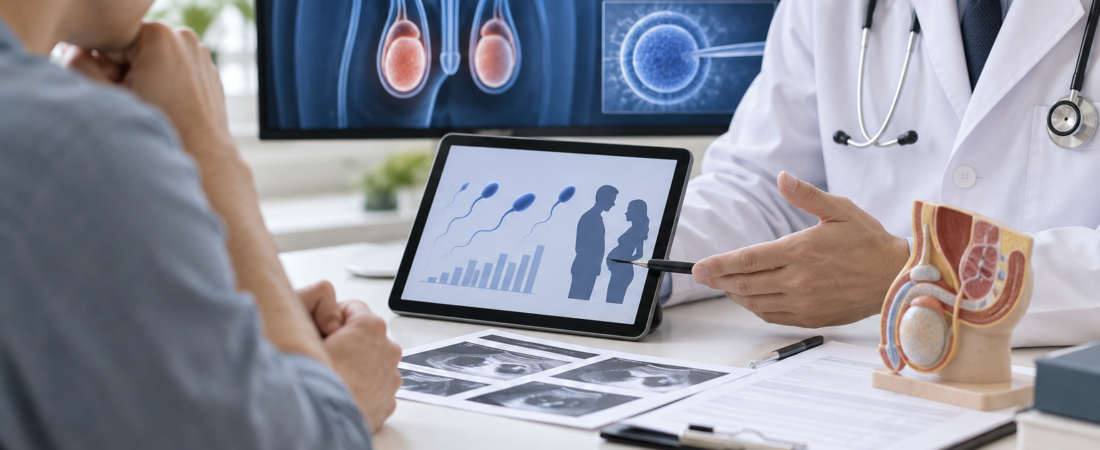
Male infertility treatment should be judged by more than improved sperm counts. Korean recommendations emphasize pregnancy and live birth, time to conception and the physical and financial burden on both partners, alongside semen measurements.
The Korean Society for Sexual Medicine and Andrology (KSSMA) guideline committee published recommendations tailored to Korean clinical practice in the October 2026 issue of the World Journal of Men’s Health, following online publication on July 23.
The recommendations address varicocele, hormonal abnormalities, obstructive and nonobstructive azoospermia, surgical sperm retrieval, IVF and intracytoplasmic sperm injection (ICSI).
A central principle is that the man’s semen analysis cannot determine the whole treatment plan. The female partner’s age, ovarian function and the couple’s pregnancy plans also matter.
Does a better sperm count mean treatment has succeeded?
Sperm concentration, motility and normal morphology are important measures. Improving them, however, does not necessarily produce a pregnancy or live birth.
The recommendations call for considering real reproductive outcomes, time to pregnancy and treatment burden when evaluating benefit.
The goal is to help a couple reach pregnancy and birth safely and effectively, rather than simply move a laboratory value into a reference range.
Varicocele does not automatically require surgery
Varicocele—abnormally enlarged veins around the testis—is a major potentially correctable cause of male infertility. Finding one does not mean every man needs an operation.
Clinical findings, semen abnormalities and the couple’s fertility circumstances should guide decisions. Even when semen results might improve, clinicians need to consider whether surgery could help achieve pregnancy and whether there is time to wait for its effect.
For couples in whom the female partner is older or has diminished ovarian function, waiting solely for a surgical response could delay a useful fertility-treatment opportunity.
Azoospermia requires cause-specific decisions
Azoospermia means no sperm are identified in the ejaculate. In obstructive azoospermia, sperm are produced but cannot pass through a blocked reproductive tract. In nonobstructive azoospermia, sperm production within the testis is impaired.
For obstruction, microsurgical reconstruction needs to be weighed against retrieving sperm directly from the testis or epididymis. The female partner’s fertility and the couple’s plan influence that choice.
In nonobstructive azoospermia, evaluation considers the cause of impaired production, hormonal status and the possibility of surgical retrieval. Microdissection testicular sperm extraction (micro-TESE), which uses a microscope to identify promising areas of testicular tissue, is an important option.
Planning retrieval alongside IVF timing and decisions about sperm freezing can reduce avoidable repeat procedures and delays.
Hormonal treatment starts with identifying the cause
Medication may help selected men with hormonal abnormalities, but it should not be applied uniformly to all male infertility.
The type of hormonal disturbance and cause of impaired sperm production should be established, followed by treatment and reassessment in appropriate patients.
Giving testosterone from outside the body can suppress sperm production in men trying to conceive. Clear treatment goals and review points are preferable to prolonged medication without establishing the cause.
ICSI is not automatically the best choice
ICSI injects a single sperm directly into an egg. It is used in situations such as very low sperm numbers, severely reduced motility or previous fertilization failure.
Evidence has accumulated that routinely using ICSI without severe male-factor infertility does not necessarily improve live birth compared with conventional IVF.
Selection should therefore reflect the clinical indication, including severe male infertility, previous failed fertilization or use of surgically retrieved sperm.
Intrauterine insemination (IUI) likewise requires consideration of the female partner’s age and ovarian reserve as well as sperm count and motility. IVF or ICSI may be more efficient after repeated IUI failure or with severely impaired semen parameters.
Do not lose sight of the female partner’s reproductive timeline
Improving sperm production takes time. Meanwhile, the female partner’s reproductive prospects may change with age and ovarian function.
Even when a correctable male factor is found, the couple’s combined reproductive situation should inform treatment order. Male treatment and IVF preparation may proceed together; assisted reproduction may be prioritized when time is limited.
The aim is a coordinated plan for both partners rather than two separate treatment pathways.
Recommendations tailored to Korean practice
The recommendations combine existing international guidelines, major research findings and consideration of Korean clinical circumstances. They address cause-specific care while emphasizing birth outcomes and treatment burden.
This is a synthesis of evidence and expert consensus, not a clinical trial testing a new treatment. Publication does not instantly change every clinic’s practice or health-insurance coverage criteria.
Ultimately, the goal extends beyond improving semen results to reducing unnecessary treatment and delay while helping couples reach a live birth. Male infertility is a couple-level reproductive and quality-of-life issue as well as a laboratory finding.
Source
Korean Society for Sexual Medicine and Andrology guideline committee, male infertility management recommendations, World Journal of Men’s Health, October 2026; first published online July 23, 2026. DOI: 10.5534/wjmh.260149. PMID: 42533487.
Related reading
For research illustrating why coordinating treatment schedules matters, read about micro-TESE timing and IVF live-birth outcomes.
Illustration created with generative AI (ChatGPT, OpenAI); it does not depict an actual patient.
Copyright © 2026 The Fertility Notes. All rights reserved. Unauthorized reproduction, redistribution, scraping, AI training, or other data use of articles, photographs, images, and all other content is strictly prohibited and may result in legal liability.