
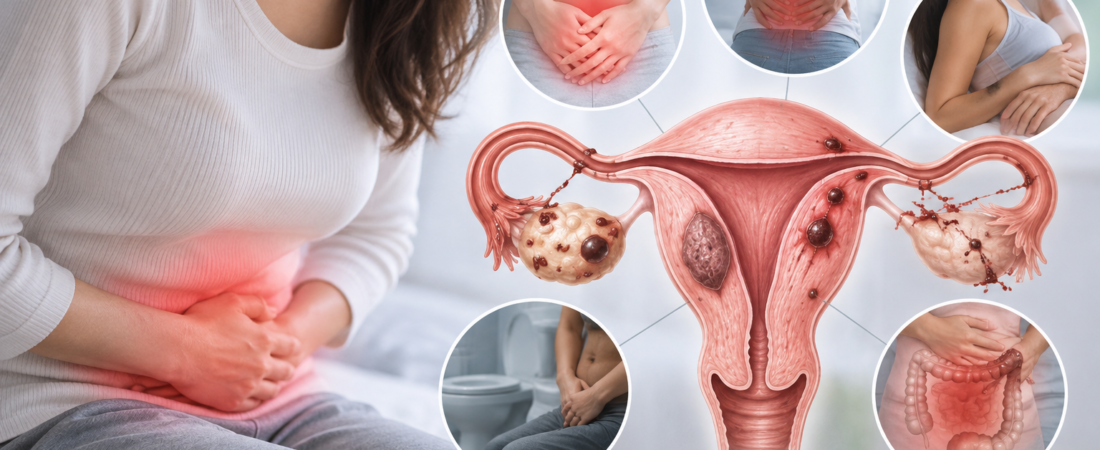
Painful periods, sex, bowel movements and back pain differed by lesion location in an Italian study.
Endometriosis and adenomyosis pain may be more closely associated with where lesions occur than how many are present. Superficial peritoneal endometriosis was associated with more severe period pain, deep pain during sex, painful bowel movements and back pain.
University of Genoa researchers analyzed 234 women with endometriosis or adenomyosis and 75 controls. They published the findings in BMC Women's Health on October 7, 2026.
The affected group included 174 women with adenomyosis, 89 with superficial endometriosis, 103 with ovarian endometriosis and 131 with deep infiltrating endometriosis. These groups overlapped because some women had more than one condition or lesion location.
The researchers assessed menstrual and non-menstrual pain, pain during sex, urination and bowel movements, and back pain.
Superficial lesions did not mean mild pain
Superficial endometriosis involves endometrial-like tissue on the pelvic peritoneal surface, rather than the deeper tissue infiltration characteristic of deep endometriosis.
After adjustment for other lesions, superficial disease was associated with pain scores 2.62 points higher for menstrual pain, 1.91 points higher for deep dyspareunia and 2.03 points higher for back pain. The reported odds of painful bowel movements were approximately 2.44 times higher.
Ovarian endometriosis was associated with menstrual pain scores 1.93 points higher, but relatively lower non-menstrual pain and deep dyspareunia.
The findings illustrate how symptom patterns may differ between ovarian and superficial peritoneal disease.
Adenomyosis and deep disease showed a different pattern
After adjustment for other lesions, adenomyosis and deep endometriosis involving the rectum or tissue around the uterus did not show independent associations with particular pain symptoms.
This does not mean those conditions are painless. In fact, 78.6% of affected participants had lesions in at least two locations.
The researchers interpreted the findings as indicating that location may be more informative about pain than the extent of disease alone.
Hormonal-treatment response also varied
The study also examined 123 women receiving hormonal treatment: 81 used progestin alone and 42 used combined estrogen-progestin treatment.
For most symptoms, treatment response did not clearly differ by lesion location. However, ovarian endometriosis was associated with approximately 3.04-fold higher odds of below-average improvement in non-menstrual pain.
Deep endometriosis in the parametrial tissue around the uterus was associated with approximately 5.31-fold higher odds of smaller improvement in deep dyspareunia.
Progestin-only treatment was associated with approximately 4.03-fold higher odds of a smaller improvement in deep dyspareunia than combined treatment.
These are observational findings from a retrospective study. They do not establish one hormonal treatment as superior or prove that lesion location directly caused the differences.
Assess the symptoms, not just lesion size
Lesion count or extent alone may not describe symptom severity adequately. Persistent pain during sex, bowel movements or in the back deserves attention to lesion location and coexisting conditions, even if menstrual pain is not prominent.
The researchers emphasized combining the anatomical findings with the types of pain a patient experiences when considering treatment.
This study evaluated pain and hormonal-treatment response, not natural conception or IVF success by lesion location. Its implication is an individualized assessment that includes experienced symptoms alongside the extent of disease seen on imaging.
Research source
University of Genoa researchers. “Association of adenomyosis and different endometriosis localizations to pain symptoms and their response to hormone therapy.” BMC Women's Health, October 7, 2026. DOI: https://doi.org/10.1186/s12905-026-04967-1.
Related reading
The illustration was generated with ChatGPT (OpenAI); any depicted people are fictional.
Copyright © 2026 Fertility Information TokTok Fertility News | THE FERTILITY NOTES. All rights reserved. Unauthorized republication, reproduction, redistribution, scraping, AI training and data use of any content, including articles, photographs and images, are strictly prohibited. Violations may result in legal liability.