
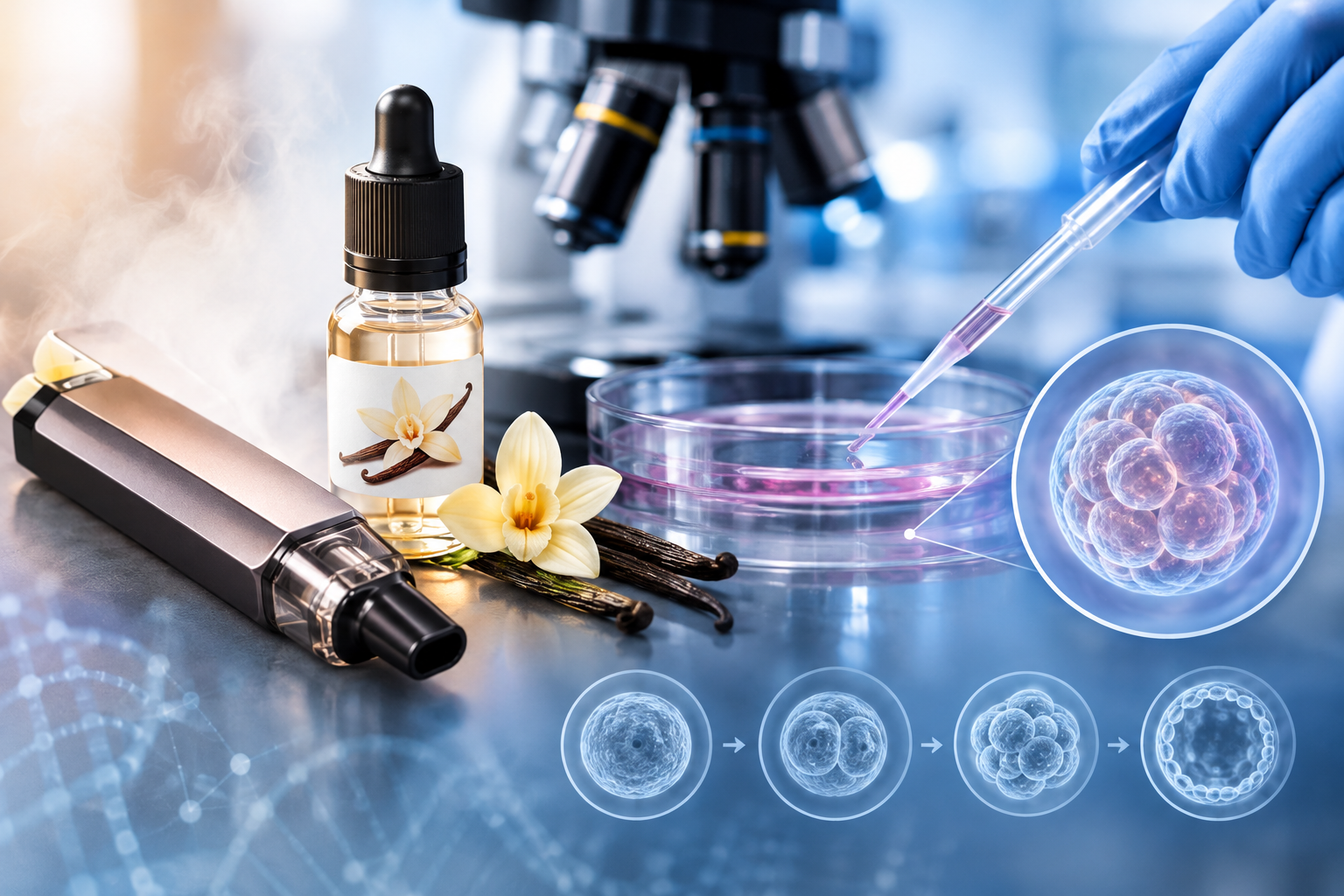
A vanilla flavoring compound altered developmental signaling in human embryonic stem cells.
The laboratory experiment did not test IVF embryos, implantation or pregnancy outcomes in people who vape.
Could vanillin, a vanilla flavoring used in e-cigarettes, influence early developmental processes? A human embryonic stem-cell study found changes in cell signaling and gene expression after laboratory exposure.
The research, published in Human Reproduction, broadens questions about vaping beyond nicotine to flavoring ingredients. However, it did not study actual human embryos or pregnancy outcomes among e-cigarette users.
Its findings identify a biological research question, not proof that vanilla-flavored vaping reduces IVF success or causes birth defects.
Why study a vanilla flavoring compound?
E-cigarettes heat liquids containing ingredients such as nicotine, flavorings and solvents to produce an inhaled aerosol. Vanilla, fruit and dessert flavors have increased interest in the biological effects of the flavoring compounds themselves.
Vanillin is a major vanilla-scented compound also used in foods and cosmetics. Use in food does not, by itself, establish safety when a substance is heated and inhaled.
The researchers examined exposure in human embryonic stem cells, which can develop into different tissue and cell types.
During early development, cells acquire different identities that lay the foundations for organs and tissues. Changes in signals governing this differentiation could potentially affect developmental processes.
Changes in signaling and developmental gene expression
One mechanism investigated involved TRPV4, a cell-membrane protein that helps cells respond to physical and chemical stimuli and participates in calcium signaling.
Calcium signals contribute to growth, movement and differentiation. The researchers examined changes in these signals and in developmental gene expression under vanillin-exposure conditions.
They assessed markers including OCT4, involved in maintaining an undifferentiated state, and SOX17, involved in early cell-lineage differentiation.
Changes in these markers suggest that processes directing stem cells toward particular identities may have been affected.
A change in gene expression does not itself establish disrupted embryo development or congenital anomalies. Those outcomes require separate investigation.
Does this show an effect on IVF success?
The findings are relevant to questions about reproductive health because fertilization is only one stage of IVF; subsequent embryo division and development also matter.
But human embryonic stem cells are not the same experimental material as embryos cultured during IVF.
Directly exposing cells to a particular concentration in a laboratory also differs from inhalation followed by absorption, metabolism and delivery to reproductive tissues.
This study therefore cannot establish that vanilla flavoring lowers egg quality, implantation, pregnancy or live birth rates.
Research measuring actual exposure in e-cigarette users and following reproductive outcomes would be needed to investigate those possibilities.
Nicotine-free does not automatically mean risk-free
Nicotine often dominates discussions of vaping and reproductive health. E-liquids can also contain multiple flavorings and solvents.
A nicotine-free product still exposes the user to other chemicals. This study is relevant because it explores whether one flavoring affects cell functions involved in early development.
The effects of vanillin itself must be distinguished from those of chemicals produced during heating. Nor can every product containing vanillin be assumed to have identical biological effects.
A research signal that needs clinical follow-up
The study suggests that flavoring ingredients warrant attention alongside nicotine when evaluating reproductive exposure before pregnancy or during IVF.
It should not be presented as proof that e-cigarette flavoring directly damages human embryos. Whether the cellular changes occur in actual pregnancies remains unknown.
The source article advises avoiding both conventional cigarettes and e-cigarettes when preparing for pregnancy, rather than choosing flavored vaping as a safe alternative simply because it contains no nicotine.
The new scientific question is how flavoring exposures relate to early cellular development—and whether the laboratory findings translate to meaningful reproductive outcomes.
Study source
Human Reproduction, October 2026 issue, study of vanillin and human embryonic stem-cell differentiation; published online August 12, 2026. DOI: 10.1093/humrep/deag126. This was basic laboratory research, not a study of IVF success or embryo development in people who vape. As noted in the Korean source, the complete author list, exact paper title and detailed experimental values were not checked against the original paper during republication.
The illustration was generated using ChatGPT (OpenAI). Any people depicted are fictional.
Related reading
Understanding implantation failure and outcomes after embryo transfer
Copyright © 2026 THE FERTILITY NOTES. All rights reserved. Unauthorized reproduction, copying, redistribution, scraping, AI training, or data use of any content, including articles, photographs, and images, is strictly prohibited. Violations may result in legal liability.