
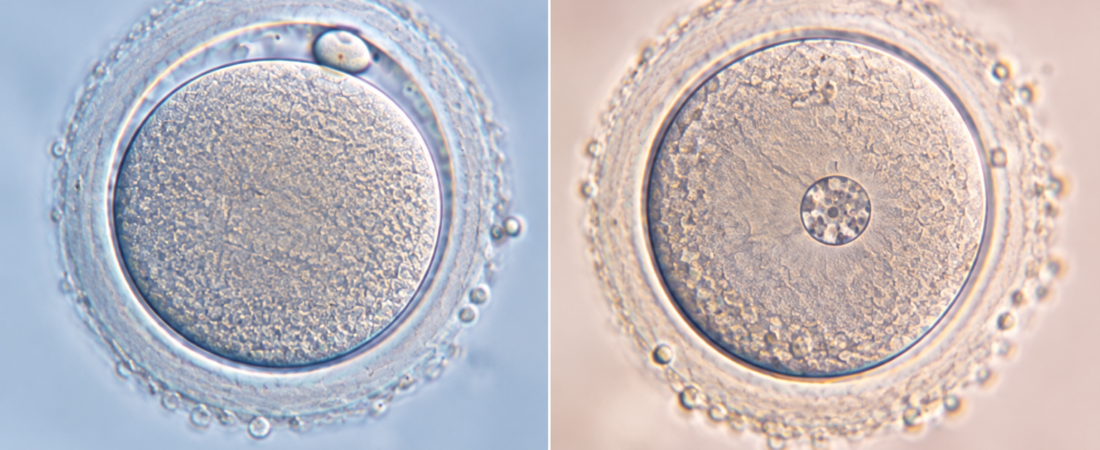
Rescue in vitro maturation (IVM) may give some immature germinal-vesicle (GV) eggs another chance after IVF retrieval. In an eight-year study of 47 carefully selected women, 127 of 266 GV oocytes—47.7%—matured within 24 hours. Adding these eggs increased the available mature oocytes, fertilized eggs, blastocysts and euploid embryos. The researchers also reported an approximately 20% relative contribution to cumulative live birth, not a 20-percentage-point increase.
What happens when egg retrieval produces fewer mature eggs than expected and many are still immature? Such eggs have often gone unused because of their limited fertilization competence. The new findings suggest that one more day of culture may provide an additional opportunity for some patients.
An extra egg may matter particularly when few are available: it can create a further chance of a fertilized egg, a blastocyst and ultimately a transferable embryo. The study appeared in the September 2026 issue of Human Reproduction.
A GV oocyte has not yet completed the maturation needed for fertilization. It remains at an earlier stage than metaphase II, or MII. Conventional IVF generally uses eggs that have already reached MII at retrieval.
Nearly half matured after up to 24 additional hours
The investigators reviewed eight years of GV-oocyte rescue at one fertility center, from 2017 through 2024.
The cohort comprised 47 women younger than 39 undergoing ICSI and PGT-A who had unexpectedly few mature eggs. Eligibility required no more than six MII oocytes, a maturation rate below 80%, and at least four GV oocytes.
The women had 266 GV oocytes in total. After up to 24 hours of additional culture, 127 reached MII and could undergo ICSI, yielding a rescue maturation rate of 47.7%. Almost half of the initially unusable immature eggs therefore became eligible for a fertilization attempt.
The mean number of mature eggs per patient rose from 4.4 initially to 7.1 when rescued eggs were included. The researchers separately calculated an average patient-level increase of 75% in usable mature oocytes. That reported patient-level metric should not be confused with the percentage calculated from the two overall means.
Rescued eggs contributed embryos, not just a better egg count
Maturation alone is not the ultimate goal. What matters is whether these eggs can fertilize, develop into embryos and contribute to pregnancy and birth.
Adding rescued eggs increased normally fertilized oocytes, blastocysts and euploid embryos per patient as well as mature egg numbers. The investigators reported greater additional benefit among patients with more GV oocytes.
Obtaining extra embryos reduced cancellations caused by having no embryo available for transfer. The researchers reported that the strategy contributed an approximately 20% relative increase in cumulative live birth in the selected population. This observational result should not be presented as a guaranteed treatment effect.
When eggs are scarce, one extra egg can matter more
The study focused on patients with fewer mature eggs than expected, rather than those routinely obtaining many mature eggs.
Rescuing one or two eggs after a retrieval of 15 is not the same clinical situation as adding them when only two or three mature eggs are available. In the latter setting, one egg may determine whether fertilization, blastocyst development and a transfer opportunity occur at all.
For patients who struggle to repeat retrieval or consistently obtain few eggs, assessing whether already-retrieved GV oocytes can mature may become a selective option rather than immediately abandoning them.
It does not mean every immature egg can be rescued
These results do not make immature eggs interchangeable with eggs already mature at retrieval. Developmental competence after rescue may remain lower than that of oocytes matured in vivo.
Rescue IVM is not a routine recommendation for all IVF patients. This was a retrospective single-center study involving only 47 women younger than 39 who met strict selection criteria. Its findings cannot simply be applied to every patient or every GV oocyte.
The point is not that all immature eggs must be used. It is that some patients with unexpectedly few mature eggs may gain value from additional use of immature oocytes.
For someone hearing that retrieval produced very few mature eggs, the value of one more egg can be considerable. The study raises a practical question: how far can the eggs already obtained be given a chance to contribute to fertilization, embryo development and ultimately birth?
Study source
This article is based on “Germinal vesicle oocytes’ rescue: a worthless treatment or a patient-centred approach? Eight years of clinical experience in poor prognosis patients,” by Danilo Cimadomo and colleagues, with affiliations including the University of Pavia, IVIRMA Global Research Alliance and IVI Valencia. It was published online on July 13, 2026, and in Human Reproduction, volume 41, issue 9, in September 2026. DOI: 10.1093/humrep/deag115. PMID: 42442002.
Related reading
The illustration was created with generative AI (ChatGPT, OpenAI). It depicts a mature oocyte on the left and an immature oocyte on the right.
Copyright © 2026 THE FERTILITY NOTES. All rights reserved. Unauthorized reproduction, copying, redistribution, scraping, AI training, or data use of any content, including articles, photographs, and images, is strictly prohibited. Violations may result in legal liability.