
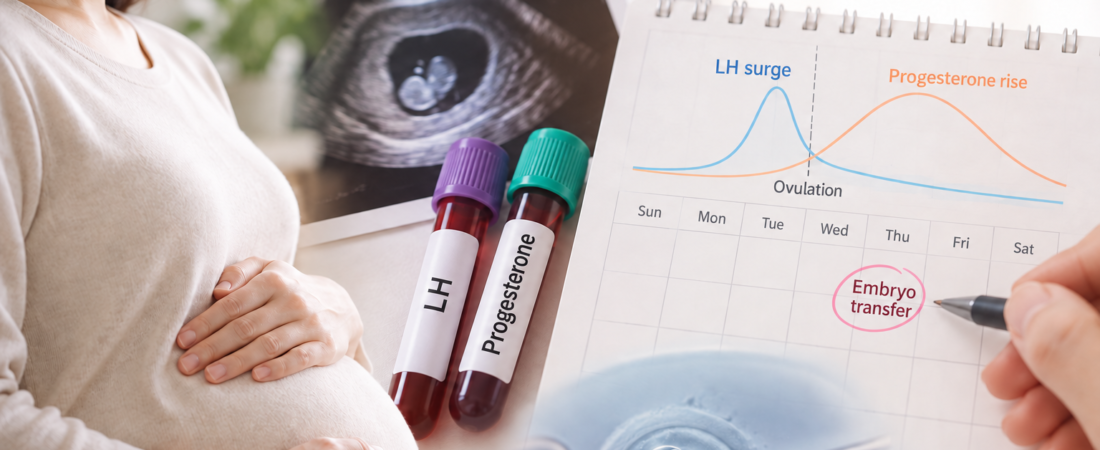
Natural-cycle frozen embryo transfer (FET) depends on synchronizing the embryo with ovulation and the endometrium. Could progesterone changes help time transfer when the LH surge is difficult to catch? A prospective study of 490 true natural-cycle FET cycles found live birth rates of 56.6% with progesterone-based timing and 52.0% with LH-based timing, without a statistically significant difference.
Identifying exactly when ovulation occurs is one of the central challenges of natural-cycle FET. Clinics have commonly estimated ovulation from the sharp rise in blood luteinizing hormone, or LH, and scheduled transfer accordingly. The new findings suggest that progesterone may offer another reference when the LH surge or ovulation timing is unclear.
Researchers at Acibadem Mehmet Ali Aydinlar University in Turkey followed patients at one fertility center between 2022 and 2025. Their comparison of pregnancy outcomes in 490 true natural-cycle transfers appeared in the September 2026 issue of Human Reproduction.
Why the ovulation date matters in natural-cycle FET
Unlike a hormone-replacement cycle, in which estrogen and progesterone are administered to prepare the uterine lining, a natural cycle relies on the woman's own follicular development and spontaneous ovulation.
After ovulation, rising progesterone transforms the endometrium into a state receptive to implantation. For blastocyst transfer in particular, the embryo's developmental stage and the lining's progression need to be aligned. Accurately identifying ovulation is therefore central to scheduling.
The LH surge is not equally obvious in every woman. LH can rise and fall between blood tests, and its pattern varies between individuals. This is one reason clinicians use repeated blood tests and ultrasound examinations during natural-cycle preparation.
The investigators focused on the progesterone rise around ovulation. Could it provide a useful timing signal even when the LH surge was not captured precisely?
Progesterone-based timing in 286 cycles versus LH timing in 204
The study grouped the 490 cycles by the main hormonal reference used to decide the transfer date: progesterone changes in 286 cycles and the LH surge in 204.
Both groups underwent serial ultrasound and blood testing to follow follicular development and ovulation. The distinction was which hormone change served as the principal scheduling reference. The primary outcome was live birth, rather than simply a positive pregnancy test or clinical pregnancy.
Live birth rates were 56.6% and 52.0%, without a significant difference
There were 162 live births among 286 progesterone-timed cycles, a rate of 56.6%, and 106 among 204 LH-timed cycles, or 52.0%.
The numerical difference was 4.6 percentage points. It was not statistically significant. Adjustment for potential influences including infertility duration and cause, endometrial thickness at transfer, embryo quality and the number of embryos transferred did not change the conclusion. The adjusted relative risk was 1.09, with a 95% confidence interval of 0.93–1.30.
Clinical pregnancy, positive pregnancy tests and miscarriage also showed no significant between-group differences.
This does not mean progesterone is better
The higher numerical live birth rate does not establish that progesterone-based timing is superior. Nor does a nonsignificant difference prove that the methods are equivalent.
This was a prospective observational study, not a trial randomly assigning patients to the two approaches. Statistical adjustment cannot rule out unmeasured differences between groups.
The useful implication is narrower: LH may not be the only hormonal reference for timing natural-cycle FET. When its surge is difficult to identify, changes in progesterone may provide an additional way to interpret ovulation and schedule transfer.
The real task is matching the embryo's clock to the endometrium
This study is less about declaring one hormone the winner than about reading the timing of ovulation and endometrial development.
As a follicle grows and ovulation occurs, progesterone rises and the lining prepares for implantation. Clinicians integrate follicle size on ultrasound with changes in LH, progesterone and other findings, then match the transfer date to the embryo's stage. The findings suggest that a progesterone-based reference can produce live birth outcomes similar to those observed with LH-surge timing in this setting.
They do not mean that every clinic should immediately stop measuring LH and use progesterone alone. The study involved one center, and hormone assays and thresholds can differ between hospitals and laboratory equipment. The investigators called for larger multicenter studies.
For patients and clinicians, the practical message is that missing a clear LH surge need not leave no way to assess transfer timing. Progesterone changes may offer another window into the timing of ovulation and the endometrium.
Study source
This article is based on “Progesterone-based ovulation timing versus LH surge monitoring in true natural cycle frozen embryo transfer: impact on live birth rates in a prospective cohort study,” by researchers at Acibadem Mehmet Ali Aydinlar University School of Medicine, Turkey. It was published online on July 15, 2026, and in Human Reproduction, volume 41, issue 9, pages 1581–1590, in September 2026. PMID: 42449543. DOI: 10.1093/humrep/deag109.
Related reading
The illustration was created with generative AI (ChatGPT, OpenAI). Any people depicted are fictional.
Copyright © 2026 THE FERTILITY NOTES. All rights reserved. Unauthorized reproduction, copying, redistribution, scraping, AI training, or data use of any content, including articles, photographs, and images, is strictly prohibited. Violations may result in legal liability.