

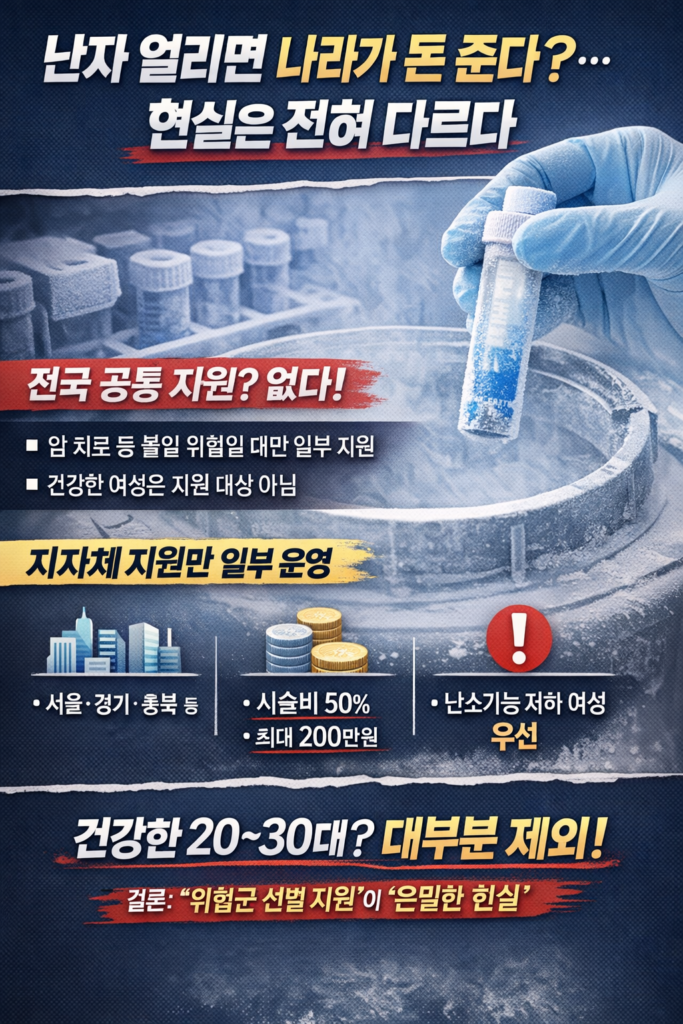
Recently, the buzzword among young women in Korea is that “the government will pay for egg freezing.” As marriage and childbirth are increasingly postponed, the awareness of “preparing in advance” has spread rapidly.
However, the reality is only partially true.
There is no nationwide program that subsidizes egg freezing for everyone. The central government offers limited support only for those whose fertility is threatened by medical conditions like cancer treatment. For the average healthy woman seeking to preserve her eggs for the future, government support is, for the most part, non-existent.
So, what about the “subsidies” people are talking about?
The key lies in local municipal policies. Seoul, Gyeonggi, Chungbuk, and several other regions have launched their own support programs. Typically, they cover about 50% of the procedure costs, up to a maximum of 2 million KRW (approx. 1,500 USD). However, these funds are limited, often operating on a first-come, first-served basis, and are exhausted quickly.
The catch? It’s not for everyone.
Most local governments prioritize support for women with diminished ovarian reserve—specifically those with low AMH levels. Some regions even apply income-based criteria. Consequently, a healthy woman in her 20s or 30s who simply wishes to “store her eggs just in case” rarely qualifies.
The Disconnect: Risk Management vs. Proactive Preservation
While these policies are framed as “childbirth preparation measures,” the actual structure is closer to “selective support for high-risk groups.” Subsidies are only granted once ovarian function has already started to decline.
Experts argue that if you are considering egg freezing, you should prioritize assessing your current fertility status over waiting for government support. A single AMH test can change the entire scope of a million-won decision.
The Reality Check:
- Support exists, but not for the majority.
- Even in cities like Hanam, which recently launched support for both egg and sperm freezing, the criteria are narrow (e.g., AMH levels of 1.5 or below). This is not “prevention”—it is “late intervention.” Egg quality declines with age, meaning the most critical window for freezing is actually before a decline is detected.
- Financial Barriers: Egg freezing typically costs between 3 million and 5 million KRW. With a subsidy capped at 2 million KRW and a “pay-first, reimburse-later” system, the initial financial hurdle remains high.
A Step in the Right Direction Despite these limitations, these municipal attempts mark a meaningful shift in policy: moving from post-childbirth support to proactive fertility preservation. To achieve real impact, however, policies need earlier intervention, lower entry barriers, and more realistic cost-benefit designs.
Current municipalities offering egg freezing subsidies include Seoul, Incheon, Busan Jin-gu, Sejong, Cheongju, Daegu, Gyeonggi-do, Ulsan, Goyang, and Chungbuk.
Disclaimer: This content is provided by a fertility specialist journalist based on the collection and analysis of domestic and international reproductive medicine research, policy materials, and statistical data. Medical judgments and treatment decisions must always be made in consultation with professional medical personnel. Image: AI-generated (ChatGPT, OpenAI) / Visual reference for illustrative purposes only.