
332 women of reproductive age with uterine fibroids followed for five years after HIFU or laparoscopic myomectomy
Five-year cumulative pregnancy rate: 59.9% with HIFU versus 50.6% with laparoscopic surgery; no clear differences in childbirth or miscarriage outcomes
Recurrence, retreatment, and ovarian function measures including AMH were also similar: “This does not mean HIFU is the answer for every fibroid”
You have been diagnosed with uterine fibroids and still want to become pregnant. When the doctor says treatment is needed, several questions immediately come to mind.
“Should I have the fibroids removed?”
“Will surgery leave scars on my uterus?”
“If I have HIFU, could it cause problems with getting pregnant?”
The question becomes more complicated for women preparing for fertility treatment. Treating the fibroids matters, but the effect of that treatment on future pregnancy and childbirth matters even more.
A long-term follow-up study has now provided information relevant to these questions.
Researchers followed women treated with high-intensity focused ultrasound (HIFU) and women who underwent laparoscopic myomectomy for five years. They found no clear differences in recurrence or retreatment, while the HIFU group actually had a higher five-year cumulative pregnancy rate. The researchers cautioned, however, that these results alone could not establish HIFU as superior to laparoscopic surgery.
Treating fibroids without open abdominal surgery?
Uterine fibroids are benign tumors that develop in the muscular wall of the uterus. Small fibroids without symptoms may be monitored, but depending on their size and location, they can cause heavy menstrual bleeding, anemia, and pain. Some may also affect pregnancy.
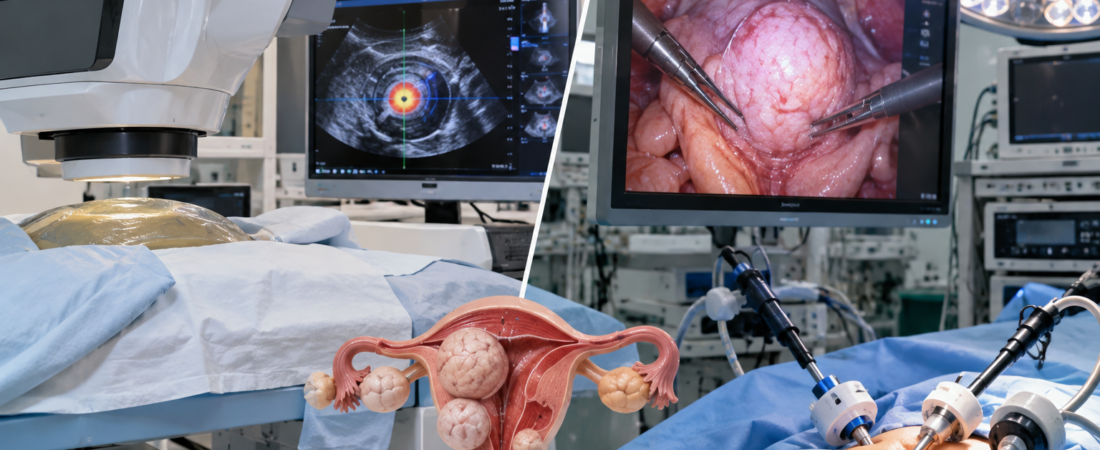
One treatment commonly considered for women who wish to become pregnant is myomectomy. As the name suggests, it removes the fibroids while preserving the uterus. The comparison treatment in this study was laparoscopic myomectomy, in which instruments are inserted through small abdominal openings to remove the fibroids.
HIFU works in an entirely different way. Instead of cutting through the skin to remove a fibroid, it focuses powerful ultrasound energy from outside the body onto the fibroid, generating heat and causing the tissue to die. In simple terms, the difference is between “removing it with a scalpel” and “destroying it with ultrasound energy.”
How, then, did the two methods compare over the long term for women who wanted to become pregnant?
Following 332 women for five years: pregnancy rates of 59.9% versus 50.6%
The researchers analyzed 332 women of reproductive age with symptomatic uterine fibroids. Of these, 172 received HIFU and 160 underwent laparoscopic myomectomy. Treatment took place between 2016 and 2019, with outcomes followed for five years through the end of 2024.
They did more than simply compare the raw numbers in the two groups. Women who choose HIFU and women who choose surgery may differ from the outset in age and in the size and location of their fibroids.
To reduce the extent to which such differences could distort the results, the researchers used a statistical method called propensity score matching, matching factors such as age, body mass index (BMI), fibroid size and location, and pregnancy-related status before treatment.
Pregnancy was the most striking result.
The five-year cumulative pregnancy rate was 59.9% in the HIFU group and 50.6% in the laparoscopic myomectomy group. The difference was statistically significant. When the researchers analyzed pregnancy over time, the HIFU group had a higher pregnancy incidence (HR 1.28, 95% CI 1.01–1.63).
However, it would be premature to jump from this result to the conclusion that “HIFU makes it easier to get pregnant.”
This was not a clinical trial that randomly assigned patients to HIFU or surgery. It was a retrospective cohort study that looked back at outcomes after treatments had already been chosen. Propensity score matching made the two groups as similar as possible, but it could not eliminate all differences that the researchers had not measured.
Beyond pregnancy: what happened at childbirth?
Becoming pregnant is not the end of the story. For patients facing infertility, the more important question is whether they can maintain the pregnancy and give birth.
Here, the differences between the two treatments were not clear.
Among women who became pregnant, the live birth rate was 72.1% in the HIFU group and 68.4% in the laparoscopic surgery group, but the difference was not statistically significant. Miscarriage rates were 19.2% and 22.8%, respectively, with no significant difference.
Preterm birth rates were 8.7% versus 10.3%, and cesarean delivery rates were 42.3% versus 45.6%; neither difference was statistically significant. Uterine rupture, a particular concern for women preparing for pregnancy, was not reported in either group.
The most cautious reading is therefore not that “HIFU produced better childbirth outcomes than surgery,” but that “during five years of observation, no signal was found that major obstetric outcomes, such as childbirth and miscarriage, were worse after HIFU than after laparoscopic myomectomy.”
“What if the fibroids come back?” Five-year recurrence was also compared
Recurrence is another important issue for younger women. Even if treatment works well now, the picture changes if fibroids return a few years later and require further treatment.
When the researchers analyzed fibroid recurrence and additional treatment over five years, they found no statistically significant difference between the groups. The risk ratio comparing recurrence and retreatment was 1.31, but the confidence interval was wide, at 0.47–3.65, and the result was not statistically significant.
In other words, this study did not provide evidence that fibroids recur much more often after HIFU, or conversely that they recur less often than after surgery.
What about AMH? No difference in ovarian function either
This finding is also worth attention for patients facing infertility.
The researchers examined whether reproductive hormones and ovarian function changed after the two treatments. They repeatedly measured AMH (anti-Müllerian hormone), commonly used as an indirect indicator of the quantity of eggs remaining in the ovaries, as well as FSH, LH, and prolactin (PRL).
Comparing changes in these hormone levels over five years revealed no significant differences between the HIFU and laparoscopic surgery groups. At least in this study, there was no signal that either HIFU or laparoscopic myomectomy caused a greater long-term decline in ovarian function.
There were also interesting quality-of-life findings. Some physical function scores were lower in the HIFU group one year after treatment, but analysis of the full five-year changes showed greater improvement in the HIFU group across several measures, including pain, vitality, social functioning, and general health.
Does this mean patients facing infertility should choose HIFU?
“I have fibroids and want to become pregnant. Should I have HIFU instead of surgery?”
This study alone cannot answer yes.
Not all uterine fibroids are the same. Their effects on pregnancy differ depending on whether they protrude into the uterine cavity, lie deep within the muscular wall, or grow toward the outside of the uterus. Decisions need to consider not only fibroid size, number, location, and any distortion of the endometrium, but also the woman’s age, ovarian reserve, cause of infertility, and whether she plans to try to conceive naturally or undergo IVF.
Above all, this was not a randomized clinical trial. It was an observational study comparing women who received HIFU with women who had laparoscopic surgery over five years. That limitation means the figures of 59.9% and 50.6% alone should not be interpreted as showing that “HIFU is better for pregnancy.”
Even so, the study has clear value. It adds long-term evidence that the options for women of reproductive age facing fibroid treatment are not necessarily limited to whether or not to have the fibroids surgically removed.
For women who want to become pregnant, in particular, fibroid treatment cannot be judged solely by how much the fibroids shrink.
We also need to ask whether a woman was able to become pregnant afterward, delivered her baby safely, remained free of recurrent fibroids, and maintained ovarian function. Those were the questions this study set out to follow for five years.
Source: This article is based on “Long-term fertility preservation and quality-of-life outcomes after high-intensity focused ultrasound ablation versus laparoscopic myomectomy in reproductive-aged women with uterine fibroids: a 5-year propensity-matched cohort study,” published in BMC Women’s Health on September 21, 2026. The study included 332 women of reproductive age with symptomatic uterine fibroids: 172 treated with HIFU and 160 with laparoscopic myomectomy. DOI: 10.1186/s12905-026-04877-2.
Medical note: Whether uterine fibroids need treatment, and which treatment is appropriate, can vary according to their location, size and number, symptoms, age, ovarian reserve, and future pregnancy plans. If you are planning pregnancy or fertility treatment, treatment choices should be made through an individual medical consultation.
Image disclosure: The image used in this article was created using generative artificial intelligence (ChatGPT, OpenAI). Any people depicted are fictional, not real individuals.
Copyright © 2026 Fertility Information TokTok · Fertility News | THE FERTILITY NOTES. All rights reserved. Unauthorized republication, reproduction, redistribution, scraping, AI training, and data use of any content, including articles, photographs, and images, are strictly prohibited. Violations may result in legal liability.