
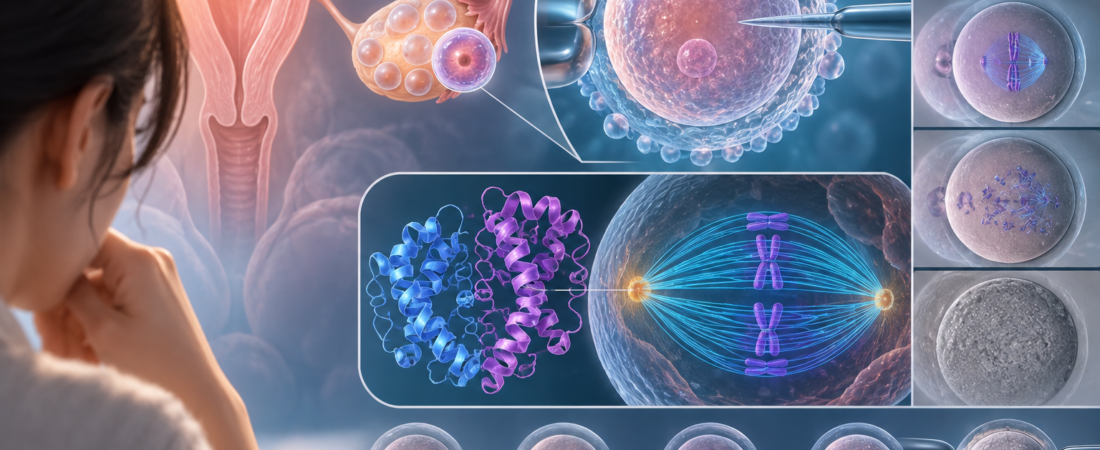
Despite no major abnormalities in ovarian function or hormones, 85.4% of retrieved eggs stopped during maturation
Analysis of six women with TUBB8 variants: fertilization rate just 6.3%, even after direct sperm injection and oocyte activation
Repeated egg maturation failure calls for looking beyond stimulation protocols to causes within the egg itself
“They said my follicles grew well. So why are there no mature eggs?”
For a woman undergoing in vitro fertilization, this can be difficult to understand. At each ultrasound, one follicle after another grew, and the eggs were retrieved. Yet after retrieval, the clinic gives her unexpected news: “Many of the eggs are immature.”
If the follicles grew well, why did the eggs not finish developing?
A recently published study offered an intriguing answer. The problem may lie not in the size of the follicle, but in the machinery that separates chromosomes inside the egg.
In a study published on September 18 in the Journal of Assisted Reproduction and Genetics, researchers identified variants in a gene called TUBB8 in women whose eggs repeatedly failed to mature. The gene defects prevented proper formation of the spindle, a structure essential for egg maturation, leaving the eggs arrested midway through the process.
A large follicle does not necessarily mean a fully mature egg
First, one distinction matters: a follicle and an egg are not the same thing.
The round sac whose size a doctor measures on ultrasound is the follicle, and the egg sits inside it. In IVF, injections stimulate the follicles to grow, and the eggs are retrieved at the appropriate time.
But a follicle growing large enough does not mean that every egg inside has finished preparing for fertilization.
The egg also needs to complete a final preparation process. It must undergo meiosis, which halves the chromosome number. Only after progressing through the MI stage and reaching MII does it become what is generally called a “mature egg.” ICSI, in which a single sperm is injected directly into an egg, is also usually performed on these MII eggs.
In the women in this study, however, the eggs stopped at MI.
The researchers analyzed six Chinese women with primary infertility who had repeatedly experienced this kind of oocyte maturation arrest. Ovarian reserve and hormone tests alone did not readily explain why their eggs consistently failed to mature.
The retrieved eggs made the problem particularly clear. In all, 85.4% of the eggs were arrested at MI. Only 5.7% reached MII, the stage at which they could be used for fertilization. The follicles had grown, but most of the eggs had failed to cross the final threshold.
Inside the egg are “tracks” that move chromosomes
Why did the eggs keep stopping at the same point? The clue the researchers found was the TUBB8 gene. Its name may sound difficult, but its role is surprisingly easy to understand. For an egg to mature, its chromosomes must be divided accurately. The chromosomes do not move by themselves. A tiny structure forms to line them up and separate them toward opposite sides.
That structure is the spindle.
Just as a train needs tracks to move, an egg needs a properly formed spindle to separate its chromosomes accurately. TUBB8 is one of the important genes needed to build those “tracks.” The participants in this study had variants in TUBB8.
When the researchers examined the eggs directly, normal spindles were either absent or severely disorganized. Put simply, the eggs needed to advance to the next stage, but the tracks for moving their chromosomes had not been laid properly.
That made it difficult for the eggs to move to the next stage of maturation, however long they waited.
Direct sperm injection and “waking up” the eggs did not change the outcome
What happened next was even more striking.
The researchers performed ICSI, injecting a single sperm directly into each egg, in these women. They also tried artificial oocyte activation (AOA).
Oocyte activation artificially provides a kind of “starting signal” that prompts the egg to begin the fertilization process after the sperm has entered.
In other words, they helped the sperm directly through the door into the egg, then also gave the egg a signal to “start fertilization now.”
Even so, the results were poor.
The fertilization rate was only 6.3%. No embryos developed to the blastocyst stage, and no clinical pregnancies occurred.
Why?
ICSI helps a sperm enter an egg, while oocyte activation supplements the signal that initiates fertilization. But the problem in these women arose earlier: the eggs themselves had not yet completed normal maturation.
The implication is that even successful sperm injection and an activation signal may not overcome a defect in the machinery that separates chromosomes inside the egg.
Should immature eggs prompt a TUBB8 test first?
A clear distinction is needed here.
Retrieving immature eggs during IVF is not, in itself, unusual. The proportion of mature eggs can vary with many factors, including the ovarian stimulation protocol, follicle size, the type and timing of the trigger injection used to induce final egg maturation, and the timing of egg retrieval.
Therefore, a high number of immature eggs on one or two occasions is not, by itself, a reason to suspect a TUBB8 variant.
The key word in this study is “repeated.”
If follicles grow adequately but repeated egg retrievals produce similar results—especially if most eggs stop at the same MI stage—the explanation may go beyond “the stimulation did not work well this time.”
At that point, it may help to change the question.
Instead of asking, “How can we make the follicles grow better?” the question becomes, “Why can this egg not pass the final stage of maturation?”
TUBB8 genetic testing may offer one clue to the cause of repeated failure in this highly selected group of patients. Identifying a gene variant does not, however, immediately create a treatment. Its value lies in understanding the cause of failure more accurately before repeating the same procedures, and in guiding future treatment and counseling.
Findings in six women cannot explain every egg maturation disorder
This study should not be overinterpreted.
The sample was very small: six Chinese women, all of whom were a special group with repeated, severe oocyte maturation arrest. TUBB8 does not explain every egg maturation disorder. Many genes and proteins are involved in egg maturation, and causes that have not yet been identified are also likely to exist.
Even so, the study is interesting because it reveals a problem inside the egg that can be obscured by the focus on “how well the follicles grew.”
A follicle growing well and the egg inside it maturing properly are not the same thing. The follicles were large enough. Eggs were retrieved. Yet if the eggs repeatedly stop at the same stage across multiple treatment attempts, “poor egg quality” alone may not be an adequate explanation.
Countless pieces of machinery work inside an egg to divide its chromosomes accurately. If even one small component fails to function properly, the egg may be unable to cross the final threshold of maturation.
TUBB8, identified in this study, is one genetic clue that may explain that “stop.”
Why were there no mature eggs available for fertilization when the follicles had grown so well? The answer, in these cases, was hidden not in follicle size but in the egg’s “division machinery,” barely visible even under a microscope.
Source: This article is based on “Novel and recurrent TUBB8 variants cause irreversible meiotic spindle defects and refractory ART failure in Chinese women with oocyte maturation arrest,” a study by researchers at the Reproductive Medicine Center of Peking University Third Hospital, China, published online in the Journal of Assisted Reproduction and Genetics in September 2026. The study included six unrelated Chinese women with primary infertility and recurrent oocyte maturation arrest. It was published online on September 18, 2026. DOI: 10.1007/s10815-026-04025-7. PMID: 42760497.
Image disclosure: The image used in this article was created using generative artificial intelligence (ChatGPT, OpenAI). Any people depicted are fictional, not real individuals.
Copyright © 2026 Fertility Information TokTok · Fertility News | THE FERTILITY NOTES. All rights reserved. Unauthorized republication, reproduction, redistribution, scraping, AI training, and data use of any content, including articles, photographs, and images, are strictly prohibited. Violations may result in legal liability.