
- Tracking 3.63 Million Canadian Women: Median age at POI diagnosis was 31 years
- Incidence 3.45 Times Higher in women with a history of endometriosis
- ‘Low AMH = Premature Menopause’ Is False: DOR and POI are distinct concepts
- The Difference Between Diminished Ovarian Reserve (DOR) and Premature Ovarian Insufficiency (POI)
“My AMH is low—does that mean I’ll go through menopause soon?”
When told that their “ovarian function is declining” during a fertility evaluation, women often feel mounting anxiety. In particular, when Anti-Müllerian Hormone (AMH) levels are low, it is easy to assume that “very few eggs remain” or that “early menopause is approaching.”
The reverse also happens. If AMH comes back normal, one might think, “At least I don’t have to worry about menopause for the time being.”
However, AMH is not an “ovarian clock” that reveals how much time remains until menopause. It is a hormone produced by the small growing follicles within the ovary, serving as an indirect indicator of the quantity of remaining eggs.
Furthermore, Diminished Ovarian Reserve (DOR)—frequently mentioned in fertility clinics—and Premature Ovarian Insufficiency (POI), where ovarian function declines before age 40, are not the same condition.
A large-scale, population-based study published in the September issue of the international journal Human Reproduction tracked the real-world incidence of POI among women and the factors associated with it. The study included 3,635,702 women aged 39 and younger in Ontario, Canada.
POI Where Ovarian Function Declines Before Age 40… Median Age at Diagnosis Was 31
Premature ovarian insufficiency (POI) is often thought of as synonymous with “early menopause,” but strictly speaking, there is a distinction.
POI refers to a condition where ovarian function declines before age 40, causing periods to become irregular or cease entirely, accompanied by elevated follicle-stimulating hormone (FSH) levels.
Recent international clinical guidelines allow a diagnosis of POI in women under 40 who present with menstrual irregularity or amenorrhea for at least 4 months, alongside an FSH level exceeding 25 IU/L. If the diagnosis is uncertain, FSH can be retested after 4 to 6 weeks.
In this study, the researchers analyzed health administrative data for 3,635,702 women in Ontario, Canada, from 1995 to 2019. The median follow-up period was 11 years.
Among them, 168,173 women were identified with POI regardless of etiology. The overall incidence rate was 389.4 cases per 100,000 person-years. “Person-years” is a statistical method calculating disease frequency by accounting for both the number of individuals and the duration of observation.
What stands out is the age at diagnosis.
The median age at POI diagnosis was 31 years, with half of the diagnoses occurring between ages 25 and 36. This indicates that POI is not exclusively a concern confined to the late 30s.
The Vast Majority of POI Cases Are Not Due to Surgery or Chemotherapy
POI can be broadly categorized according to its underlying cause.
Chemotherapy or radiation therapy can impact the ovaries, or ovarian function can be lost due to medical interventions, such as surgical removal of both ovaries. On the other hand, POI can also occur without any clear identifiable trigger.
In this study, “non-iatrogenic POI”—cases without an evident medical cause such as surgery or cancer therapy—comprised the vast majority, at 351.4 cases per 100,000 person-years.
In contrast, POI following ovarian surgery occurred at 30.2 cases per 100,000 person-years, and POI associated with chemotherapy or radiation therapy accounted for 5.5 cases per 100,000 person-years.
Ultimately, this means that for a substantial proportion of actual POI patients, it was difficult to pinpoint a single definitive cause and say, “this is what caused ovarian function to decline.”
The Most Notable Associated Factor Was ‘Endometriosis’
Which women, then, experienced higher rates of POI?
What stood out most prominently in this study was endometriosis. The incidence rate of POI among women with a history of endometriosis was 3.45 times higher than in women without endometriosis.
Higher incidence rates were also observed in women with a history of cancer who received chemotherapy or radiation therapy (2.01 times), those with a history of substance use or smoking (1.59 times), those with chromosomal abnormalities (1.50 times), and those with autoimmune diseases (1.19 times).
However, caution is needed to avoid simplistically interpreting these numbers as “having endometriosis means you have a 3.45-fold chance of getting POI.”
This study was an observational study investigating the association between specific factors and the occurrence of POI; it did not establish a causal relationship proving that endometriosis itself directly causes POI.
In women with endometriosis, not only the disease itself but also the treatment process must be considered. Particularly when surgery is required due to ovarian endometriomas, ovarian reserve both before and after surgery warrants comprehensive evaluation.
DOR vs. POI: How Does ‘Ovarian Reserve Decline’ Differ?
This is precisely the most confusing distinction for women navigating subfertility.
Being told at a clinic that “your ovarian function has declined” does not automatically equate to POI.
Diminished Ovarian Reserve (DOR), commonly discussed in fertility clinics, simply means a state where “the number of remaining follicles in the ovary is lower compared to one’s age group.” A patient can be evaluated as having low ovarian reserve if AMH is low or the antral follicle count (AFC) visible on ultrasound is low.
However, women with DOR can still have regular menstrual cycles each month and ovulate normally. It certainly does not mean that natural pregnancy is impossible.
In in vitro fertilization (IVF), ovarian reserve testing is particularly useful for predicting whether multiple follicles will grow or whether fewer eggs will be retrieved following controlled ovarian stimulation.
POI is a slightly different story.
In POI, beyond simply having “few remaining follicles,” the normal endocrine function of the ovary itself deteriorates. This is accompanied by changes such as periods becoming irregular or ceasing for months, along with an elevation in FSH.
To use a simple analogy: DOR is closer to the concept of “the inventory of eggs remaining in the warehouse has decreased.” POI is closer to the concept of “the factory called the ovary is no longer operating normally.” While the two may be related, they are not the same diagnosis.
An AMH in the 0.x Range Means Imminent Menopause? NO
Does a woman with an extremely low AMH inevitably develop POI?
Anti-Müllerian Hormone (AMH) is secreted by the small follicles growing within the ovary; as follicles decrease, AMH generally drops as well. Hence, it is valuable for gauging the current quantity of remaining follicles—that is, ovarian reserve—and predicting how the ovaries will respond to hyperstimulation during IVF.
However, one should not calculate that an AMH of 0.5 ng/mL leaves a few years until menopause, or that 0.1 ng/mL leaves a few months.
Current international clinical guidelines on premature ovarian insufficiency explicitly recommend against using AMH as a primary diagnostic test for POI. They also state that there is insufficient evidence to use AMH as a routine screening test to predict whether POI will occur in the future.
Therefore, one cannot conclude that “low AMH = POI is coming soon.” Conversely, one cannot guarantee that POI will not develop in the future simply because current AMH levels are normal.
While AMH is an important clue to estimating the quantity of remaining follicles in the ovary, it is not a countdown clock telling you “at what age your ovaries will stop.”
POI Does Not Mean the Ovaries Have Completely ‘Shut Off’
An important nuance is also embedded in the term “Premature Ovarian Insufficiency.” In the past, this condition was widely referred to as “Premature Ovarian Failure (POF).” In recent years, however, the medical community favors the term “insufficiency” over “failure.”
This is because “failure” can be misunderstood as a state where the ovaries have permanently lost all function and will never work again.
In women with POI, ovarian function does not halt in a steady, permanent manner; rather, intermittent follicular development and spontaneous ovulation can still occur. Thus, POI is not completely identical to natural menopause.
For this exact reason, one should not understand POI as meaning “there are zero eggs left” or “the probability of pregnancy becomes absolute zero from that day forward.”
However, because ovarian function is markedly diminished, women desiring pregnancy should seek specialized consultation considering age, residual ovarian function, and menstrual status.
Meanwhile, the incidence rate of surgical POI dropped significantly from approximately 60 cases per 100,000 person-years in 1995 to about 20 cases in 2019. The researchers suggested that the wider adoption of ovary-sparing surgical techniques likely contributed to this shift.
On the other hand, the overall incidence rate of POI declined between 2002 and 2008 and then rose again, demonstrating an upward trend particularly after 2011. This increase was primarily driven not by POI from surgery or chemotherapy, but by non-iatrogenic POI.
This reflects the reality that while many etiologies of POI are known—including genetic factors, chromosomal abnormalities, autoimmune diseases, chemo/radiation therapy, and ovarian surgery—many cases still lack an identifiable cause.
Ovarian Function: Look at ‘Menstrual Changes’ Alongside the AMH Number
The state of the ovaries cannot be defined by a single number.
When reading this study from the perspective of women undergoing fertility treatment, the most vital takeaway is not to treat “what is my AMH level?” and “do I have POI?” as the same question. A low AMH does not immediately equate to premature menopause. While DOR and POI can be interrelated, they are medically distinct concepts.
Conversely, one cannot rule out the possibility of future POI simply because past AMH results were normal.
Particularly if a woman under 40 experiences periods that cease for several months or cycles that change distinctly from before, accompanied by symptoms suggestive of estrogen deficiency such as hot flashes and night sweats, she should look beyond a single AMH number and evaluate menstrual patterns alongside hormone panels, including FSH.
※ Study Source: Published in the September 2026 issue of the international journal Human Reproduction (Volume 41, Issue 9). Conducted by researchers from Queen’s University, the Institute for Clinical Evaluative Sciences (ICES), and McGill University in Canada. Title: “Incidence and factors associated with premature ovarian insufficiency: a population-based cohort study.” Published online July 15, 2026; appearing in Volume 41, Issue 9, Pages 1612–1621. DOI: 10.1093/humrep/deag111, PMID: 42449546.
※ The contents of this article do not replace individualized clinical diagnosis or care. AMH levels alone cannot determine the presence of premature ovarian insufficiency or the timing of menopause; medical consultation should synthesize menstrual cycle changes, hormone assays such as FSH, age, past medical history, and surgical or therapeutic interventions.
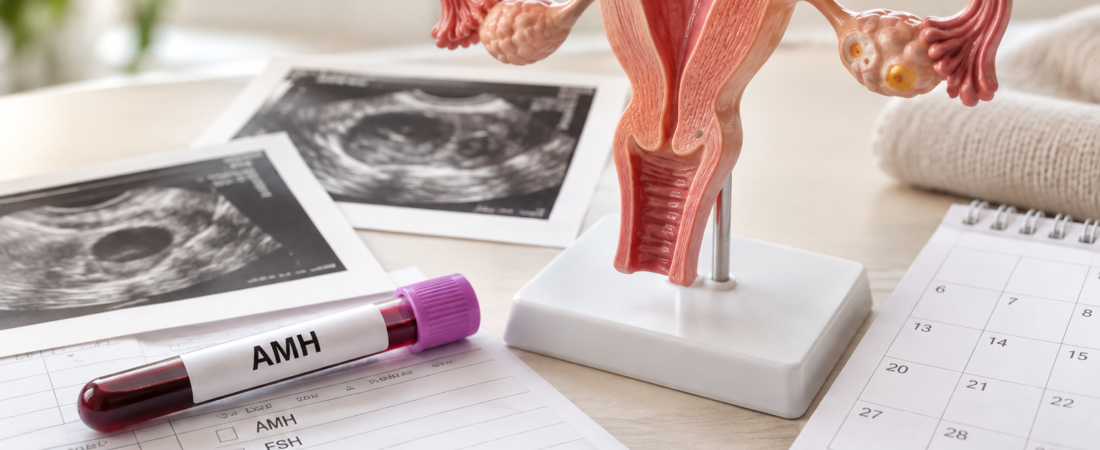
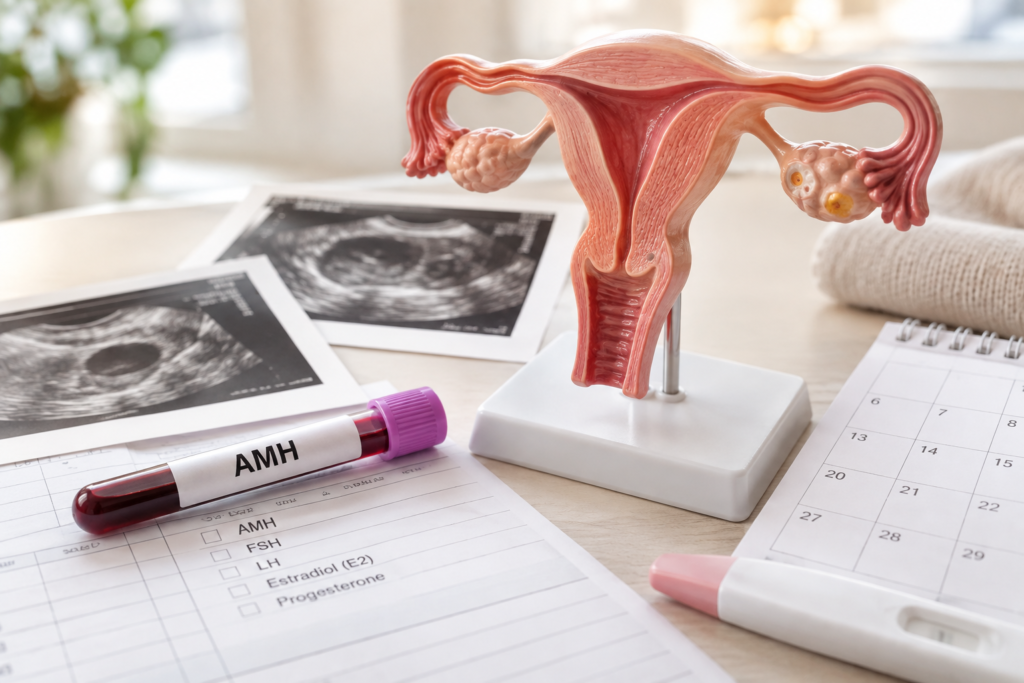
※ The images used in this article were generated using artificial intelligence (ChatGPT, OpenAI) as illustrative reference materials and do not depict real individuals.
※ Copyright © 2026 THE FERTILITY NOTES. All rights reserved. Unauthorized reproduction, duplication, redistribution, scraping, AI training, or data utilization of all content, including articles, photos, and images, is strictly prohibited and subject to legal liability.