
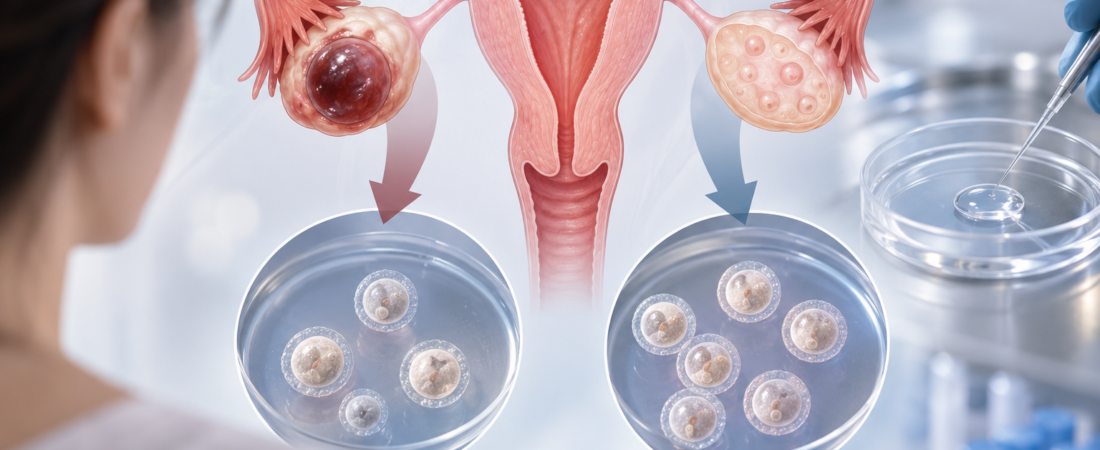
A meta-analysis found no clear difference in retrieved or mature eggs between affected and opposite ovaries.
Fewer embryos were formed from affected ovaries, but the findings do not establish lower live birth rates.
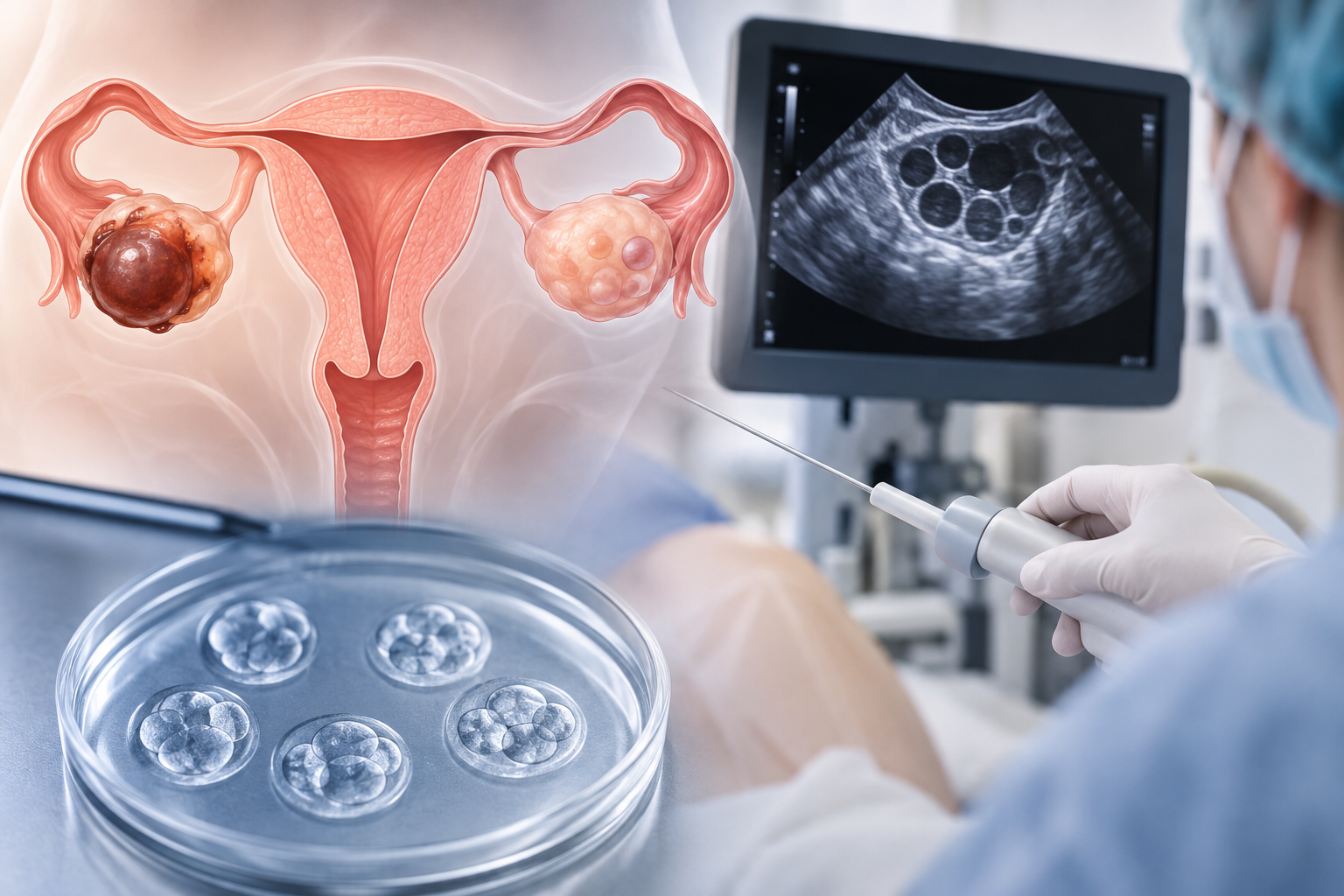
An ovarian endometrioma on one side does not necessarily mean that ovary will yield substantially fewer eggs during IVF. A meta-analysis comparing an affected ovary with the healthy opposite ovary found no statistically clear difference in retrieved or mature egg numbers.
The number of embryos formed after fertilization was lower for affected ovaries. The findings suggest that effects on egg retrieval and subsequent embryo formation may differ.
Published in the October 2026 issue of Human Reproduction, the analysis combined 13 studies of women with unilateral, unoperated endometriomas.
Comparing two ovaries within the same woman
Endometriosis involves tissue similar to the uterine lining growing outside the uterus, where it can cause inflammation and adhesions. When it forms a blood-containing cyst in an ovary, it is called an ovarian endometrioma, sometimes known as a chocolate cyst because of the dark appearance of old blood.
Endometriomas can affect surrounding tissue and are associated with infertility. Before IVF, patients may worry that a cyst will impair follicular growth or reduce egg yield.
The researchers screened 2,903 studies and selected 13 observational studies meeting their criteria. These compared the ovary containing an unoperated endometrioma with the unaffected ovary in the same woman.
This within-person comparison reduces differences attributable to age or general hormonal status and helps investigate the local effect of the cyst.
An average of 0.72 fewer eggs, but no statistically clear difference
Eleven studies involving 560 women contributed data on egg retrieval.
The affected ovary yielded an average of 0.72 fewer eggs than the opposite ovary, but the difference was not statistically significant.
Six studies involving 149 women examined mature eggs. The affected ovary produced an average of 0.60 fewer mature eggs, again without a statistically significant difference.
These findings do not support assuming that an endometrioma necessarily causes a major reduction in that ovary's egg yield. However, results varied substantially between studies, so they should not be interpreted as predicting the same outcome for every patient.
Similar egg counts did not mean identical embryo formation
Four studies comparing embryo numbers found an average of 0.72 fewer embryos from affected ovaries, a statistically significant difference.
There was no clear difference in the number of good-quality embryos assessed by appearance and development.
An endometrioma might therefore influence fertilization or embryo formation even when a clear reduction in egg yield is not detected.
The analysis cannot establish whether fewer embryos resulted from egg quality, differences in fertilization or other factors. It also does not establish that pregnancy or live birth rates were lower.
Does an endometrioma need surgery before IVF?
It may seem intuitive to remove a cyst before egg retrieval. However, surgery can damage healthy ovarian tissue or affect blood supply, potentially reducing ovarian function.
This possibility is particularly relevant when ovarian reserve is already reduced.
Because the meta-analysis did not find clear evidence that unoperated unilateral endometriomas reduced retrieved or mature egg numbers, it does not support rushing to surgery solely to increase egg yield.
That does not mean surgery is never appropriate. A large cyst, substantial pain, concern about malignancy or difficulty accessing follicles during retrieval can affect the decision. Previous ovarian surgery, ovarian reserve and age also matter.
The findings cannot automatically be extended to very large cysts or endometriomas affecting both ovaries.
Preserving ovarian function is central to treatment planning
The presence of a cyst alone does not establish that egg retrieval will go badly. Actual ovarian reserve and response to stimulation need to be considered alongside the diagnosis.
The included studies were observational rather than randomized trials, and differed in participant characteristics, cyst size and stimulation methods. This is not a definitive account of every effect on eggs or embryos.
Still, the findings argue against assuming a major loss of eggs or choosing surgery automatically simply because a unilateral endometrioma has been detected.
The objective is to preserve ovarian function while pursuing pregnancy. The order of treatment and IVF requires an individualized assessment of cyst size and location, symptoms, reserve and age.
Where does alcohol sclerotherapy fit?
The source article also discusses alcohol sclerotherapy as an option considered in some settings instead of cyst excision, which can damage normal ovarian tissue.
Sclerotherapy drains fluid from the cyst and introduces medical-grade alcohol to reduce its size and help limit recurrence. Preserving ovarian tissue can make it a consideration for women with low reserve or future IVF plans.
It is not suitable for every endometrioma. Size, location, recurrence and possible malignancy require assessment. Leakage of alcohol into surrounding tissue can cause inflammation or tissue injury, so the procedure requires an appropriately experienced specialist.
For someone planning pregnancy, the decision involves more than shrinking a cyst: subsequent egg retrieval and reproductive plans also matter. This treatment discussion should not be confused with proof from the meta-analysis that sclerotherapy improves pregnancy outcomes.
Study source
D. R. Kalaitzopoulos, M. Zografou, A. Daniilidis and colleagues: “The impact of unilateral endometriomas on ovarian response to stimulation: a systematic review and meta-analysis.” Human Reproduction, 2026;41(10):1715–1724. Published online August 31, 2026. DOI: 10.1093/humrep/deag137. PMID: 42672534.
The illustration was generated using ChatGPT (OpenAI). Any people depicted are fictional.
Related reading
cumulative live birth versus success per transfer
Copyright © 2026 THE FERTILITY NOTES. All rights reserved.