
- Live birth rates remain comparable when timing ovulation via progesterone rise instead of LH surge
- Prospective cohort analysis of 490 true natural frozen embryo transfer cycles: 56.6% vs. 52.0%
- Researchers note: “A viable alternative when the rapid LH surge is missed”
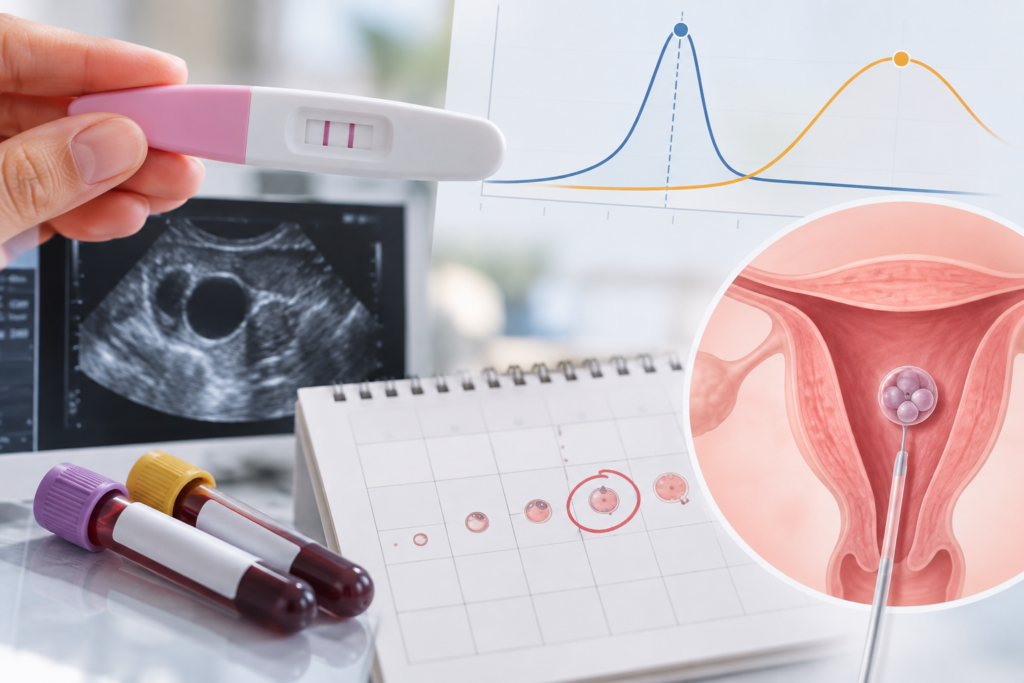
For fertility patients preparing for a natural cycle frozen embryo transfer (NC-FET), few moments cause more anxiety than pinpointing the exact day of ovulation. At home, patients watch closely to see if the two lines on their urine ovulation predictor kits (OPKs) darken; at the clinic, physicians monitor follicle diameter via ultrasound and draw serial blood samples to track luteinizing hormone (LH) and progesterone levels.
Why monitor ovulation so meticulously? In a natural cycle frozen embryo transfer, the developmental stage of the cryopreserved embryo must synchronize with the receptive window of the endometrium; misjudging the timing of ovulation by even a single day can alter the scheduled transfer date.
Yet, emerging research suggests that the traditional benchmark—the rapid “LH surge”—does not necessarily have to be the sole criterion for timing natural cycle transfers.
In a prospective cohort study published in the September 2026 issue of the international journal Human Reproduction, researchers compared pregnancy outcomes between scheduling embryo transfer based on serum progesterone elevation versus traditional LH surge monitoring. The results demonstrated no statistically significant difference in live birth rates between the two approaches.
Why a Single Ovulation Day Dictates Outcomes in Natural Cycle Transfers
A true natural cycle frozen embryo transfer relies on a woman’s spontaneous ovulation and subsequent corpus luteum function to prepare the endometrial lining. Unlike medicated or programmed cycles (HRT-FET)—which suppress natural ovarian function and artificially prime the endometrium with exogenous estrogen and progesterone—a natural cycle tracks physiological follicle development and spontaneous ovulation, timing embryo thawing and transfer to match that biological rhythm.
The clinical challenge, however, is that pinpointing the exact moment of ovulation to a single point in time is notoriously difficult.
Because an LH surge precedes follicular rupture, natural cycle protocols have traditionally relied on detecting an LH rise in blood or urine as the primary benchmark. What fertility patients colloquially call “two lines on an ovulation test strip” operates on this exact principle—capturing the surge of LH excreted in urine.
However, the LH surge varies widely between individuals in both its onset and duration. Furthermore, depending on clinic testing intervals, the transient peak of a rapid surge can easily be missed between routine blood draws.
To address this limitation, researchers turned to progesterone, which begins climbing around the time of ovulation. Because serum progesterone levels begin rising near follicular rupture and climb steadily through the early luteal phase, this hormonal shift provides an additional biochemical indicator that ovulation and endometrial luteinization have actually taken place.
56.6% with Progesterone vs. 52.0% with LH
The research team prospectively analyzed 490 “true natural cycle” frozen embryo transfers conducted between October 2022 and April 2025 at an affiliated university IVF center in Turkey.
Among these, 286 cycles were timed based on serum progesterone rise, while 204 cycles were scheduled using traditional LH surge criteria. Across all cycles, ovulation was tracked through serial ultrasound monitoring and serum endocrine assays.
On the primary clinical endpoint—the live birth rate—the progesterone-timed cohort reached 56.6% (162 out of 286 cycles) compared to 52.0% (106 out of 204 cycles) in the LH-timed group. While numerically 4.6 percentage points higher in the progesterone arm, this difference was not statistically significant.
This parity persisted after adjusting for maternal age, body mass index (BMI), duration and etiology of infertility, endometrial thickness at transfer, preimplantation genetic testing (PGT) status, number of embryos transferred, and morphological embryo quality. The adjusted relative risk (aRR) for live birth in the progesterone-based group was 1.09 (95% CI: 0.93–1.30), confirming no significant disparity.
Adjusted live birth probabilities were calculated at approximately 57.2% for the progesterone group versus 52.3% for the LH group—an absolute difference of 4.9 percentage points, but with a confidence interval spanning from -3.8% to +13.6%.
Clinical pregnancy rates were similarly comparable at 67.5% in the progesterone group versus 62.3% in the LH group. Serum hCG positivity rates were 74.1% versus 70.6%, while early pregnancy loss rates following a clinical pregnancy were nearly identical at 16.1% and 16.5%, respectively. In short, which hormone served as the primary reference point to time ovulation was not an independent predictor of reproductive success.
This Does Not Mean Transfer Is Decided by a ‘Single Ovulation Strip’
These findings should not be misinterpreted to suggest that LH testing is unnecessary or that patients should abandon ovulation test strips. Patients in this study did not rely solely on home urine tests; they underwent rigorous, serial transvaginal ultrasound monitoring alongside paired serum hormone measurements in a clinical setting.
What the researchers evaluated was not home urine test kits versus progesterone testing, but whether a fertility clinic should anchor its transfer scheduling protocol to the LH surge or to the serum progesterone rise.
The core insight from this study is that reproductive endocrinologists do not have to rely on a single dogmatic method to identify ovulation in natural cycles. In patients whose LH surge is so transient that it peaks and declines between blood tests, or in women whose LH profiles are erratic or blunted, tracking the trajectory of rising progesterone provides clinicians with a reliable, data-backed method to schedule transfer.
The investigators highlighted that progesterone-based timing offers a practical, robust alternative to LH monitoring. It mitigates the risk of cycle cancellation when an LH surge is missed and simplifies natural cycle surveillance without compromising clinical pregnancy outcomes.
However, it is premature to conclude that the progesterone approach is “superior” to LH-based timing. This was a single-center prospective observational study rather than a randomized controlled trial, and patients were not randomly assigned to either protocol.
Moreover, because specific progesterone threshold cutoffs were established using that laboratory’s specific assay platforms and clinical algorithms, external validation is needed before other centers can adopt the exact numerical values. The authors noted that larger, multicenter studies are warranted.
Ultimately, what matters in a natural cycle frozen embryo transfer is not merely whether an ovulation test strip showed two dark lines. The true clinical goal is synthesizing follicular growth dynamics, the timing of the LH surge, and the initial climb of progesterone to ensure the embryo is transferred into the uterine cavity at the exact biological moment of peak endometrial receptivity.
This study demonstrates that clinical pathways for synchronizing that critical window can expand beyond an exclusive reliance on LH to include progesterone as a dependable alternative.
※ This article was written based on the prospective cohort study “Progesterone-based ovulation timing versus LH surge monitoring in true natural cycle frozen embryo transfer: impact on live birth rates in a prospective cohort study” published in Human Reproduction (September 2026 Issue, Vol. 41, Issue 9, Pages 1581–1590; DOI: 10.1093/humrep/deag109). It does not replace individualized clinical diagnosis or medical care, and specific treatment decisions should always be made in consultation with a qualified reproductive specialist.
※ Image: AI generated (ChatGPT, OpenAI) / For illustrative reference only.