
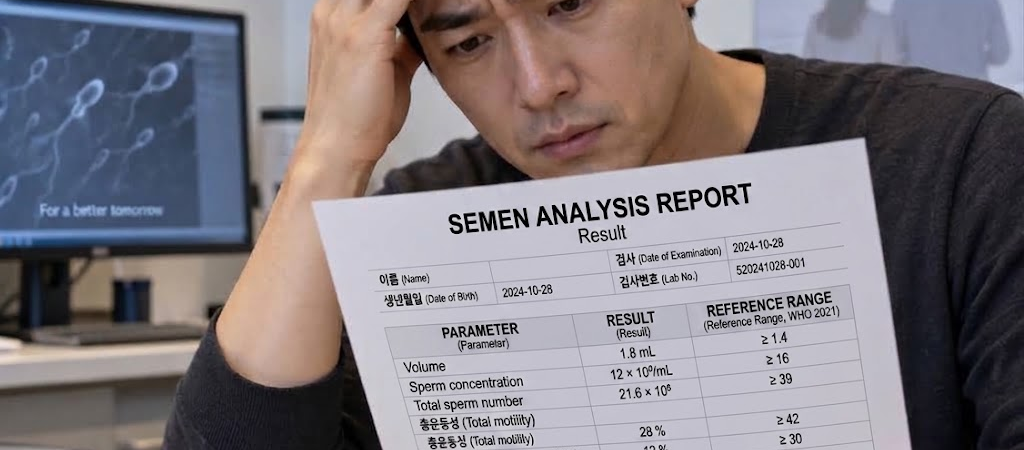
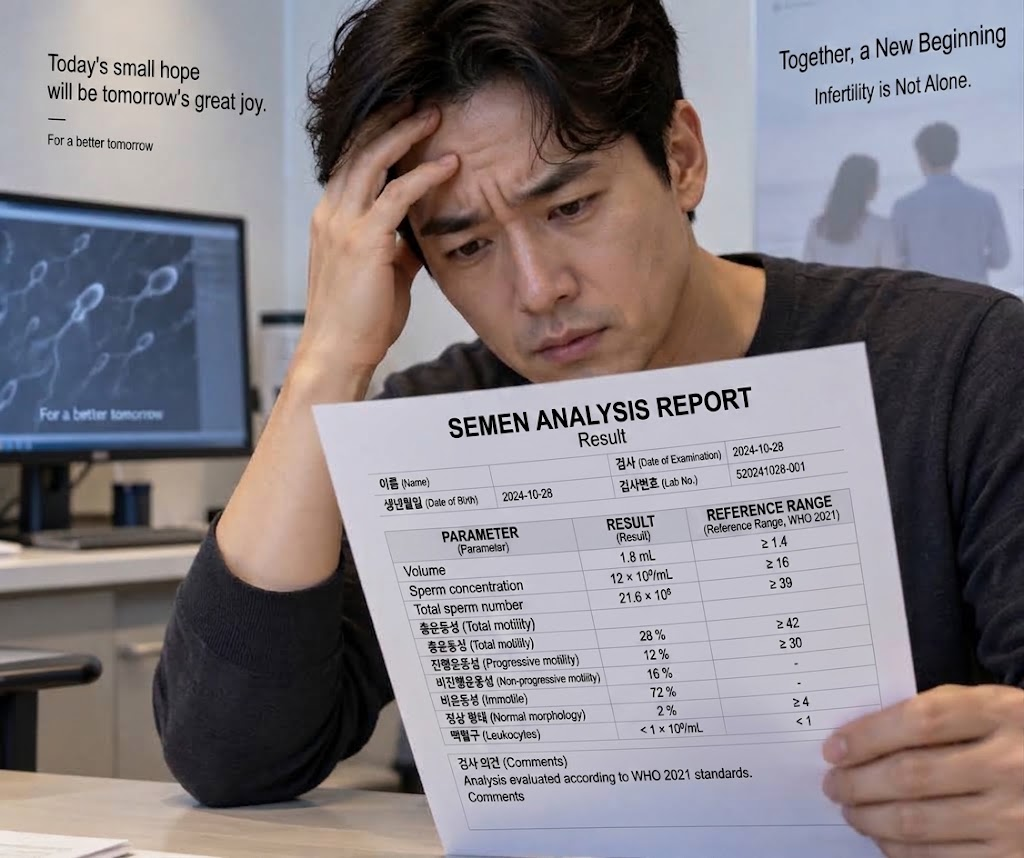
- Even in the same individual, sperm concentration and motility can fluctuate dramatically from test to test
- 2026 analysis of 11,141 men: 63% of studies evaluating psychological stress link it to reduced sperm motility
- High fever from the flu can leave traces for months: Prolonged abstinence is not always better
- A single semen analysis cannot definitively determine male fertility status
“Last time, motility was over 50%, but this time they say it is under 20%. Did my sperm suddenly deteriorate?”
This is one of the most common questions couples ask when reviewing semen analysis results during fertility evaluations. Even when the same man undergoes testing within a relatively short window, the reported sperm count and motility can swing wildly from one analysis to the next.
The short answer: this is not abnormal. Rather than a fixed, immutable marker like a blood type, a semen analysis functions more like blood pressure—a dynamic biological measurement that shifts in response to physical condition, lifestyle stressors, and precise laboratory testing parameters.
Clinical guidelines on male infertility from the American Urological Association (AUA) and the American Society for Reproductive Medicine (ASRM) emphasize that semen parameters are biological measurements characterized by high intra-individual variability across ejaculates. This is why guidelines caution against rendering definitive diagnostic conclusions from a single test, recommending repeat evaluations instead.
Was the Motility Drop During a Stressful Month Pure Coincidence?
Recent research increasingly validates the physiological connection between psychological stress and semen quality.
A systematic review published in JBRA Assisted Reproduction (online ahead of print, July 2026) evaluated 34 studies encompassing 11,141 men. Among the studies investigating psychological stress, 63.3% identified an association between elevated stress and decreased sperm motility. Furthermore, 52.9% of studies linked stress to lower sperm concentration, and 56.3% observed adverse associations with total sperm count.
The evaluated stressors ranged from occupational strain and daily life anxiety to academic examination pressure, major life disruptions, and the emotional burden of fertility treatments themselves. Because the majority of these studies were observational, science cannot yet declare direct biological causality.
Nevertheless, if a man experiences a drop in sperm motility during a period marked by chronic overwork, severe sleep deprivation, and acute psychological strain, the connection is physiologically grounded.
Sperm are not synthesized overnight on the morning of the test. Developing from spermatogonia through maturation in the epididymis to final ejaculation takes several weeks to months. Consequently, a man’s overall health and lifestyle exposures over the preceding two to three months leave clear footprints on his current results.
A Bout of Severe Flu Can Sharply Depress Sperm Quality
Among transient physiological disruptors, high fever exerts one of the most pronounced impacts.
In a longitudinal study tracking 27 healthy men over 16 months, experiencing a febrile episode led to an approximate 33% to 35% reduction in sperm concentration, accompanied by a marked rise in immotile sperm. Researchers noted that elevated core body temperature directly impairs specific heat-sensitive stages of spermatogenesis.
Another study investigating men who experienced high fevers exceeding 39 degrees C (102.2 degrees F) for 3 or more days observed that sperm concentration and rapid progressive motility dropped sharply between 3 and 6 weeks post-fever. Notably, recovery to baseline parameters required 4 to 6 months.
Therefore, if a semen analysis is performed shortly after recovering from influenza, COVID-19, or another acute febrile illness, poor numbers should not be immediately interpreted as permanent testicular failure.
“I Held It In for Days, So the Quality Must Be Better”… Not Necessarily
The duration of sexual abstinence prior to collection is another major factor that can alter the report card.
It is common to assume that longer abstinence allows more sperm to accumulate, yielding a “better” sample. However, sperm quantity and sperm functional quality do not always travel in the same direction.
A 2024 meta-analysis pooling 13 studies across 2,315 men demonstrated that while longer abstinence intervals increased total semen volume and sperm concentration, progressive motility declined and sperm DNA fragmentation significantly increased. Furthermore, a systematic review of 85 studies noted that for subfertile men in particular, a relatively shorter abstinence window often proves more beneficial for progressive motility and DNA integrity.
Assuming that “holding out for a full week will yield the best sample” is clinically misleading.
A Single Deviation in the Collection Process Changes the Numbers
Variability also arises outside the body. To ensure reproducible results, the World Health Organization (WHO) outlines strict collection and processing protocols. Laboratories must systematically record the exact abstinence interval, collection time, whether the entire ejaculate was captured, and the transit time from collection to microscopic assessment.
Crucially, the initial fraction of the ejaculate contains the highest concentration of spermatozoa. If a portion of this first fraction is spilled or missed during collection, the final count will be artificially depressed. Similarly, prolonged transit time or improper temperature maintenance while transporting a home-collected sample to the clinic will directly compromise motility readouts.
A ‘Continuous Film’ Rather Than a Single Snapshot
Finding a motility of 15% on a lab report does not mean a man’s motility is perpetually 15%. Conversely, a reading of 60% does not mean his parameters are permanently protected.
The numbers on any given day reflect an intersection of recent stress, sleep quality, febrile illnesses, abstinence duration, alcohol consumption, lifestyle factors, and the mechanical precision of sample handling.
When evaluating male fertility, clinicians must follow the overall trajectory rather than fixate on a single data point. Evaluating sperm concentration, total count, progressive motility, and strict morphology together—and confirming abnormal results through repeat testing under standardized conditions—remains essential.
A sudden dip on a semen analysis report is not an immediate reason to despair, just as a single optimal test is not an excuse to disengage. A semen analysis is rarely an unchangeable report card; it is simply one frame in a moving biological film.
Medical Source & Study Information
- Journal: JBRA Assisted Reproduction (Published online ahead of print, July 13, 2026)
- Study Title: Psychological stress and semen quality impairment: A systematic review
- Lead Institutions: Department of Clinical Analysis, Federal University of Santa Catarina, Brazil
- DOI: 10.5935/1518-0557.20260023
- Study Scope: Systematic review analyzing 34 studies published between 1988 and 2023, encompassing 11,141 men
※ This article was synthesized based on the systematic review published in JBRA Assisted Reproduction (July 2026) alongside male infertility evaluation guidelines from the AUA, ASRM, and WHO. It does not replace individualized clinical diagnosis or medical care, and specific treatment decisions should always be made in consultation with a qualified urologist, andrologist, or reproductive endocrinologist.
※ The images associated with this article were generated using generative AI (ChatGPT, OpenAI) as illustrative visual references and do not depict real individuals.