
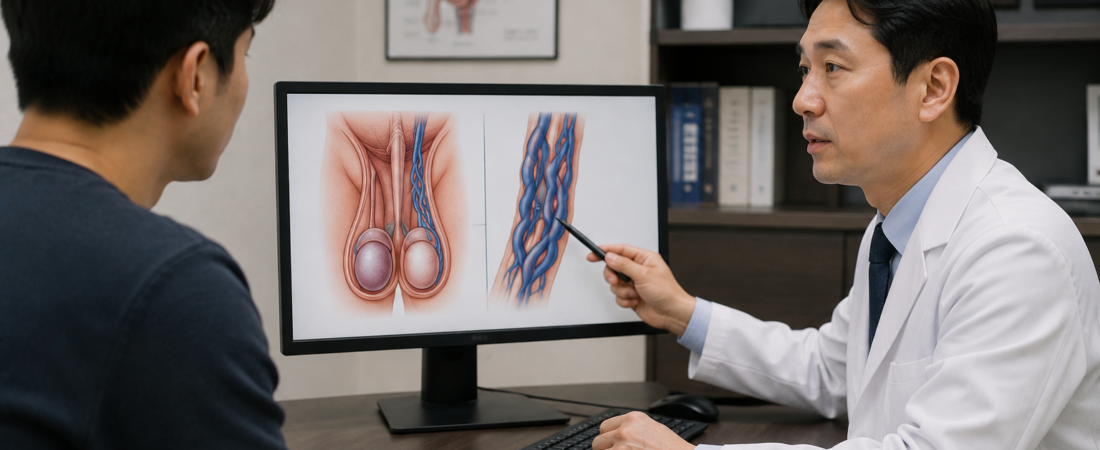
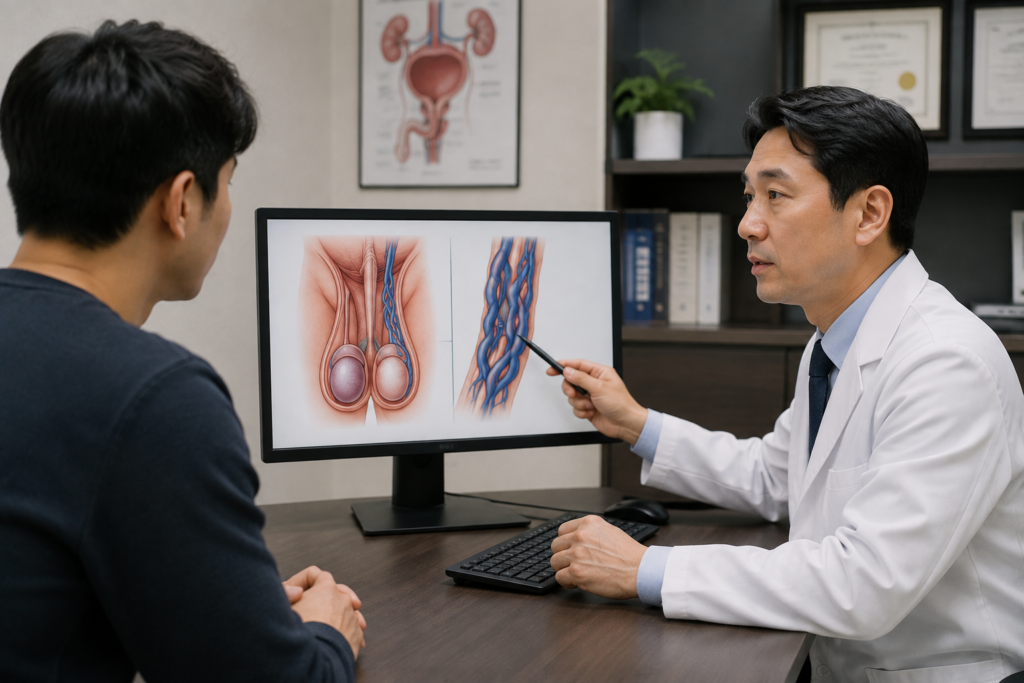
- Retrograde Venous Blood Flow Elevates Testicular Temperature and Oxidative Stress, Impairing Spermatogenesis
- Varicocelectomy Indicated for Clinically Palpable Varicoceles Combined with Documented Semen Abnormalities
- If Female Age Is Advanced or Ovarian Reserve Is Diminished, Delaying IVF for Varicocele Recovery Carries Significant Risk
When a male fertility evaluation reveals a varicocele, couples immediately face a clinical dilemma: Should the male partner undergo surgical varicocelectomy and attempt natural conception, or is it better to save time and proceed directly to In Vitro Fertilization (IVF)?
Neither approach is universally optimal for every patient. The decision must be personalized based on the clinical grade of the varicocele, baseline semen parameters, and—critically—the female partner’s age and ovarian reserve.
Pathophysiology: Venous Stasis, Hyperthermia, and Oxidative Stress
A varicocele is an abnormal dilation and tortuosity of the pampiniform venous plexus draining the testicle, functionally similar to varicose veins in the lower extremities.
Incompetent or absent venous valves, combined with the unique anatomical entry of the left internal spermatic vein into the left renal vein at a perpendicular 90∘ angle, cause retrograde venous reflux and blood pooling. Consequently, the vast majority of varicoceles occur on the left side. According to the American Urological Association (AUA), varicoceles are present in approximately 15% of all adult men and up to 40% of men presenting with primary infertility.
Normal spermatogenesis requires a scrotal temperature roughly 2–3°C below core body temperature. Venous stasis disrupts this counter-current heat exchange mechanism:
- Elevated Testicular Temperature: Induces cellular hyperthermia within the seminiferous tubules.
- Hypoxia and Reactive Oxygen Species (ROS): Poor venous drainage causes microcirculatory hypoxia and triggers oxidative stress.
- Downstream Damage: Sustained oxidative stress impairs sperm concentration, progressive motility, normal morphology, and elevates sperm DNA fragmentation (SDF).
Diagnostic Criteria: Palpable vs. Subclinical Varicoceles
The presence of a varicocele on a scrotal ultrasound does not automatically indicate a need for surgical intervention.
Joint clinical practice guidelines from the American Urological Association (AUA) and the American Society for Reproductive Medicine (ASRM) recommend surgical repair only when all of the following criteria are met:
- The varicocele is clinically palpable on physical examination (Grade 1–3).
- The couple has documented infertility.
- The male partner exhibits abnormal semen parameters on repeat analyses.
Conversely, subclinical varicoceles (detected solely by Doppler ultrasound without physical palpation) are not recommended for routine surgical repair.
Guidelines from the European Association of Urology (EAU) align with this approach: surgical correction improves natural pregnancy rates primarily in men with palpable varicoceles, impaired semen quality, and otherwise unexplained couple infertility, provided the female partner has normal fertility potential.
The Spermatogenic Timeline: Accounting for the Biological Clock
Surgical repair does not yield immediate results. The human spermatogenic cycle—from spermatogonial stem cell division through epididymal maturation—takes approximately 70 to 90 days.
Semen parameters typically show progressive improvement over several months, with spontaneous conceptions post-varicocelectomy occurring most frequently between 6 and 12 months post-surgery.
- When the Female Partner is Young with Normal Ovarian Reserve: If the female partner is under age 35 with reassuring AMH levels and antral follicle counts, prioritizing surgical repair followed by a 6- to 12-month window for natural conception or intrauterine insemination (IUI) represents an evidence-based, cost-effective strategy.
Female Ovarian Reserve: The Limiting Factor in ART Decisions
If the female partner is in her late 30s or early 40s, or presents with diminished ovarian reserve (low AMH / low AFC), the treatment algorithm changes significantly.
While male sperm production continues throughout life and can improve after varicocelectomy, age-related decline in oocyte quantity and quality is biologically irreversible. Waiting 6 to 12 months for postoperative semen normalization risks further depletion of the female ovarian reserve.
The EAU guidelines explicitly state that female age and ovarian reserve must be systematically integrated into the decision-making process when choosing between varicocelectomy and assisted reproductive technology (ART). For couples facing time-sensitive ovarian decline, moving directly to IVF/ICSI—or performing varicocelectomy concurrently while banking embryos—is often the more pragmatic path.
Severe Oligozoospermia and the Role of ICSI
In cases of severe oligozoospermia (<5×10⁶ sperm/mL) or severe asthenozoospermia, the likelihood of achieving a natural conception post-surgery remains statistically low. For these couples, Intracytoplasmic Sperm Injection (ICSI) is frequently the primary indication.
Notably, varicocele repair is not exclusively reserved for natural conception:
- Recent meta-analyses indicate that repairing a clinical varicocele prior to IVF/ICSI cycles may improve sperm DNA integrity, resulting in higher clinical pregnancy and live birth rates compared to non-repaired cohorts.
- However, because much of this literature consists of retrospective cohort studies, routine pre-IVF varicocelectomy requires individualized clinical assessment rather than universal application.
Management in Men Not Actively Trying to Conceive
A varicocele diagnosed in a man without immediate pregnancy plans does not mandate surgery:
- Asymptomatic Cases: If there is no scrotal pain, discomfort, or testicular atrophy, regular clinical observation without surgical intervention is standard.
- Indications Outside Active Infertility:
- Chronic Scrotal Pain: A dull, dragging ache directly attributable to the varicocele that fails conservative management.
- Testicular Volume Loss (Hypotrophy): Progressive reduction in testicular size, particularly critical in adolescent patients where asymmetric growth warrants surgical evaluation.
- Future Fertility Preservation: Men with palpable varicoceles and progressively deteriorating semen parameters who wish to preserve fertility for the future may discuss preventative repair.
Clinical Summary
Navigating a varicocele diagnosis extends beyond a binary choice between “surgery or IVF.” The clinical strategy requires balancing:
- Physical exam palpability (clinical vs. subclinical)
- Degree of semen parameter impairment and sperm DNA fragmentation
- The realistic probability of achieving natural conception
- The female partner’s age and remaining reproductive window
When female ovarian reserve is robust, sequential management—varicocele correction, monitoring semen recovery, and attempting natural conception—is clinically sound. When female reproductive time is limited, delaying IVF to pursue surgery alone can compromise cumulative treatment success.
Medical Guidelines & Sources
- AUA/ASRM Guideline: Diagnosis and Treatment of Infertility in Men (Joint Clinical Practice Guideline of the American Urological Association and the American Society for Reproductive Medicine)
- EAU Guideline: Sexual and Reproductive Health Guidelines (European Association of Urology)
※ This article was synthesized based on clinical practice guidelines from the American Urological Association (AUA), the American Society for Reproductive Medicine (ASRM), the European Association of Urology (EAU), and relevant peer-reviewed meta-analyses in male reproductive health. It does not replace individualized clinical diagnosis or medical care, and specific treatment decisions should always be made in consultation with a qualified urologist and reproductive specialist.
※ The images associated with this article were generated using generative AI (ChatGPT, OpenAI) as illustrative visual references and do not depict real individuals.