
- NYU Research Team Analyzes 7,763 Single Euploid Embryo Transfers (PGT-A)
- First-Transfer Live Birth Rate at 63.1%… Cumulative Rate Reaches 92.0% at 3 Transfers and 98.3% at 5 Transfers
- Fewer Than 5% of Patients Meet Diagnostic Criteria for ‘Recurrent Implantation Failure’ After Three Consecutive Transfers
When an embryo confirmed to be chromosomally normal fails to implant during In Vitro Fertilization (IVF), patients are understandably shaken. Questions quickly arise: “Why did a normal embryo fail to implant?”, “Is there an underlying uterine pathology?”, or “Should I get tested for recurrent implantation failure?” This often leads couples to pursue extensive immunological panels and experimental adjuvant therapies.
However, a large-scale study reveals that assuming one has Recurrent Implantation Failure (RIF) simply because one or two PGT-A euploid embryos failed to implant is premature. When transferring euploid embryos sequentially, the cumulative probability of achieving a live birth reaches 92.0% by the third transfer, and fewer than 5% of patients met the clinical definition of true RIF after three attempts.
Tracking 5,811 Patients: 63.1% First-Transfer Success and 92% Cumulative Rate
Researchers from the NYU Grossman School of Medicine and NYU Langone Fertility Center analyzed 5,811 patients who underwent 7,763 single euploid embryo transfers (SEET) between January 2014 and December 2024. The study tracked outcomes across up to six consecutive single euploid transfers until the patient either achieved a live birth or discontinued treatment.
The cumulative outcomes demonstrated strong overall prognosis:
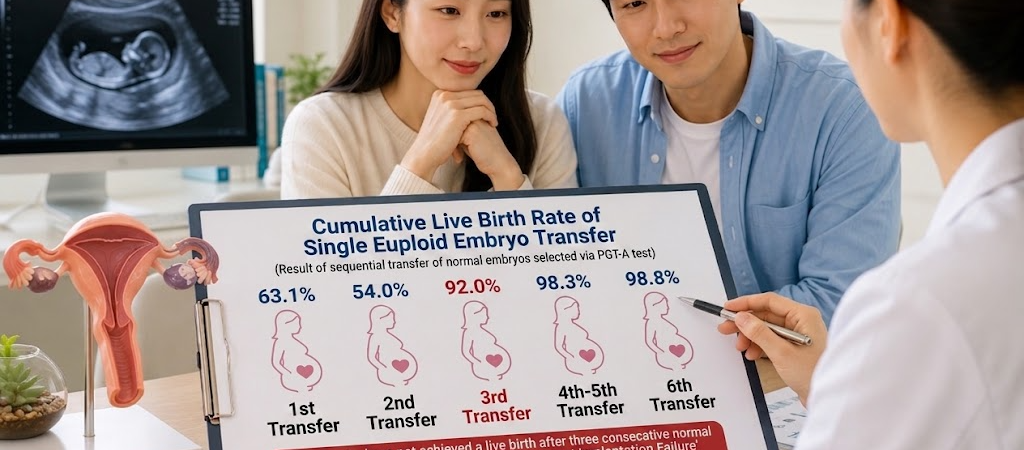
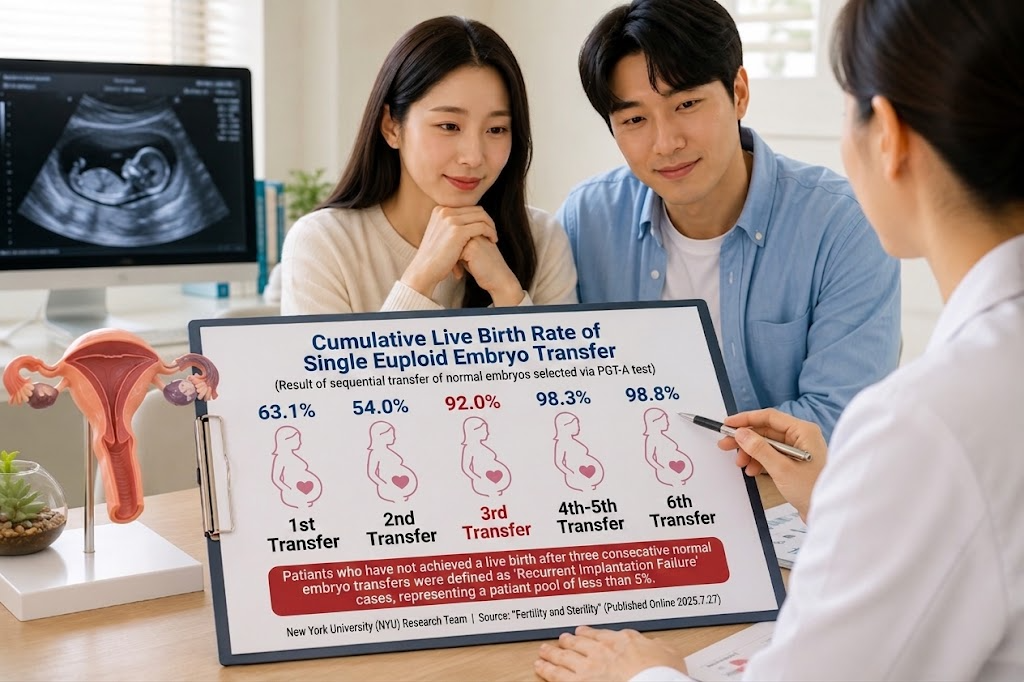
- First Transfer Live Birth Rate: 63.1%
- Cumulative Live Birth Rate (3 Transfers): 92.0%
- Cumulative Live Birth Rate (5 Transfers): 98.3%
- Cumulative Live Birth Rate (6 Transfers): 98.8%
Failing the initial transfer did not signal a sharp decline in future success.
Stable Prognosis on Subsequent Transfers: Second Transfer LBR at 54%
Evaluating individual transfer cycles provided notable insights:
- The live birth rate was 63.1% for the first transfer and 54.0% for the second transfer.
- On subsequent consecutive euploid transfers, the per-transfer success rate stabilized rather than precipitously dropping.
There was no statistical evidence indicating that an initial failed euploid transfer substantially diminishes the intrinsic implantation potential of subsequent euploid embryos.
This confirms that a single failed euploid transfer does not automatically serve as clinical evidence of an underlying uterine, anatomical, or immunological defect. Passing PGT-A indicates the absence of numerical chromosomal aneuploidy in the sampled cells; it does not guarantee that every euploid embryo possesses complete developmental viability or that implantation will occur on any given cycle. Implantation is multifactorial, depending on embryonic competence, endometrial receptivity, and procedural execution.
Distinguishing Miscarriage from True Implantation Failure
A critical clinical distinction highlighted in the study is the difference between the 92% cumulative live birth rate and the <5% RIF rate:
- While an 8% gap remained without a live birth after three transfers, not all of these patients experienced true implantation failure. A portion of this cohort achieved initial implantation but experienced biochemical pregnancies or early clinical miscarriages.
- Under standard clinical criteria, fewer than 5% of patients experienced true Recurrent Implantation Failure (complete failure to achieve hCG positivity across three consecutive euploid transfers).
- After five sequential euploid transfers, fewer than 2% of patients failed to achieve a live birth.
Failing to achieve a live birth across three transfers is clinically distinct from three consecutive complete implantation failures. Clinical evaluations must differentiate between absent implantation and post-implantation pregnancy loss.
Caution Against Premature Add-On Testing and Overtreatment
These findings carry direct clinical implications for patient management. Experiencing a single failed euploid transfer does not justify labeling a patient with “recurrent implantation failure.”
The study authors concluded that for patients with an adequate cohort of banked euploid embryos, continuing sequential single euploid transfers remains the primary, evidence-based management strategy.
In contemporary reproductive practice, debate persists regarding the threshold for initiating invasive endometrial receptivity assays, thrombophilia panels, immunological testing, and empirical add-on therapies. These findings provide evidence that adding unvalidated tests and empirical medications after only one or two failed euploid transfers is often unnecessary.
Study Limitations and Patient Context
While the reported success rates are high, they cannot be universally applied across all IVF demographics:
- Study Design: This was a retrospective cohort study conducted at a single academic fertility center (NYU Langone).
- Selection Criteria: The cohort comprised patients who successfully produced and banked multiple PGT-A euploid embryos. For patients with advanced maternal age or diminished ovarian reserve who struggle to obtain a single euploid embryo, a “92% rate across three transfers” cannot be interpreted as a baseline expectation.
- Scope of Findings: The study does not demonstrate that PGT-A inherently improves live birth rates for all IVF patients; rather, it documents the cumulative prognosis across available euploid embryos.
A Single Failed Transfer Is a Statistical Outcome, Not a Diagnosis
For couples undergoing fertility treatment, an embryo transfer is not merely a statistical exercise. After navigating ovarian stimulation, egg retrieval, fertilization, and genetic screening, a failed transfer can feel like an ominous indicator for all future attempts.
However, in this large-scale analysis, the first-transfer live birth rate was 63.1%—meaning roughly one in three euploid transfers does not result in a baby on the first attempt. Yet, among patients who had additional euploid embryos to transfer, cumulative live birth reached 92% by the third cycle.
A single failed euploid transfer is a statistical outcome within expected biological variation, not a definitive diagnosis of irreversible uterine dysfunction.
Medical Source & Study Information
- Authors: Claudia Durbin, James A. Grifo, et al. (NYU Grossman School of Medicine / NYU Langone Fertility Center)
- Study Title: Cumulative probability of a live birth after up to six sequential single euploid embryo transfers
- Journal: Fertility and Sterility (Official Journal of the American Society for Reproductive Medicine, ASRM), Published online July 27, 2026.
※ This article was synthesized based on research conducted by the NYU Grossman School of Medicine and NYU Langone Fertility Center, published in the ASRM official journal Fertility and Sterility, alongside publicly available data from the National Library of Medicine (PubMed). It does not replace individualized medical advice, clinical diagnosis, or treatment, and specific medical decisions should always be made in consultation with a qualified reproductive specialist.
※ The images associated with this article were generated using generative AI (ChatGPT, OpenAI) as visual references to aid understanding and do not depict real individuals.