
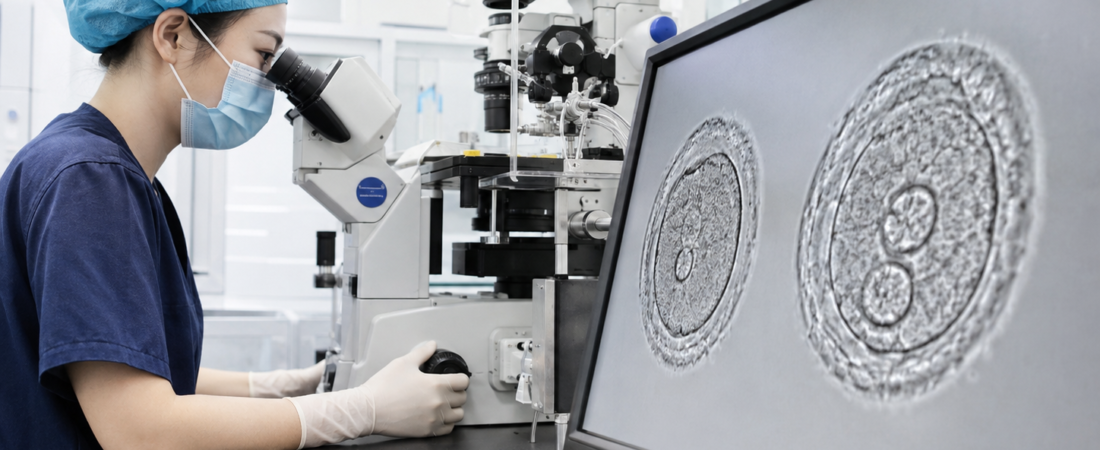

“Embryos Once Discarded as Abnormal Have Become Babies”… Re-evaluating IVF ‘1PN Embryos’
Analysis of 13,203 1PN Embryos: 96.9% of Standard IVF 1PN Blastocysts Confirm Genetic Material from Both Parents When Chromosomes Are Normal and Biparental Origin Is Confirmed, Pregnancy and Live Birth Outcomes Show No Difference from 2PN Embryos A New ‘Embryo Option’ for Older or Low-Responder Patients for Whom a Single Egg Is Desperate
During In Vitro Fertilization (IVF), one of the very first things medical staff check when confirming fertilization is the pronucleus. In a normally fertilized egg, two pronuclei—one originating from the mother and one from the father, commonly known as ‘2PN’—are typically observed.
In contrast, ‘1PN embryos’, which display only a single pronucleus, have historically been treated differently. For a long time, the possibility that they did not undergo normal fertilization led to them frequently being excluded from transfer or discarded altogether.
However, a recently published large-scale study has cast a question mark over this long-standing practice. The core inquiry is whether judging a 1PN embryo as categorically abnormal is truly correct.
The Findings of the Large-Scale Study
The research team analyzed a staggering 13,203 1PN embryos across 10,730 IVF treatment cycles—making it one of the largest studies ever conducted on 1PN embryos.
The results proved far more intriguing than anticipated.
Examining 1PN blastocysts generated through standard in vitro fertilization (where sperm and eggs fertilize on their own without active injection) that underwent genetic analysis revealed that 96.9% contained genetic material from both the mother and the father.
This means that while superficially only a single pronucleus was visible, a significant proportion of these embryos actually possessed normal genetic material from both parents.
Even among 1PN embryos created via Intracytoplasmic Sperm Injection (ICSI)—where a single sperm is directly injected into an egg—65.9% were confirmed to carry genetic material from both parents.
Clinical Outcomes: Comparable to 2PN Embryos
The more critical finding followed.
When 1PN blastocysts confirmed to have normal chromosomes and biparental genetic origin were actually transferred, there were no statistically meaningful differences in pregnancy rates, live birth rates, or neonatal outcomes compared to traditional, normal 2PN blastocysts.
In other words, the final developmental potential of an embryo should not be summarily dismissed simply because only one pronucleus was visible at the time of fertilization checks.
Implications for Older and Low-Responder Patients
This finding commands heightened attention because not all patients undergoing IVF produce multiple high-quality embryos.
The study identified that in roughly 1 out of every 6 treatment cycles, usable normal 2PN embryos were absent, making a 1PN embryo effectively the sole available embryo option.
For a young patient with robust ovarian function, selecting the best embryo from among numerous eggs and embryos is feasible. For patients in their 40s or low responders with severely diminished ovarian reserve, however, the reality is entirely different.
For a patient who undergoes an egg retrieval cycle only to secure one or two eggs, a single embryo is far more than just the number ‘1.’ It represents a pivotal opportunity determining whether they must endure months of repeat injections and another retrieval procedure.
This study prompts a re-evaluation of whether immediately closing the door on a hard-earned egg simply because it was judged as 1PN post-fertilization is genuinely the optimal approach.
Caution and Nuance in Clinical Application
Nevertheless, these results must not be interpreted as meaning that “all 1PN embryos can henceforth be transferred.”
The embryos that demonstrated favorable pregnancy and live birth outcomes in the study were not transferred merely because they were 1PN. They were restricted to 1PN embryos that successfully developed to the blastocyst stage and were subsequently confirmed via genetic testing to possess normal chromosomes and biparental genetic material.
Because true abnormally fertilized embryos can still exist within the 1PN pool, decisions must be made with extreme caution, synthesizing fertilization methods, embryo developmental kinetics, and genetic testing results.
Conclusion
Even so, the message delivered by this study is unequivocal.
Among embryos previously excluded uniformly on the grounds of “potential abnormality,” some may harbor the capacity to lead to normal pregnancies and live births.
Particularly for older or low-responder patients for whom each individual egg and embryo is a matter of utmost desperation, this carries profound significance.
As IVF technology advances, the criteria for evaluating embryos are evolving beyond a simple binary check of “one or two pronuclei” toward verifying actual chromosomal status and parental genetic architecture.
1PN embryos—once routinely discarded without a second thought.
This large-scale study demonstrates that the time has arrived to revisit that practice and ask of certain embryos among them: “Do we truly need to throw this away?”
※ This article was synthesized based on the paper “A large-scale retrospective study on the transfer of 1PN embryos: the need for a unified clinical guideline revision” by Nicole O. McPherson et al., published in the international journal Human Reproduction in August 2026. It does not replace a specific individual’s diagnosis or treatment, and actual medical judgment must be made through consultation with a specialist.
※ The images used in this article were generated using generative AI (ChatGPT, OpenAI) as visual references to aid understanding and do not depict real individuals.