
Women Who Need to Widen the ‘Narrow Path’ Before IVF
“We need to place a balloon inside the uterus to widen the path a bit.”
When an infertile patient preparing for In Vitro Fertilization (IVF) hears these words, initial panic is entirely understandable. Does it mean putting a balloon inside the uterus and inflating it? Does it imply there is something wrong with the uterus itself?
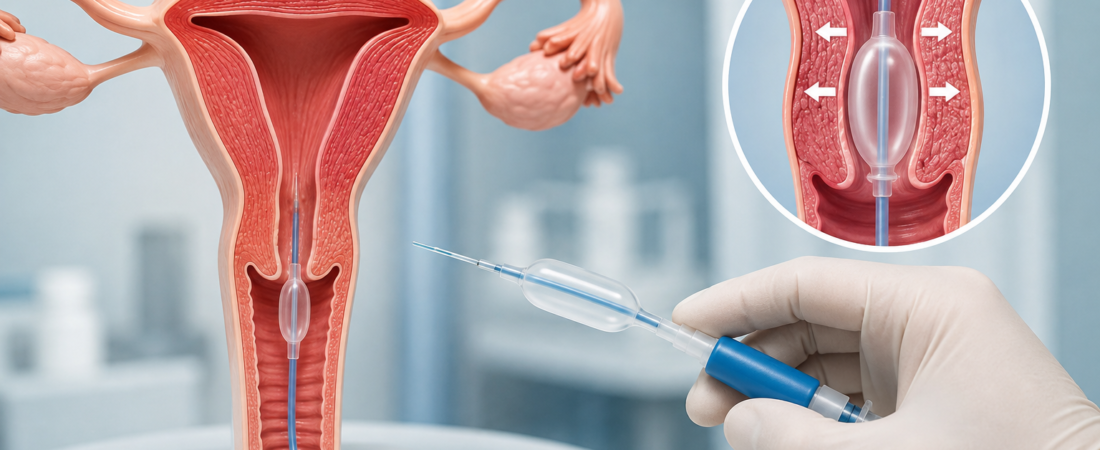
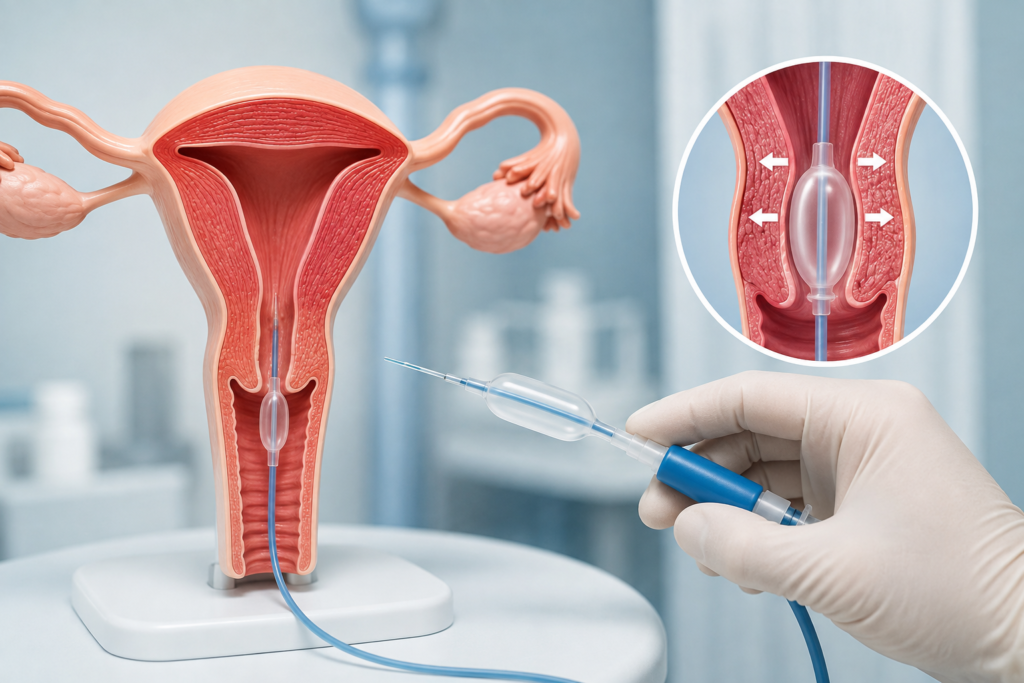
In fertility treatments, a ‘balloon dilation’ is not a procedure to inflate the uterus. When the cervix—the narrow passage connecting the vagina and the uterus—is overly narrow, making it difficult for medical instruments or an embryo transfer catheter to pass through, a small medical balloon is used to widen the passage.
Understanding the Cervix as a “Door”
Thinking of the uterus as a room makes the concept easy to grasp.
The cervix acts as the “door” entering that room. For most women, a thin embryo transfer catheter passes through this door without major difficulty. However, for some women, the cervix may be congenitally very narrow, or the passage may have narrowed due to past cervical surgeries, procedures, inflammation, or scarring. This condition is known as ‘cervical stenosis.’
Because it typically produces no special symptoms in daily life, many women remain unaware that they have cervical stenosis. It is often discovered for the first time during a hysteroscopy or infertility treatment.
In IVF in particular, this tiny passage holds surprising importance. Even if eggs are laboriously retrieved and fertilized to create high-quality embryos, the catheter must ultimately pass through the cervix to enter the uterine cavity during the final embryo transfer stage.
Why the Passage Matters in Embryo Transfer
Embryo transfer involves loading an embryo onto the tip of a thin catheter, navigating past the cervix, and placing the embryo at the optimal location inside the uterus. However, if the cervix is excessively narrow or severely curved, the catheter may not enter smoothly.
Forcibly pushing it through or attempting multiple insertions can cause bleeding in the cervix or irritate the uterus, potentially triggering contractions. Consequently, some fertility clinics perform a ‘mock embryo transfer’ prior to the actual transfer to check whether the catheter can navigate smoothly into the uterine cavity.
If cervical stenosis is identified during this process, dilation therapy may be considered. The method varies depending on the patient’s condition.
Options include using graduated thin dilators sequentially, or treating the narrowed area under direct visualization via hysteroscopy. In some cases, a catheter equipped with a small balloon at the tip is used to gently dilate the constricted area.
The underlying principle is simpler than it sounds: a thin catheter is positioned at the narrowed site, and the small balloon at the tip is inflated to expand the passage. Rather than forcibly prying open a tight door, it is best understood as gradually securing space from within.
Who Needs Balloon Dilation?
Crucially, undergoing IVF does not mean everyone requires a balloon inserted into their cervix. If the cervix opens normally and the embryo transfer catheter passes through easily, this procedure is unnecessary.
Medical staff determine its necessity only in limited situations, such as when cervical stenosis is present or when a patient experienced significant difficulty with catheter insertion during a previous embryo transfer. Moreover, balloon dilation is not the sole treatment available.
The reason cervical dilation matters to fertility patients is ultimately to secure the pathway for embryo transfer. Succeeding in creating a great embryo only to face unexpected hurdles on transfer day because the path into the uterus is narrow leaves both patients and medical staff in a difficult position.
Particularly if a patient was told during a past embryo transfer that “the uterine opening is narrow,” “the catheter wouldn’t go in smoothly,” or “the transfer took a long time,” discussing the status of the cervix with the medical team prior to the next transfer is well advised.
Pain, Complications, and Realistic Expectations
Patients worry most about pain.
The degree of pain varies depending on the severity of the stenosis, the dilation method, and the extent of the procedure. Mild cases may involve discomfort or pressure similar to menstrual cramps, but severe stenosis requiring aggressive dilation can cause more intense pain.
Depending on the situation, painkillers, local anesthesia, sedation, or anesthesia may be considered. Following the procedure, minor bleeding or abdominal pain can occur, and rare complications like infection, bleeding, cervical trauma, or uterine perforation are possible, making the judgment of an experienced medical team essential.
Furthermore, widening the cervix once does not guarantee it will remain permanently dilated. Depending on the underlying cause of the stenosis or the degree of scarring, re-stenosis can occur, requiring re-evaluation if necessary.
Another vital point to keep in mind is that expanding the cervix with a balloon does not directly increase the implantation rate. The balloon is not a treatment designed to improve the endometrium or enhance an embryo’s capacity to implant.
The core objective is to widen a narrowed cervix so that hysteroscopy instruments or embryo transfer catheters can enter the uterine cavity more smoothly.
Conclusion
Discussions of IVF often focus heavily on egg counts, embryo grades, chromosomal testing, and endometrial thickness. Yet the final few centimeters of the path that a hard-earned embryo must traverse are equally critical.
No matter how excellent the embryo, if the journey into the uterus is excessively difficult, the transfer process itself can become complicated.
Therefore, hearing the phrase “let’s widen the path with a balloon” during fertility treatment is not a terrifying story about inflating the uterus. It is closer to a preparatory procedure that refines the narrowed “final stretch” so that a high-quality embryo can glide more gently into the uterine cavity.
Succeeding in fertility treatment requires looking after the pathway that allows the embryo to arrive safely at the uterus, just as much as securing good eggs and quality embryos.
Fertility specialists explain, “This procedure is not necessary for every infertile woman; it is primarily considered for women whose cervix is genuinely narrow, making it difficult for the embryo transfer catheter to pass. Typical cases include those where catheters failed to enter smoothly during past transfers, prolonged transfer times occurred, or stenosis developed due to scarring after previous cervical surgeries or procedures.”
They emphasize, “It is not a procedure performed simply because a patient experienced recurrent implantation failure; rather, the priority is verifying whether there is an actual physical problem along the ‘final path’ through which a good embryo enters the uterus.”