
Declining Pregnancy and Birth Success Rates Clear Beyond Age 49 ‘Uterine Environment’ and Overall Systemic Health Prove More Critical Than Embryos Alone
“If you use donor eggs, a woman’s age no longer matters.”
This is a common notion among women preparing for In Vitro Fertilization (IVF). Because donor eggs come from young, healthy women, donor egg IVF is widely recognized as a premier treatment that significantly lowers the risk of embryonic chromosomal abnormalities and increases pregnancy success rates.
However, a recently published study points out that this common belief requires a vital revision. Even when utilizing young eggs, the woman’s own age continues to impact pregnancy and childbirth outcomes.
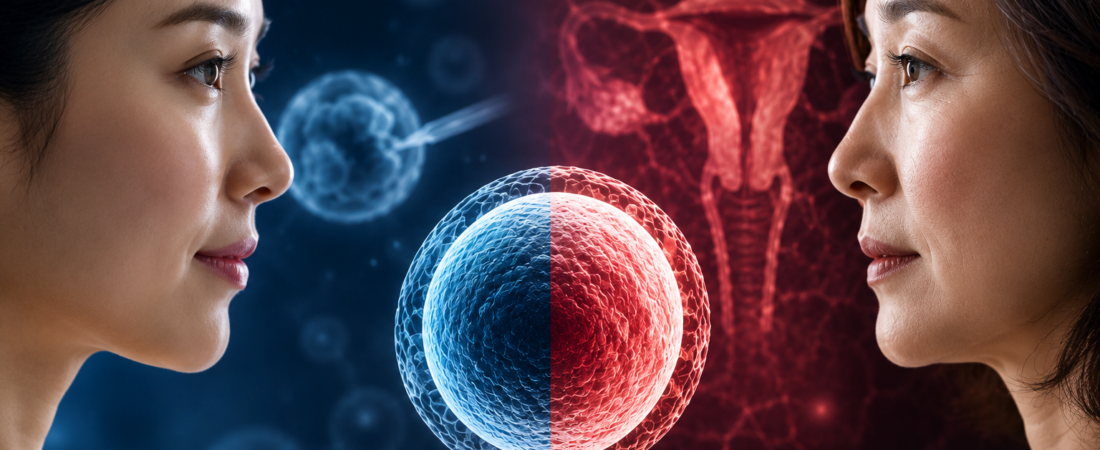
Researchers emphasize that the core of fertility treatment now extends beyond ‘young eggs’ to include managing a ‘young uterine environment’ and maintaining a healthy physical baseline.
Declining Success Rates After Age 49
According to a study recently presented at the European Society of Human Reproduction and Embryology (ESHRE), an analysis of women who underwent donor egg IVF categorized by age revealed that pregnancy and birth outcomes gradually decline as a woman’s age increases.
This shift was particularly distinct in women aged 49 and older.
Clinical pregnancy rates reached 54.0% in women aged 35 to 40, but dropped to 42.6% for those 49 and older; live birth rates likewise decreased from 46.2% to 31.7%.
Conversely, miscarriage rates rose from 24.2% up to 37.6%. Given that all embryos were created using eggs from young donors, researchers explained that this variance is likely driven by the physical condition of the woman carrying the pregnancy rather than the age of the egg itself.
Interestingly, endometrial thickness showed no significant differences across age groups. However, the formation rate of a ‘triple-line endometrium’—known to favor implantation—tended to decrease as age increased.
This implies that the functional readiness of the uterus to support actual implantation may hold greater importance than the externally visible thickness of the lining.
The Phenomenon of ‘Uterine Aging’
Fertility specialists describe this as the phenomenon of ‘uterine aging.’
As women age, the uterus ages alongside ovarian function. Uterine blood flow decreases, tissue elasticity diminishes, and chronic inflammation and fibrosis can increase.
Furthermore, alterations in the immunological environment where the embryo and uterus exchange signals can gradually impair implantation capacity and pregnancy maintenance. In other words, creating a healthy embryo is not enough; the uterus receiving that embryo must also be healthy.
Systemic health conditions—such as hypertension, diabetes, and obesity—also emerge as crucial variables. These disorders can affect blood flow to the uterus and placental development, thereby influencing pregnancy maintenance and delivery outcomes.
Consequently, selecting donor eggs does not entirely overcome age-related physical changes, researchers explain.
Optimizing the Overall Body for Success
This research does not negate the efficacy of donor eggs.
Donor eggs remain a treatment providing substantially higher pregnancy success rates than using one’s own eggs in advanced age, standing as one of the most effective options available today. However, success is not determined by the age of the egg alone.
Optimizing uterine health alongside blood pressure, blood glucose, body weight, and chronic disease management is what truly maximizes the probability of a successful pregnancy.
In the past, numerous studies suggested that using donor eggs meant a woman’s age was largely inconsequential.
Yet, as large-scale studies encompassing larger patient cohorts accumulate, evidence continually emerges showing that beyond a certain age, the recipient’s age and uterine environment independently influence pregnancy and childbirth outcomes.
This study illustrates a shifting paradigm in fertility treatment.
While past eras focused primarily on securing high-quality eggs, modern medicine sees successful pregnancies determined by a holistic ‘body-wide preparation’—encompassing healthy embryos paired with a favorable uterine environment, vascular health, metabolic status, and chronic disease management.
Ultimately, recent research reaffirms that a ‘young egg’ is merely the starting point of pregnancy, and only with a healthy uterus and a healthy body can one reach the finish line of childbirth.
※ This article was synthesized based on recent research presentations from the European Society of Human Reproduction and Embryology (ESHRE) and international reproductive medicine literature. It does not replace a specific individual’s diagnosis or treatment, and actual medical judgment must be made through consultation with a specialist.
※ Images: Created using generative AI (ChatGPT, OpenAI); depicts fictional individuals, not real people.