

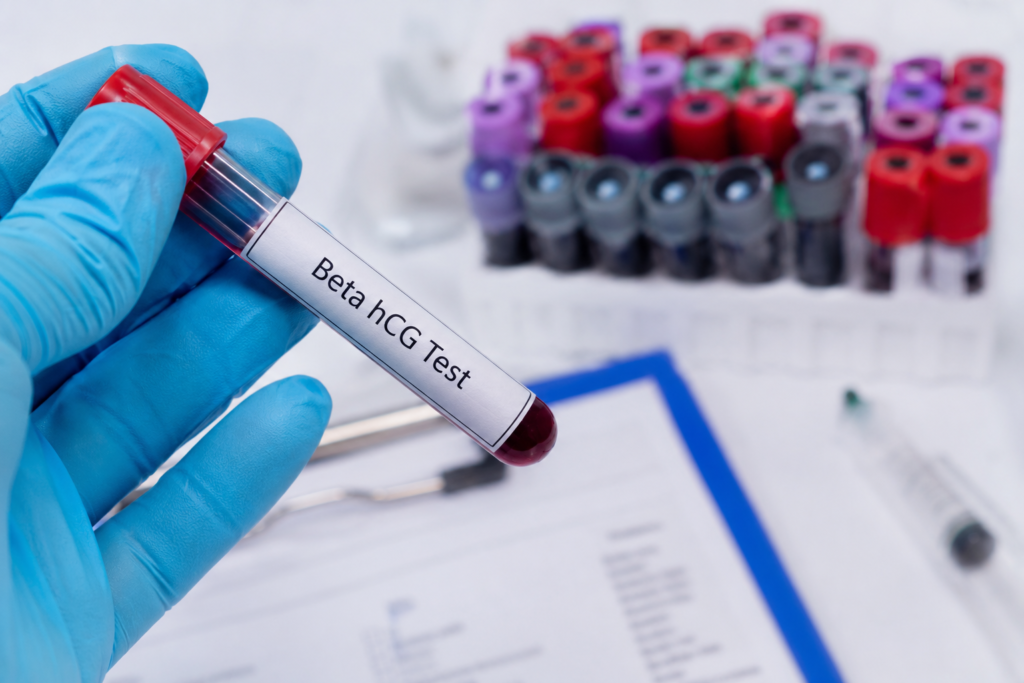
Pregnancy Hormones Secreted by the Trophoblast After Implantation… Date of Test and Upward Trend Matter More Than the Initial Value The 48-Hour 66% Increase Is Just a Traditional Benchmark; Even Low Starting Numbers Can Lead to Normal Delivery
For couples who have completed an In Vitro Fertilization (IVF) cycle, there is one day that brings even more tension than the embryo transfer itself: “blood test day,” when pregnancy is confirmed via blood work.
Among fertility patients, phrases like “If the first blood test is over 100, you’re in the safe zone” and “20 or 30 means little hope” frequently circulate.
It is true that, generally speaking, the higher the initial blood level of beta-human chorionic gonadotropin (β-hCG), the greater the likelihood that the pregnancy will progress successfully.
However, one cannot definitively seal the outcome of a pregnancy simply because the initial number is low. A pregnancy that starts at 20 or 30 can still make it all the way to childbirth if subsequent numbers rise appropriately and an ultrasound normally confirms a gestational sac and heartbeat.
What the IVF “Blood Test” Actually Measures
The “blood test” in IVF measures the concentration of β-hCG in the bloodstream.
hCG is not directly secreted by a fully formed fetus the moment a fertilized egg attaches to the endometrium; rather, it is produced by the trophoblast—the outer cells of the embryo that initiate implantation.
The trophoblast subsequently develops into crucial parts of the placenta. Therefore, the detection of blood hCG means the embryo has made contact with the endometrium and begun the implantation process, and a continuing rise in the numbers indirectly shows that the trophoblast tissue is proliferating and the pregnancy is advancing.
Consequently, the hCG test is not a simple binary verdict of whether a woman is pregnant or not. By looking at a single numerical reading alongside its subsequent changes, one can roughly gauge the direction in which an early pregnancy is heading.
However, hCG is not a “fetal health score” that directly measures the fetus’s cell division speed, chromosomal normality, or future health status. Because this hormone primarily reflects the activity of the trophoblast and early placenta, a high value does not automatically guarantee a healthy birth, nor does starting low immediately confirm an abnormal pregnancy.
Why Initial Values Vary Greatly Among Individuals
This is also why initial blood test values vary significantly from person to person.
Embryos settle into the endometrium at slightly different times, and there are individual differences in the speed at which the proliferating trophoblast releases hCG into the bloodstream.
Even if the exact same 5-day blastocyst is transferred on the same day, one embryo might begin implantation relatively early, while another does so a day or two later.
If the testing window differs by even a single day, the initial hCG level can change considerably. Therefore, dividing pregnancies into black-and-white outcomes using single numbers—such as “20 is failure, 100 is success”—is clinically inaccurate. This is why fertility clinics place greater importance on a follow-up test two days later than on the initial number.
Rethinking the “66% Increase in 48 Hours” Rule
In the past, the widespread explanation was that for a normal early pregnancy, hCG should rise by approximately 66% or more—or nearly double—over 48 hours. For instance, if the first blood test was 30, a positive sign was considered an increase to roughly 50 or higher two days later; if it was 50, a rise to about 83 or higher. Even if the starting number was somewhat low, if it rose by 66% or more at two-day intervals, tracking tests would continue under the assumption that the trophoblast was developing and the pregnancy was progressing.
However, a 66% increase is not an absolute passing grade that every normal pregnancy must achieve.
Recent studies have accumulated showing that even among normally progressing pregnancies, the minimum 48-hour rise rate can be lower than this depending on the initial hCG concentration.
Clinical guidelines now account for scenarios where normal outcomes are confirmed even when hCG increases by about 49% over 48 hours for low initial numbers, about 40% for mid-range numbers, and roughly 33% for relatively high numbers.
Therefore, one should not instantly diagnose a miscarriage or ectopic pregnancy simply because the level did not exactly double or fell slightly short of 66% after 48 hours. When numbers are low or rising sluggishly, additional blood tests and transvaginal ultrasounds must be performed together for evaluation.
The American College of Obstetricians and Gynecologists (ACOG) notes that while low or decreasing hCG can suggest pregnancy loss, multiple hCG tests and ultrasounds may be required to confirm a diagnosis.
For example, if the first blood test is 25, rises to 55 two days later, and then reaches 130 two more days later, it can be viewed as a relatively positive sign that pregnancy tissue is actively growing, despite the low starting point.
Conversely, if the initial number starts at 120 but stalls at 130 two days later or drops, relief cannot be found solely in the fact that the initial number was high. In other words, in early pregnancy, “where it started” matters alongside “in what direction and how fast it is moving.”
Understanding Lower Starting Numbers
Can a pregnancy starting at an hCG of 20 or 30 reach term? It is possible, but on average, it carries a higher risk of ending in a biochemical pregnancy, early miscarriage, or ectopic pregnancy than a pregnancy starting above 100. In particular, if a test performed at a relatively late stage—such as 14 days post-embryo transfer—stagnates at 20 to 30, the prognosis is likely worse than if that same number appeared on day 9 or 10 post-transfer.
Studies analyzing low β-hCG levels 14 days after frozen blastocyst transfer have also shown that lower initial values drastically reduce live birth probabilities. Ultimately, the meaning of a number like 20 or 30 changes entirely depending on “what day-old embryo was transferred,” “how many days post-transfer the test was taken,” and “how much it increased on the next test.”
Another point of caution is that if a fertility medication containing hCG (such as Ovidrel) was administered during a fresh embryo transfer or natural-cycle frozen transfer, residual external hCG may linger in initial tests.
Because a single low positive reading cannot confirm implantation in this scenario, serial testing is required to verify whether the levels are declining or rising due to an authentic pregnancy. While externally administered hCG decreases over time, hCG secreted by a pregnancy shows an upward trajectory as implantation proceeds.
Conclusion
A blood test is merely the first hurdle in the long journey of pregnancy. Once hCG rises appropriately, transvaginal ultrasounds around the 5th week of pregnancy must confirm the presence of a gestational sac inside the uterus, followed sequentially by the yolk sac, fetal pole, and heartbeat.
Particularly when hCG rises slowly or is accompanied by abdominal pain and bleeding, the possibility of an ectopic pregnancy must be ruled out. Because the hCG change patterns of normal pregnancies, early miscarriages, and ectopic pregnancies overlap in certain zones, a single number cannot definitively establish the location or viability of a pregnancy.
An initial blood test result of 100 is unquestionably a pleasant start. However, it does not automatically mean “entering the safe zone.”
Conversely, 20 or 30 may be a worrisome beginning, but it is not an immediate death sentence for the pregnancy either. The most critical questions in an IVF blood test do not end with “What was your first number?”
A fertility specialist must always look further: “On what day was the test taken, how much did it rise after 48 hours, and does subsequent ultrasound normally confirm an intrauterine pregnancy?”
Numbers are not report cards judging the destiny of a pregnancy; they are the initial signals indicating which direction an as-yet-invisible early pregnancy is heading.