
Egg freezing has increased fourfold, but actual utilization remains at 5.7%. Egg freezing is not storing eggs; it is storing your ‘youthful age.’
In an era where marriage and childbirth are being delayed, ‘egg freezing’ is no longer an unfamiliar medical procedure for women. Once considered a treatment to preserve fertility for patients facing cancer therapy, it has rapidly established itself as a choice to prepare for future pregnancy potential, considering career paths, education, economic conditions, and timing of marriage.
Recently published research forces us to rethink what we knew about egg freezing. While the number of women freezing eggs is exploding, the actual utilization rate is far lower than expected, and the most crucial factor determining pregnancy success is not the freezing technology itself, but ‘how old you were when you froze them.’
According to a large-scale study published in the United States, the number of elective egg freezing cases increased approximately fourfold from 2014 to 2021. However, only 5.7% of women who froze their eggs actually thawed them to attempt pregnancy.
The research team analyzed that while many women store their eggs as a ‘fertility insurance’ for the future, most maintain their storage status because the right time to use them has not yet come or because they succeeded in natural pregnancy.
This figure does not mean that egg freezing is a failed technology. Instead, experts explain that regardless of whether they are used, the psychological stability of “not losing the choice to give birth” is a significant value of egg freezing. The fact that one can plan for the future holds great meaning for many women.
The reproductive medicine community recently considers 32 to 35 years old to be the most appropriate age to freeze eggs. At this age, egg quality and chromosomal normality are relatively excellent, but ovarian function and egg quality gradually decline after 35, and pregnancy success rates drop noticeably after 38.
Therefore, the perception is spreading that “one should check one’s ovarian age before worrying about marriage.” Regardless of marital status, checking fertility in advance and preserving eggs at their healthiest stage can widen future options.
This trend was confirmed again in a large-scale U.S. study published last year. When the research team analyzed years of accumulated egg freezing data, they found that the younger a woman was when she froze her eggs, and the higher the number of sufficient eggs secured, the higher the success rate of subsequent births through IVF. Conversely, when eggs were frozen at an older age, while the usage timing was earlier, pregnancy success rates could not overcome the impact of age.
The research team summarized this in a single, easy-to-understand sentence:
“Egg freezing is not a technology that turns back time; it is a technology that stores your current age.”
If you freeze eggs at 40, you are preserving 40-year-old eggs, not 30-year-old eggs. Conversely, eggs frozen at 32 maintain their biological characteristics from age 32, even if used 10 years later. Ultimately, the core of egg freezing lies not in ‘when you use them,’ but in ‘when you froze them.’
Reflecting these research findings, the American Society for Reproductive Medicine (ASRM) reaffirmed in its latest ethics guidelines that planned egg freezing is a medically acceptable method for future fertility preservation. However, they emphasized that medical staff must fully explain several facts before the procedure.
Egg freezing is not a technology that guarantees future childbirth, and the most important variable determining success is the age at the time of freezing. They also recommended that age is just as important as the number of eggs, and that individual life plans and pregnancy timing should be considered through sufficient consultation.
Egg freezing is no longer a procedure only for special people. However, at the same time, it is not a panacea. Medicine cannot stop time. It can only move the fertility of your healthiest moment into the future.
The message from the latest research is clear. Egg freezing is not a technology that guarantees the future; it is a technology that protects the ‘choice’ for the future. And the value of that choice grows greater the younger you are when you make it.
※ This article was written by synthesizing the latest guidelines from the American Society for Reproductive Medicine (ASRM) and research published in the American Journal of Obstetrics & Gynecology and Fertility and Sterility. It does not replace specific individual diagnosis or treatment, and actual medical judgment must be made through consultation with a specialist.
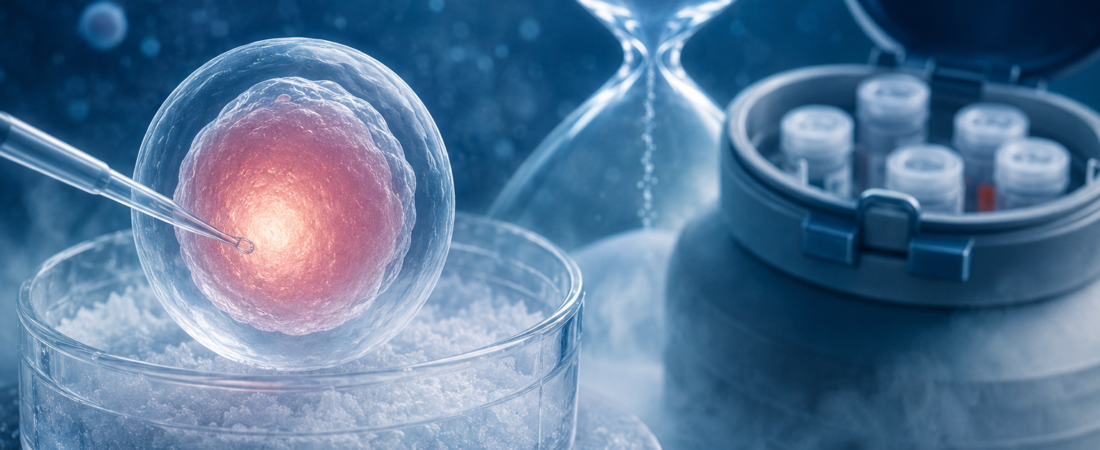
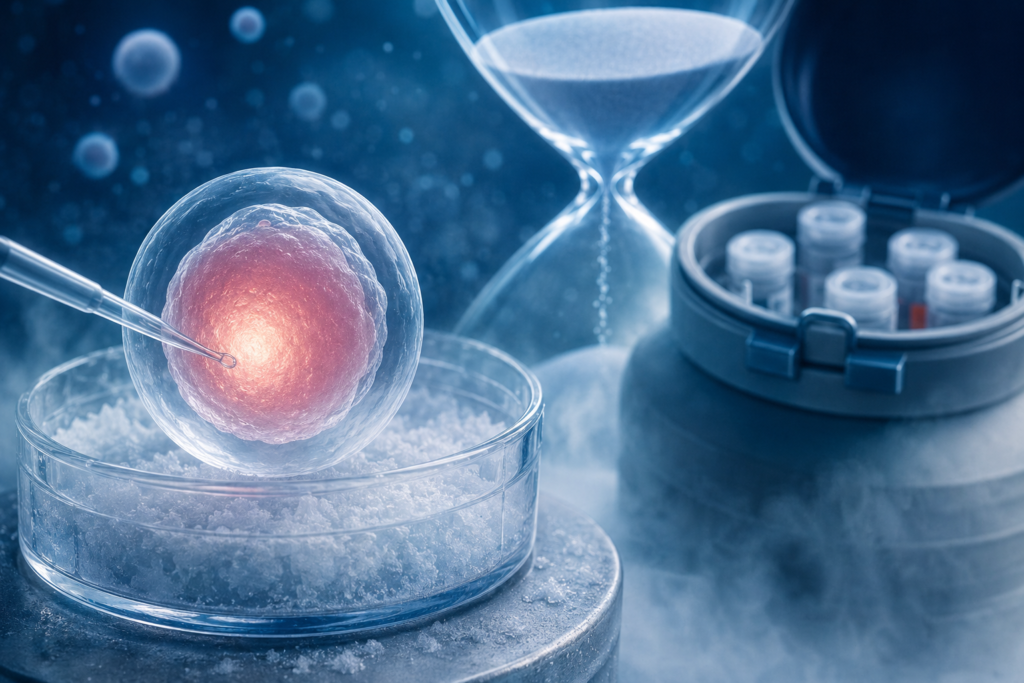
※ Image: Created using generative AI (ChatGPT, OpenAI); depicts fictional individuals, not real people.