
The Hidden Hindrance to Implantation: ‘Uterine Polyps’… Easily Solved with Hysteroscopy
When told there is a “growth” inside the body, anyone would feel nervous. However, small polyps found in the uterus are often an exception.
“It’s small, so you can just leave it alone.” “There are no symptoms, so you don’t need to worry.”
Many women hear these words from doctors and move on. Indeed, endometrial polyps are a common benign gynecological condition. Most are unrelated to cancer and cause almost no pain.
However, the reproductive medicine community is beginning to view these small polyps differently. A series of studies suggests they may be a more significant variable than previously thought for women planning for pregnancy.
Pregnancy begins when a fertilized egg moves to the uterus after ovulation and firmly plants itself into the endometrium. While many think pregnancy happens as long as there is a “good embryo,” the endometrium—which acts as the “bed” for the embryo—is equally important. It is the same principle as the difficulty of roots taking hold in uneven soil, no matter how healthy the seed.
An endometrial polyp is like a small bump rising on that bed. Recent studies suggest that even if it is only a few millimeters in size, it can take up space where the embryo should attach and create unfavorable conditions for implantation by altering endometrial blood flow, immune responses, and inflammatory environments. It is not merely a matter of physical space; the biological environment of the endometrium itself can be changed.
In fact, a comprehensive review in an international journal published this year confirmed a general trend of improved pregnancy success rates in women who had endometrial polyps removed. Researchers analyzed that the effect was relatively clear in intrauterine insemination (IUI), and studies are consistently accumulating to show potential improvements in clinical pregnancy rates and live birth rates in In Vitro Fertilization (IVF) as well.
Of course, not all studies show the same results. They noted that it is difficult to reach a uniform conclusion because the effect depends on the size, location, and number of polyps, as well as the patient’s age and the cause of infertility.
Recently, another question is being answered: How long should one wait to attempt pregnancy after removing a polyp? A study published this year showed that pregnancy outcomes did not decline even when frozen embryos were transferred relatively soon after polyp removal via hysteroscopy.
Conversely, other studies have reported higher ongoing pregnancy rates when the transfer was performed after about two months, allowing the endometrium to recover sufficiently. While there is no single “correct answer,” the recent trend is shifting from waiting for an arbitrary amount of time to deciding treatment schedules in a personalized manner after verifying the state of endometrial recovery.
So, should all polyps found in the uterus be removed for pregnancy?
The experts’ answer is “not necessarily.” Polyps that are very small (around 5mm) and asymptomatic sometimes disappear naturally.
On the other hand, removal is often recommended if they have grown to 1cm or larger, if multiple polyps are discovered, or if they are located in the upper part of the uterus where fertilized eggs primarily implant.
In particular, if you are preparing for IVF or have a history of repeated implantation failure, it is a general clinical principle to use a hysteroscope to accurately confirm the condition before deciding whether to treat.
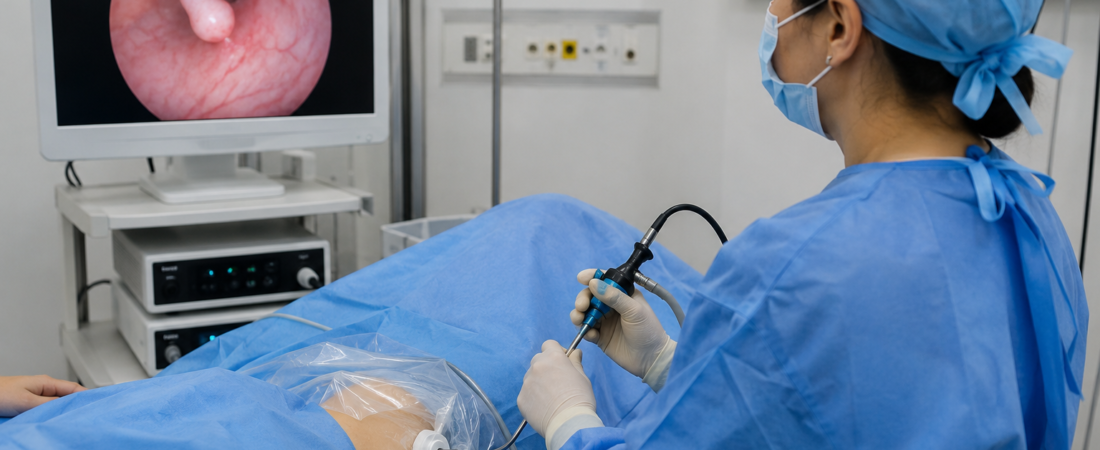
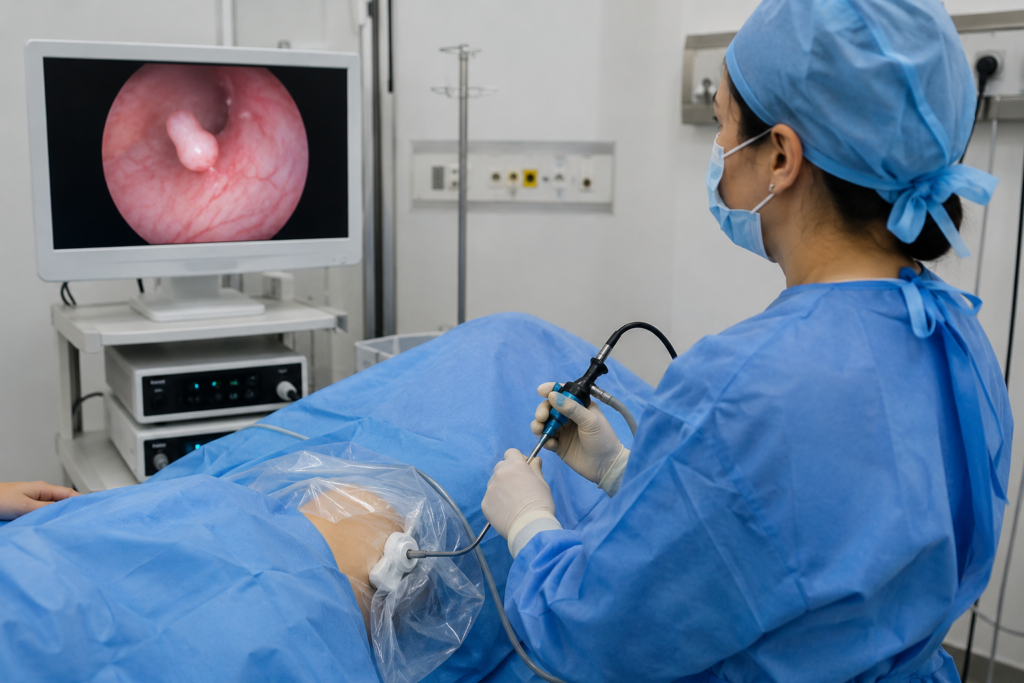
Fortunately, polyp removal is not as burdensome as it might seem. Most procedures are performed via hysteroscopy, where a thin endoscope is inserted into the uterus through the vagina to precisely remove only the polyp. Because it does not involve an incision, there are no scars, and bleeding and pain are relatively minimal.
The procedure time is typically short—about 10 to 20 minutes—and most patients can be discharged on the same day. While most removed tissues are confirmed as benign through biopsy, a major advantage is that it allows for the rare detection of other hidden lesions.
Recently, the importance of hysteroscopy is growing not just as a treatment, but as an accurate diagnostic tool. This is because lesions that appeared to be polyps on ultrasound are sometimes confirmed as submucosal fibroids or uterine adhesions during hysteroscopic examination.
Fertility specialists explain that if you are planning a pregnancy, directly confirming the internal environment of the uterus and minimally removing only necessary lesions is one of the most effective ways to improve the environment for implantation. Since it is common for polyps not to be visible on ultrasound, infertility specialists generally suggest considering a hysteroscopic exam and procedure after several failed IVF attempts.
Reproductive medicine is now expanding its focus from creating “good embryos” to creating a “uterine environment” where embryos can stay safely.
Endometrial thickness, blood flow, chronic endometritis, uterine fibroids, and endometrial polyps are all evaluated as factors determining implantation rates. With the recent series of research publications, the perception that “a small polyp is fine” is gradually changing.
Even without noticeable symptoms, small changes within the uterus can make a surprisingly big difference at the starting point of a new life. Pregnancy is ultimately the result of a good embryo and a healthy uterus working together. This is precisely why recent studies are paying close attention to endometrial polyps once again.
※ This article is based on recently published international reproductive medicine research, comprehensive reviews on endometrial polyps, and clinical evidence in the field of reproductive medicine. It does not replace specific individual diagnosis or treatment, and actual medical judgment must be made through consultation with a specialist.
※ The image is a visual aid created using generative AI (ChatGPT, OpenAI) and does not depict a real person.