
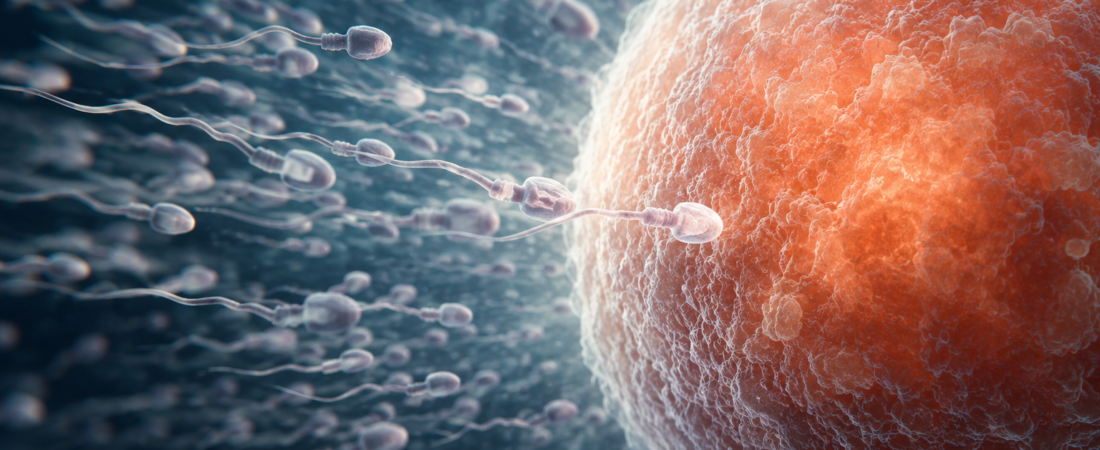
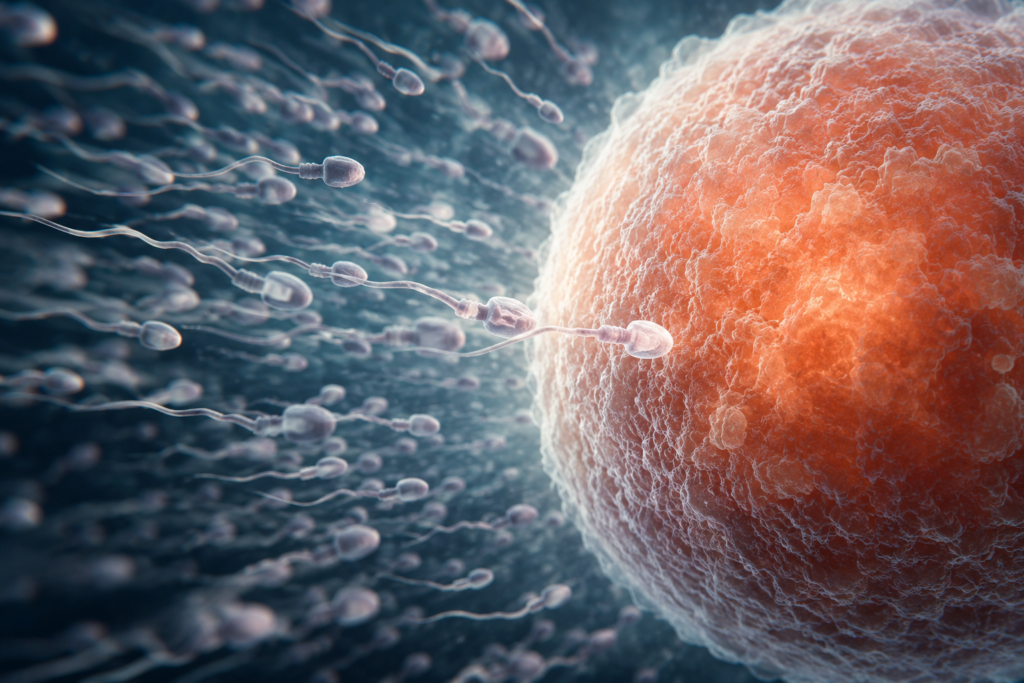
The Egg Attracts and Selects the Sperm
Many people understand fertilization as a competition among sperm. The common belief is that hundreds of millions of sperm race toward an egg, and the fastest and strongest one reaches it to succeed in fertilization. For a long time, biology textbooks have indeed explained it this way.
However, recent studies in reproductive biology are gradually shifting our perspective on fertilization. It is becoming clear that fertilization is not merely a competition of sperm, but a selection process by the egg.
In reality, sperm are not as good at finding their destination as one might think. While a single ejaculation contains tens to hundreds of millions of sperm, only a few hundred reach the ampulla of the fallopian tube.
Most die in the acidic environment of the vagina, are filtered out by cervical mucus, or are removed by the woman’s immune cells. By the time they reach the fallopian tube, a fierce selection process has already concluded.
What is interesting is that the egg is not simply waiting passively.
Immediately after ovulation, the egg, along with surrounding cumulus cells, secretes various chemicals. One of the representative substances is progesterone.
Recent studies show that this progesterone influences the direction of sperm movement, acting as a guide toward the egg. This is called chemotaxis. Just as bacteria move toward nutrients, sperm can also move by following specific chemical signals.
In other words, the egg is not just sitting still waiting for sperm; it is sending out signals to reveal its location. Some researchers describe this as an “invitation from the egg.”
The Reversal of Fertilization: The Egg Calls for Sperm
Recently, research results have suggested that follicular fluid itself can choose sperm. It has been observed that even sperm from the same male move more actively in the follicular fluid of certain females compared to others. While not all mechanisms are fully understood yet, the possibility is being raised that eggs may prefer sperm with a more compatible genetic combination.
Indeed, studies continue to be published suggesting that human immune genes, such as the HLA (MHC) family, may influence mate choice and the fertilization process.
Even in the moments just before fertilization, the selection continues.
When sperm approach the surface of the egg, the sperm’s IZUMO1 protein must bind with the egg’s JUNO receptor. If this process fails, the sperm cannot fuse with the egg. Simply put, there is a door on the surface of the egg, and the sperm must possess the correct “pass” to enter.
Even after the sperm enters the egg, the egg’s authority does not end.
The egg immediately triggers a cortical reaction. Granules inside the egg are released, changing the structure of the zona pellucida (the outer layer) and blocking other sperm from entering.
If this process fails, polyspermy occurs—where multiple sperm penetrate the egg simultaneously—and in most cases, the egg cannot develop into a normal embryo.
Ultimately, from the beginning to the end of fertilization, the egg plays a much more active role than previously anticipated.
Of course, fertilization is not achieved solely by the unilateral choice of the egg. The motility of healthy sperm, the function of the sperm membrane, and the acrosome reaction are also essential. However, recent studies show that it is difficult to explain fertilization as a simple story of “the sperm’s victory.”
The beginning of life is a process where competition and selection operate simultaneously.
Sperm compete. The female reproductive system selects. The egg sends chemical signals to attract sperm. And at the final moment, the egg accepts the sperm that enters it and shuts the door on the rest.
In conclusion, the story of fertilization we have known until now was only half-right. The fertilization described by modern reproductive medicine is less a process of sperm finding the egg, and more a process of the egg and sperm finding each other.