
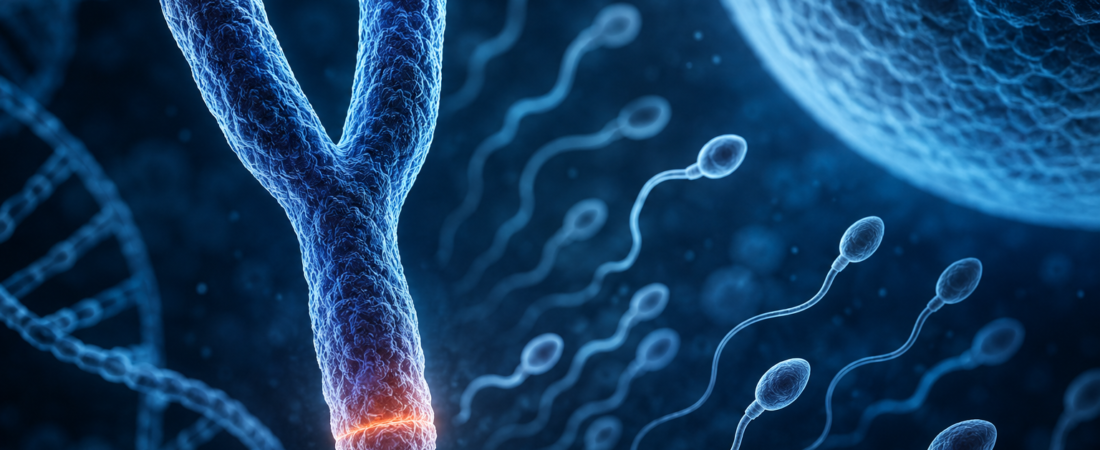
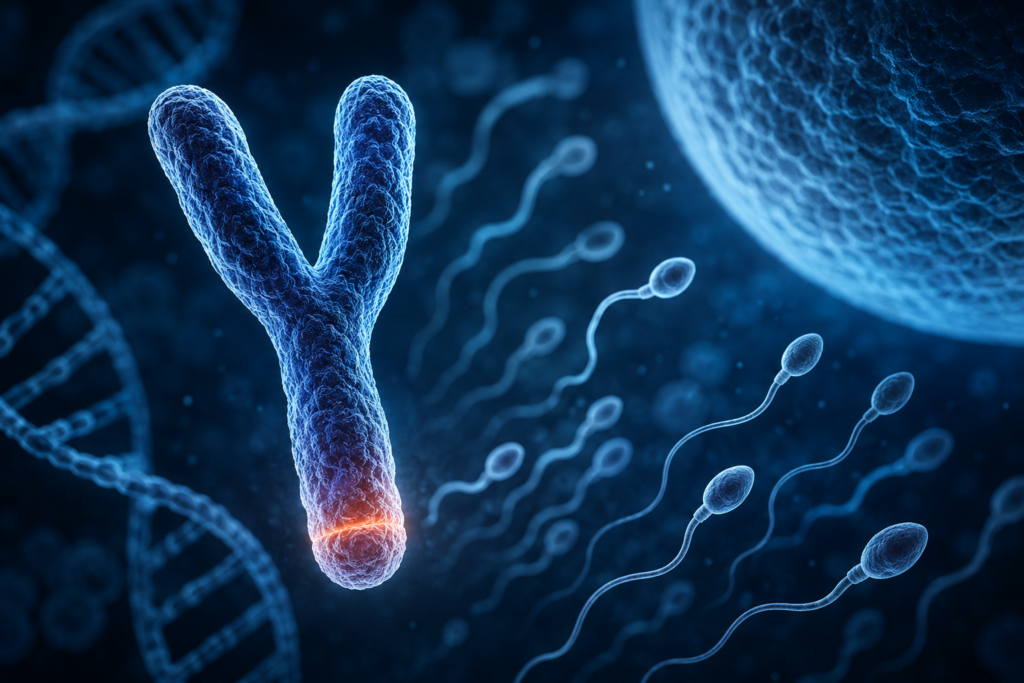
Must-Check Conditions for Oligozoospermia and Azoospermia
Human history is, in essence, the history of genes. Countless pieces of information passed from father to son, and then to grandson, are recorded within tiny chromosomes to be transmitted to the next generation. What happens if part of this record disappears?
The Y-chromosome microdeletion, often encountered while covering male infertility, is a story that begins with exactly that question.
Many people are quite surprised when they first hear the diagnosis because of the term “chromosome deletion.” However, in reality, it is a very small genetic deletion that is invisible and completely imperceptible in daily life.
Yet, because that small deletion can affect a man’s sperm production capacity and, in some cases, be passed down to the next generation, it is far from a minor issue.
Humans are born with 46 chromosomes. The ones that determine gender are the X and Y chromosomes. Women have XX, and men have XY. The Y chromosome, in particular, is closely related to male reproductive function because various genes necessary for sperm production are concentrated within this small chromosome.
An interesting fact is that the Y chromosome has a more unstable structure than one might think. Most chromosomes exist in pairs, allowing them to exchange genetic information with each other and having the opportunity to correct errors. However, the Y chromosome effectively exists alone. Furthermore, similar gene sequences are repeatedly copied inside it—much like a book where the same sentence is repeated dozens of times.
The problem is that this structure is vulnerable to copying errors.
During cell division, if repeated sentences align incorrectly with one another, an event can occur where several pages in the middle of the book disappear entirely. Geneticists call this “non-allelic homologous recombination.” A significant portion of Y-chromosome microdeletions occurs during this exact process.
In particular, there is a region within the Y chromosome called AZF (Azoospermia Factor). As the name implies, it is a zone where the genes necessary for making sperm are gathered. This region is divided into three parts: AZFa, AZFb, and AZFc.
If AZFa is deleted here, there are often almost no cells capable of producing sperm. AZFb deletion frequently causes the sperm production process to halt at an intermediate stage.
AZFc deletion is relatively diverse. While it can manifest as azoospermia (total absence of sperm), in some cases, a small number of sperm are still produced. Consequently, there are reports of successful pregnancies using micro-TESE (micro-surgical sperm extraction) to locate sperm, followed by IVF and ICSI (intracytoplasmic sperm injection).
What causes Y-chromosome microdeletion? Many men, upon receiving the diagnosis, try to find the cause within themselves. “Did I drink too much alcohol?” “Was it because of too much stress?” “Is it because I didn’t exercise?”
Y-chromosome microdeletion is generally known not to be caused by individual lifestyle habits, but rather as a structural change that happens by chance during the DNA replication process. It is no one’s fault.
In fact, Y-chromosome microdeletions are found in approximately 5–15% of patients with non-obstructive azoospermia and about 3–7% of patients with severe oligozoospermia. This is why it is considered one of the most significant genetic causes of male infertility. It is usually discovered when a married couple faces infertility and both undergo testing.
So, what happens if a man with a Y-chromosome microdeletion has a son through IVF?
The conclusion is that it is passed down (inherited). The Y chromosome is transmitted from father to son. Therefore, the deletion is also highly likely to be transmitted. Indeed, reports have long existed of sons born to men with Y-chromosome microdeletions inheriting the exact same deletion.
For this reason, in genetics, the Y-chromosome microdeletion test is viewed not merely as an infertility test, but as the starting point for genetic counseling. This is because one must explain not only the current possibility of pregnancy but also the potential impact on future generations.