
Infertility Specialist Dr. Cho Jung-hyun Fighting Against Endometriosis
Dr. Cho Jung-hyun
- Performed 40,000 IVF procedures
- Current Vice President of the Korean Association of Obstetricians and Gynecologists (KAOG), Director of Sarang-i Women’s Clinic
- Graduate of Yonsei University College of Medicine, former Professor at Gangnam Cha Hospital, former Director of MizMedi Gangnam
- “Alcohol Sclerotherapy is the Answer to Endometriosis Treatment for Pregnancy”
40% of Infertility Causes are Endometriosis Ovarian Resection is Like Castrating a Woman’s Happiness Experience of IVF Doctors and Embryologists is Crucial
Doctors always agonize before making prescriptions or surgical decisions for their patients. They wonder, “Which choice is beneficial and brings happiness to the patient?” For desperate couples who earnestly desire conception, a second-best option can often be a far more hopeful choice than the “best” one.
Dr. Cho Jung-hyun, a 40-year veteran infertility specialist and Director of Sarang-i Women’s Clinic, says, “It is no exaggeration to say that I have been battling endometriosis for over 30 years while dedicated to fertility treatment.” This is because nearly 40% of the causes of infertility are attributed to endometriosis.
In women, as ovulation occurs every month, the endometrium thickens due to female hormones (E2), and if pregnancy does not occur, the lining is shed with blood (menstrual blood) and expelled from the body. Endometriosis is a disease where this endometrial tissue, which should be expelled, implants outside the uterus (ovaries, abdominal cavity, pelvic cavity, etc.), causing inflammation in surrounding tissues, lower abdominal pain, menstrual cramps, and infertility. These ectopic endometrial tissues interfere with the reproductive framework by joining the brain-ovary-uterus reproductive hormone axis.
Endometriosis has a higher incidence rate in women who frequently consume greasy foods and meat. Dr. Cho stated, “Endometriosis was a very rare disease during the ‘barley hump’ era (times of food scarcity). Today, with the increase in consumption of greasy foods and meat, the number of patients is increasing by 10% on average per year.”
40% IVF Success Rate After Alcohol Sclerotherapy If endometriosis is severe, it is standard practice to remove cysts (endometriomas) in the ovaries or adhesions around the pelvis through laparoscopic surgery. However, this can significantly decrease fertility and lead to infertility.
Dr. Cho emphasized, “I am worried because the number of cases where some obstetricians remove parts of the ovaries through laparoscopic surgery in hopes of a complete cure is increasing,” adding, “Whether one is single, unmarried, or even a woman who has already given birth, touching the ovaries is like cutting away a woman’s happiness.” He believes that as a doctor, his mission is to preserve the ovaries of women of reproductive age as much as possible.
“Endometriosis is the primary culprit behind various pains such as pelvic pain, degradation of sexual quality, and pregnancy disruption (infertility). However, if you want to become pregnant, it is better to prioritize the preservation of fertility by choosing non-invasive techniques that do not require ‘going under the knife’ rather than aiming for a complete cure.”
Non-surgical treatments include using hormone analogs or contraceptive pills to reduce or eliminate menstrual volume. However, while this reduces the intensity of menstrual cramps, it makes natural pregnancy difficult to expect.
Dr. Cho has been performing alcohol sclerotherapy, a non-surgical treatment for endometriosis, for 20 years. Recently, his total number of procedures surpassed 1,300 cases. He has boosted the pregnancy success rate to 40% in In Vitro Fertilization (IVF) procedures performed after sclerotherapy. We asked him about endometriosis and the treatment method.
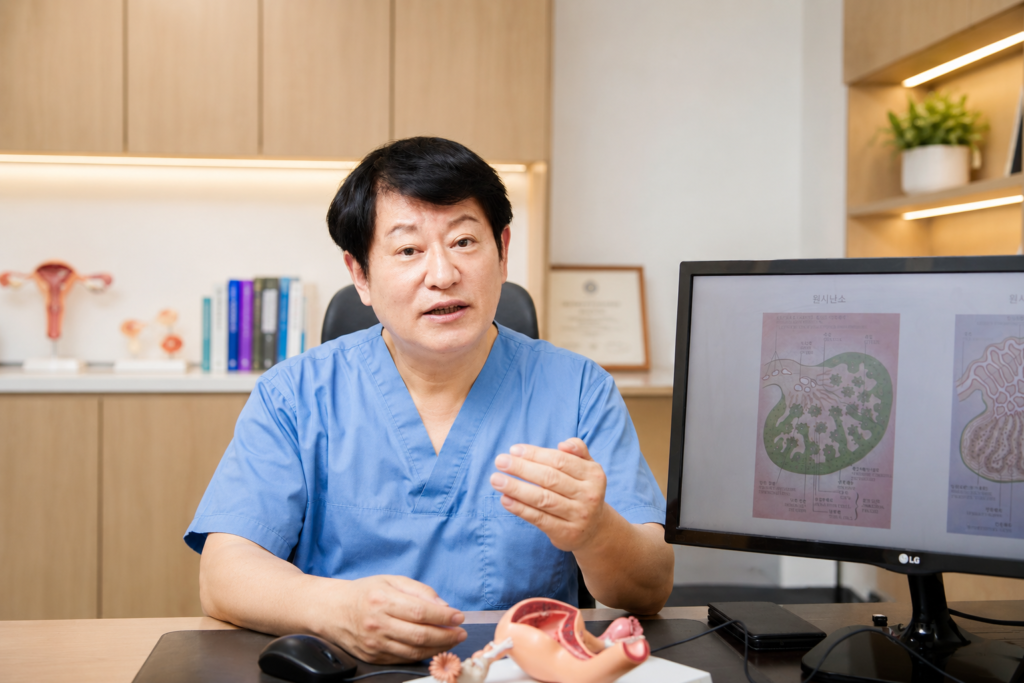
How can the endometrium, which should be inside the uterus, be outside (elsewhere in the abdominal cavity)?
“During menstruation, endometrial tissue and body fluids can reflux into the pelvic cavity through the fallopian tubes. Every woman experiences slight reflux during menstruation. Endometrial tissue and stem cells within the lining can reflux through the blood and attach to the inside of the abdominal cavity like barnacles on a rock, causing inflammation. In a healthy abdominal environment, the refluxed menstrual blood is cleaned up by macrophages, but if it attaches to a vulnerable area, it causes endometriosis.”
How does the inflammation caused by endometriosis affect reproductive function?
“In conclusion, it has a negative impact. In particular, endometriosis occurring in the ovaries, called endometrioma, interferes with follicle maturation and fertilization, and can also damage the DNA and nutritional substances of sperm. It also hinders embryo implantation and disrupts the movement of sperm that have entered the female reproductive tract to meet the egg.”
Can an endometrioma even hinder implantation?
“The reaction of the endometrium to progesterone, commonly known as the ‘implantation hormone,’ becomes distorted. Progesterone is a luteal hormone secreted by the ovaries; it is the hormone that changes the uterine wall to suit pregnancy conditions and also leads the process from pregnancy to childbirth. Progesterone secretion decreases, and the inflammatory action of endometriosis reduces receptivity for implantation. Even if implantation occurs, it can interfere with the decidualization of the endometrium (successful bonding between mother and fetus). Besides this, various other disruptive actions occur in the endometrium.”
Endometriosis Even Degrades Sperm Quality It is surprising that endometriosis even degrades sperm quality.
“Various substances secreted by macrophages in the abdominal cavity interfere with sperm motility, degrading sperm quality. This is why pregnancy rates drop in natural conception and artificial insemination when endometriosis is present in the abdominal cavity.”
If there is endometriosis in the abdominal cavity, does it cause problems with fertility?
“It can change the function of the ovaries. Endometriosis in the abdominal cavity can cause inflammation, twisting reproductive or fertility functions. As various inflammatory cells and cytokines are involved here, if the function of NK cells is weakened and autoimmune reactions increase, fertility decreases. Furthermore, components of the endometrioma cyst fluid can seep into major tissues, reducing the follicle count and causing fibrosis, which can lead to structural abnormalities.”
You are famous for recommending alcohol sclerotherapy to patients as a treatment for endometrioma. You have performed 1,300 cases over the last 10 years.
“The ovary is a storehouse for eggs. I can confidently say that there is no procedure as effective as alcohol sclerotherapy for preserving the ovaries and recovering follicle function. Alcohol sclerotherapy is a method where a needle for egg retrieval is inserted through the vaginal canal into the endometrioma in the ovary to aspirate the concentrated contents, which are similar to menstrual blood. Because it is difficult to extract these contents, small amounts of saline are injected, diluted, and aspirated. When it is judged that all contents inside the endometrioma have been aspirated, medical-grade alcohol is injected to about 85–90% of the total volume of the contents, left for 10 minutes, and then aspirated again. This scleroses the secretory cells inside the endometrioma.”
Could alcohol flow into the abdominal cavity during the procedure?
“If alcohol enters the abdominal cavity, adhesions can occur in the organs or tissues where it was introduced. If alcohol flows into the abdominal cavity, it can be painful enough for the patient to toss and turn even under anesthesia. Even so, one can gauge the amount of alcohol that flowed into the abdominal cavity, inject a needle to remove it immediately, and then quickly wash it with saline. However, it must be done at a very fast speed.”
Ovaries and Follicles Must Be Preserved as Much as Possible
I heard that ovarian bleeding and pelvic abdominal pain can occur with alcohol sclerotherapy.
“Ovarian bleeding also occurs during egg retrieval. Compared to egg retrieval, which involves piercing the ovary several times with a needle, alcohol sclerotherapy only requires piercing twice (once for aspirating contents, once for injecting alcohol), so the frequency of ovarian bleeding is relatively lower. Women who had severe pelvic pain or menstrual cramps might complain of minor abdominal pain or discomfort after alcohol sclerotherapy, but compared to the pain they experienced before the sclerotherapy, it is like night and day.”
What is the biggest advantage of alcohol sclerotherapy?
“It is a non-hospitalization, non-surgical (non-laparotomy) therapy. Also, it can preserve the ovaries and follicles as much as possible. When performing an AMH (Anti-Müllerian Hormone) test, which indicates the number of follicles in the ovaries, there is almost no change in the number of follicles before and after sclerotherapy.”
What is the ultimate goal of alcohol sclerotherapy?
“The ultimate goal is to succeed in pregnancy and give birth. Also, it is to lead a comfortable life free from various symptoms. Women who frequently visited the emergency room due to pelvic pain or menstrual cramps say their quality of life has improved after receiving alcohol sclerotherapy.”
Are you against surgery to remove endometriomas through laparoscopy?
“That is correct. Even if a woman has finished giving birth, if she has an endometrioma, I would like to recommend alcohol sclerotherapy. Even if the size is over 7cm, it can be made small with 2–3 rounds of alcohol sclerotherapy, and you can observe it while watching the symptoms. The surgical method is decided by synthesizing CT, MRI, precision ultrasound, and ovarian cancer tests. There is no need to decide on laparoscopic surgery simply because the size of the cyst is large.”
Can’t endometriomas be removed through robot-assisted surgery? I heard that after aspirating the material inside the tumor through instruments, they cut the ovary to access it.
“Whether it is robot-assisted, laparotomy, or laparoscopy, if you touch the ovaries, the primordial follicles on the surface of the ovaries are tremendously damaged. No surgical method can prevent the loss of eggs. In the end, I believe that non-surgical alcohol sclerotherapy is the answer and the best option.”
Is there a special reason you are confident that alcohol sclerotherapy is the only way to protect the ovaries?
“At least it can protect the follicles. When performing an ovarian function test (AMH) after alcohol sclerotherapy, it is similar to before the procedure. Also, it does not cause changes in the anatomical structure within the pelvis. Especially for women in their 40s or older, or women whose ovarian function has started to decline, I am confident that there is no better choice for treating endometriosis than alcohol sclerotherapy.”
Recently, the number of infertility-specialized medical institutions has increased. If you were to give advice on the criteria for choosing an infertility hospital, what would it be?
“The experience of the doctor and the embryologist. In the case of surgeries for diseases in other departments, large hospitals like university hospitals, Samsung Medical Center, or Asan Medical Center might be considered more professional, but in IVF procedures, the experience of the attending physician and the embryologist is more important than the size of the hospital. An infertility specialist must, above all, know how to perform an ultrasound themselves. And to hang up the title of ‘infertility specialist,’ one should have obtained an obstetrics and gynecology specialist certification and experienced 6,000–7,000 IVF procedures (50 cases per month). If you say it takes about 10 years to reach that point, a male doctor would be in his mid-40s and a female doctor would be over her early 40s. To succeed in IVF, you must meet an attending physician you can trust, rely on, and communicate well with to create a synergy effect.”
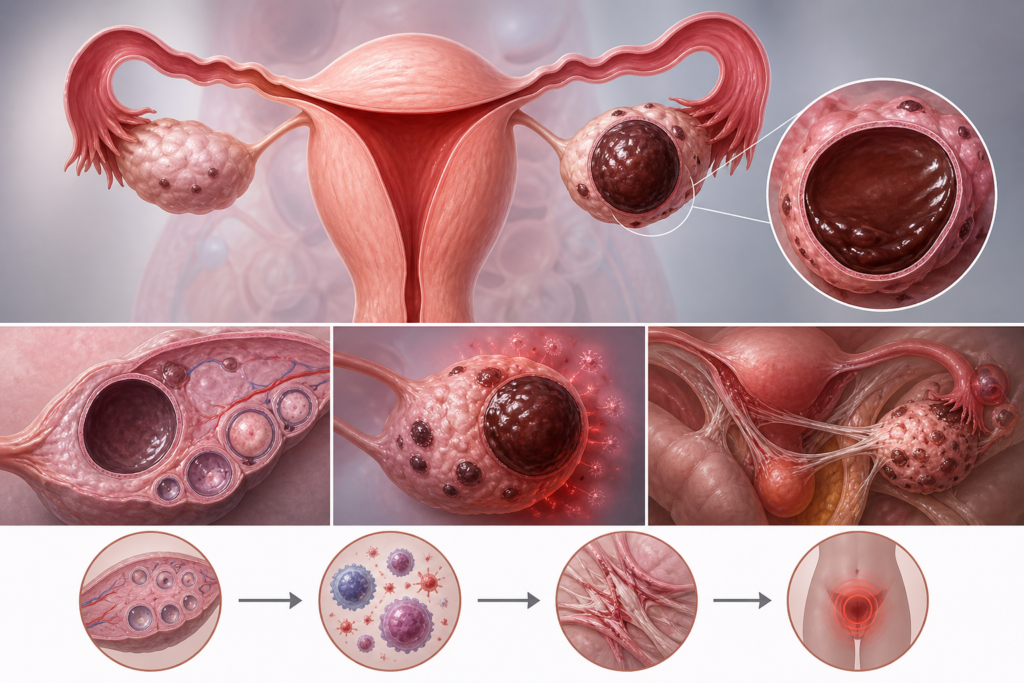
Anatomical illustration in the style of a medical textbook explaining endometriosis, particularly ovarian endometrioma (chocolate cyst). AI-generated (ChatGPT, OpenAI) / Reference visual aid for better understanding.