

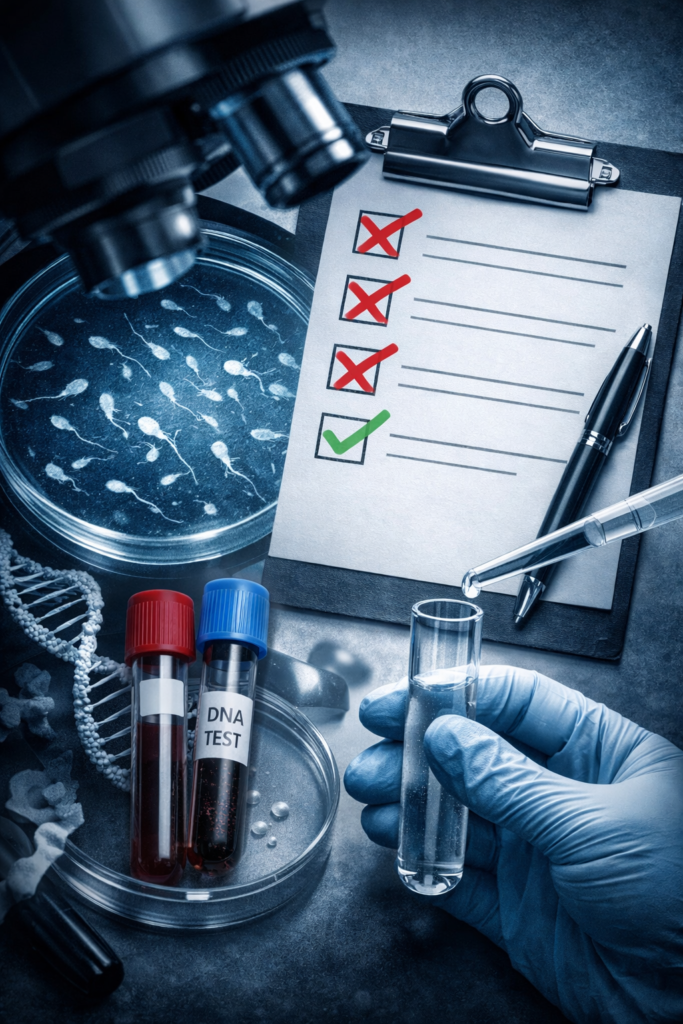
The process of donating sperm is often envisioned as a simple biological contribution. The reality, however, is a grueling journey of selection. Across many international fertility centers, the attrition rate is staggering: out of every 100 men who step forward to donate, only 30 to 40 emerge six months later with a “fit for donation” status.
Why is the failure rate so high? The answer lies in the fact that we are no longer just screening for “sperm”—we are screening for a specific standard of genetic, physical, and psychological “optimal health.”
The Multi-Layered Gatekeeping The screening process functions like a series of increasingly narrow filters:
- The Semen Analysis: The first hurdle—sperm count, motility, and morphology. If the sperm does not meet strict functional benchmarks, the process ends immediately.
- The Infectious Disease Screen: HIV, Hepatitis B and C, Syphilis, and STIs. In this gate, even a historical record of infection can be a permanent disqualifier.
- Systemic Health Screening: A comprehensive look at the body’s internal metrics: liver function, kidney health, blood glucose, and hematology.
- The Genetic & Family Audit: This goes beyond the individual to the lineage. Family history, karyotyping, and genetic testing ensure that the donor is not a carrier of significant hereditary conditions.
- The Lifestyle & Psychological Filter: Beyond biology, donors are evaluated on lifestyle—obesity, smoking, drug use—and even internal psychological stability, such as histories of clinical depression or suicidal ideation.
From ‘Average’ to ‘Optimal’ In a standard medical checkup, “average” or “within normal limits” is a pass. In the world of sperm banking, the bar is set much higher. The system is designed to identify the “optimal.” Even a donor who is considered “healthy” by everyday standards may be disqualified because sperm banks operate under the premise that the genetic material provided will be used to build a life, not just for a one-time procedure.
The Uncomfortable Truth The low pass rates—sometimes as low as 10% to 20% in certain regions—reveal an uncomfortable reality: the modern male is struggling to meet these stringent requirements. Environmental stressors, sedentary lifestyles, and the cumulative impact of sub-optimal diet and habits have made the “optimal” man a rarity.
The Necessity of the Infrastructure Critics often argue that these criteria are unnecessarily high. Yet, for couples facing non-obstructive azoospermia or severe genetic risks, the sperm bank is the only viable path to parenthood. Despite the controversies and the high costs involved, the sperm bank remains an essential, if clinically uncomfortable, medical infrastructure.
Conclusion: A Mirror for Male Health The rigors of sperm donation serve as a mirror for contemporary male health. When 70% of potential donors are excluded, it isn’t just a failure of the donors; it is a signal of the broader systemic health issues affecting men today.
Being a sperm donor today is not just about donating a cell; it is about proving one’s biological and psychological fitness to a standard that few can achieve. As we continue to refine these criteria, we must also ask what we are doing to support men in achieving that level of health before they ever walk into a clinic.
Sources: International guidelines for sperm bank screening; clinical protocols for donor selection; WHO and ASRM donor criteria guidelines.
Disclaimer: This report is for informational purposes. Donation criteria are rigorous for the protection of the offspring and the recipient. The high rejection rate reflects the ethical and medical obligation of sperm banks to prioritize genetic and systemic safety.