
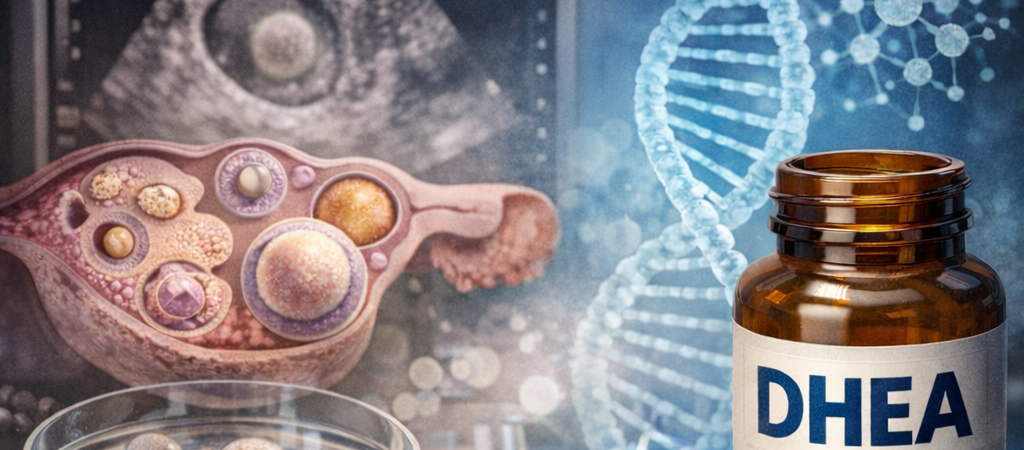
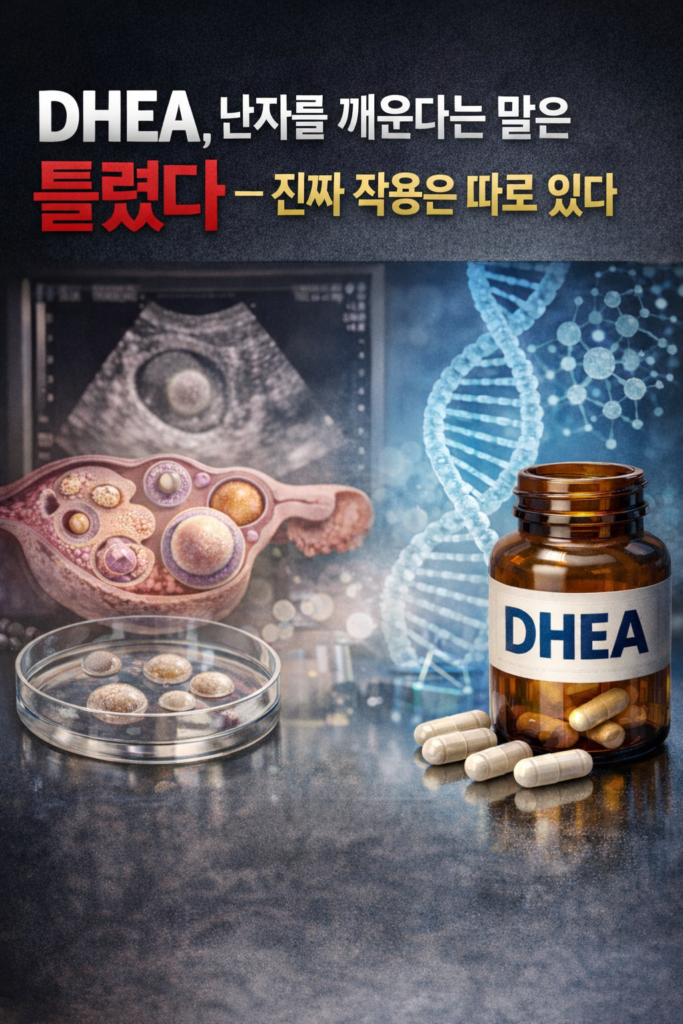
“I heard that taking this supplement can actively revitalize and awaken my eggs.”
Women navigating the realities of diminished ovarian reserve (DOR) are profoundly driven by urgency. They cling to the hope that integrating DHEA into their regimen might yield even one additional follicle during their next cycle. To establish the clinical reality straightforwardly: DHEA is not a therapeutic agent engineered to awaken dormant oocytes.
DHEA, or dehydroepiandrosterone, is a weak androgenic precursor synthesized natively within the adrenal glands and ovaries. Once inside the body, it is biochemically converted into testosterone and estrogen, directly influencing the ovarian microenvironment—specifically optimizing the responsiveness of granulosa cells.
Consequently, it is frequently deployed within poor ovarian responders (POR) or DOR cohorts under the clinical expectation that it can enhance overall follicular sensitivity. However, it is precisely at this juncture that the scientific meaning becomes distorted. This subtle “shift in cell responsiveness” is, at some point, unscientifically translated into the phrase “awakening the ovaries.”
The human ovary does not operate via a mechanical switch. A woman’s total oocyte pool is permanently determined at birth; from that moment onward, the supply undergoes a continuous baseline depletion, with zero mathematical possibility of regeneration. DHEA lacks the biological capacity to intervene within this primordial pool. It cannot manufacture non-existent oocytes, nor can it summon entirely new dormant follicles. What, then, is actually being altered under its administration?
The definitive variable is never the raw number, but rather the process of biological selection. Under the influence of systemic FSH stimulation, a highly competitive micro-environment dictates which follicles successfully respond and which undergo atretic dropout. DHEA subtly alters the trajectory of these intracellular signals. In essence, it acts merely as a localized environmental coordinator that gently nudges a subset of pre-existing follicles toward a responsive pathway.
Nevertheless, measurable physiological shifts have been documented across specific literature. Within poor ovarian responder cohorts, data has reported a minor increase in the total number of retrieved oocytes, a slight upward trend in overall embryo yield, and a potential elevation in clinical pregnancy rates.
Ultimately, however, the direct efficacy of DHEA for patients with diminished ovarian reserve remains strictly limited. The net increase in retrieved oocytes averages roughly one additional egg per cycle, the long-term data remains highly inconsistent across replication studies, and clinical trials confirm zero distinct benefit for women possessing normal, age-matched ovarian reserve. This is not a miracle drug engineered to flip the entire reproductive landscape; it is a supplementary card that operates exclusively when specific biological conditions are met.
In reality, the perceived subjective efficacy of this supplement is frequently exaggerated by consumer experiences. The underlying explanation for this is remarkably simple: ovarian response inherently fluctuates from one menstrual cycle to the next. A patient may yield two oocytes in a given month and four in the next entirely on a natural baseline. When DHEA administration overlaps with this native biological volatility, the sudden upward variance is automatically misattributed to the supplement.
When you concurrently alter the primary stimulation protocol, the gonadotropin dosage, and the precise trigger timing, isolating the true causal variable becomes highly distorted. Consequently, personal anecdotes grow emotionally powerful while empirical evidence blurs.
Even within active clinical practice, professional opinions remain starkly divided. One faction of reproductive endocrinologists asserts that they witness clear, responsive successes in specific cases, while an alternative faction maintains that the intervention yields zero statistical significance for the vast majority of patients. Neither conclusion is inherently incorrect. This divergence exists because DHEA functions less as a standardized medical solution and far more as a volatile biological variable.
The definitive conclusion is remarkably simple, yet uncompromisingly uncomfortable: DHEA does not awaken dormant oocytes. Instead, it merely alters the mathematical probability that a fraction of your remaining follicles will respond to stimulation. While that statistical margin appears minor, for a specific subset of patients, that single additional oocyte is the exact variable that reconfigures the final outcome of their cycle. Therefore, this compound should neither be categorized as a clinical contraindication nor overhyped as a universal panacea.
The core problem resides entirely within how the technology is communicated. Asserting that a supplement “awakens the ovaries” builds an artificial, fragile hope; clarifying that it “subtly modulates response probabilities” empowers an informed strategic choice. Evidence-based medicine must strictly align with the latter framework.
Ultimately, the clinical focus must be fundamentally reframed. The question is no longer whether this supplement is universally beneficial, but rather: Does this specific patient possess the biological profile where DHEA can help secure that one, profoundly meaningful oocyte? Only when a clinical team can accurately answer that question does DHEA truly transition into a calibrated strategy.
📚 Medical References
- Human Reproduction
- Significance: Longitudinal clinical trials exploring the outcomes of targeted DHEA supplementation in patients presenting with severely diminished ovarian reserve (DOR).
- Fertility and Sterility
- Significance: Robust meta-analyses evaluating global clinical data regarding the true efficacy, limitations, and statistical oocyte yield variance of DHEA therapy within poor responder cohorts.
- Reproductive Biology and Endocrinology
- Significance: Comprehensive peer-reviewed biochemical reviews mapping out the precise molecular pathways of DHEA within the ovarian microenvironment and its specific androgenic interaction mechanisms with granulosa cells.
Editor’s Note: This content is an analytical commentary prepared by a specialized fertility journalist through the collection and evaluation of domestic and international reproductive medicine research, clinical policies, and statistical data. All medical diagnoses and treatment decisions must exclusively be established through direct consultation with a qualified medical professional.
Image Source: AI-generated (ChatGPT, OpenAI) / Provided solely as a supplemental visual aid for conceptual understanding.