
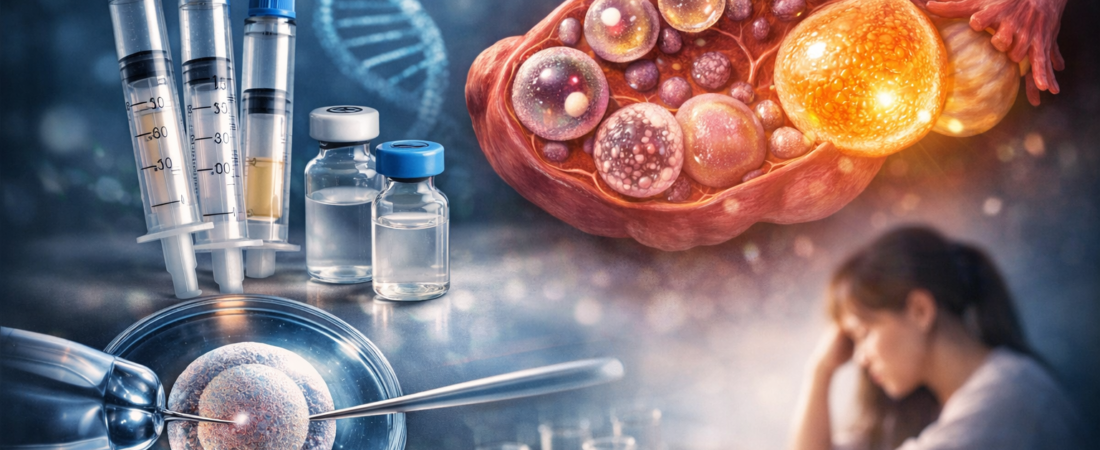
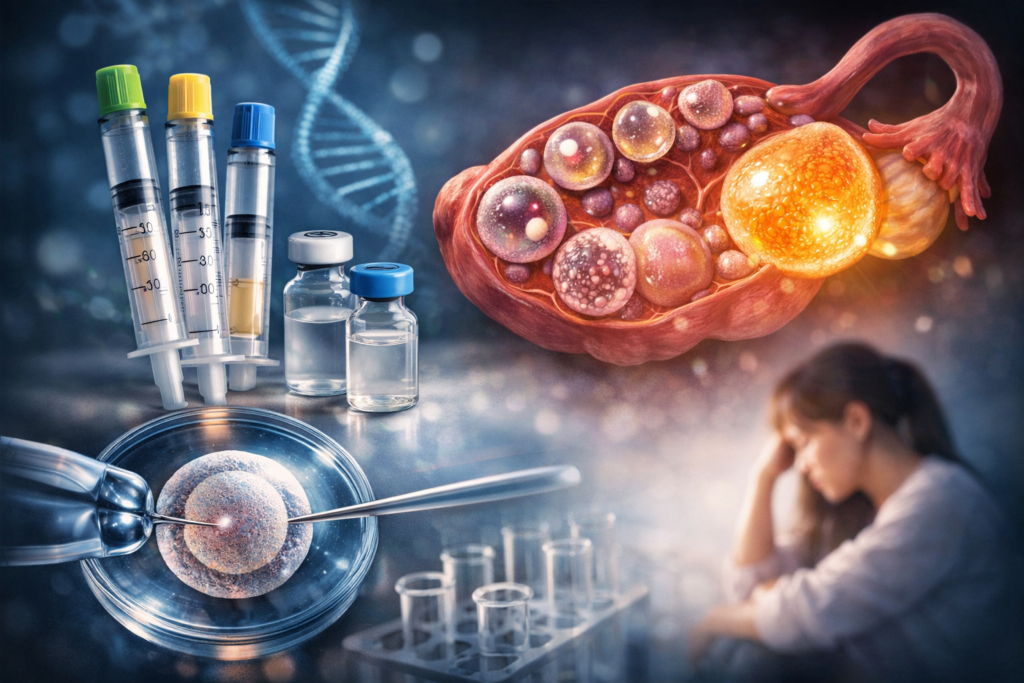
“Is it truly safe for me to take these injections?”
This is a question that countless women ask immediately prior to initiating ovarian stimulation. This inquiry does not stem from mere curiosity; it is a primal, instinctive caution against artificially altering the body’s natural physiological rhythms.
To resolve this anxiety, we must precisely comprehend the true biological nature of these medications.
The foundational active ingredient in injections engineered to induce controlled ovarian hyperstimulation (COH) is FSH, or Follicle-Stimulating Hormone. Major clinical brands such as Gonal-F, Puregon, Gonadopin, and Follitrope are all formulated upon this essential FSH backbone.
In a natural, unmedicated cycle, the body continuously secretes native FSH to awaken a cohort of immature oocytes resting within the ovaries, though the physiological system ultimately selects only one solitary dominant follicle for ovulation. Ovarian stimulation injections bypass this natural restriction by temporarily elevating systemic FSH concentrations, systematically expanding the selection window so that multiple follicles can grow and mature simultaneously.
In specific clinical protocols, an additional component is introduced. A highly prominent example frequently prescribed in fertility centers is Pergoveris. This injection combines standard FSH with LH, or Luteinizing Hormone. While FSH governs the initial “growth and recruitment” of the follicles, LH is responsible for the final “maturation and completion” phase of the oocyte.
While pure FSH is entirely sufficient to drive follicular growth in a large subset of patients, specific sub-populations require the synergistic addition of LH to achieve stable, high-quality oocyte maturation. Pergoveris is structurally designed to supply both essential reproductive hormones concurrently.
Where exactly are these hyper-stimulating hormones manufactured?
In the early eras of reproductive medicine, clinicians relied heavily on highly purified extracts derived from the urine of postmenopausal women. Today, however, the global market has transitioned almost exclusively to advanced recombinant DNA technology (유전자재조합기술). These modern compounds are synthesized within controlled laboratory environments to possess a molecular architecture that is virtually identical to native human FSH. Because they contain negligible impurities, maintain highly consistent concentrations, and yield highly predictable clinical responses, modern stimulation protocols have become exponentially more precise than legacy therapies.
At this juncture, patients invariably ask: “Does this mean the treatment is absolutely risk-free?” The clinical answer defies simple categorization.
These injections do not introduce a foreign, synthetic chemical into the human body; rather, they deliver highly purified, concentrated forms of hormones that are already natively present within the female endocrine system. Consequently, the risk of long-term systemic toxicity or dangerous drug accumulation is clinically negligible. Decades of cumulative global epidemiological data have failed to establish any consistent, statistically significant link between controlled ovarian stimulation and an increased risk of severe, long-term adverse pathologies.
However, individual physiological responsiveness varies profoundly. It is critical to differentiate between systemic side effects and transient physiological symptoms. Symptoms such as headaches, abdominal bloating, and localized ovarian tenderness can comfortably manifest. In cases where the ovaries are profoundly hyper-responsive, this can escalate into Ovarian Hyperstimulation Syndrome (OHSS, 난소과자극증후군). Utilizing the exact same medication dosage, one patient may navigate the cycle with absolute ease, while another experiences a severe physiological disruption. This divergence is dictated not by the inherent toxicity of the medication, but by the unique, baseline sensitivity of the patient’s own body.
From a clinical standpoint, recombinant FSH preparations like Gonal-F or Puregon exhibit exceptionally high purity profiles with minimal protein impurities. Consequently, certain patient cohorts report a lower baseline incidence of transient symptoms, such as injection-related headaches. However, because individual biological variation is immense, this cannot be treated as an absolute mathematical rule.
The overriding variable is never the commercial brand name of the medication; it is the highly unique, case-by-case manner in which your specific endocrine system interacts with that hormone.
Ultimately, ovarian stimulation injections should neither be feared as an inherently dangerous hazard nor blindly oversimplified as universally harmless. They represent a highly potent clinical tool. And the definitive outcome of any tool depends entirely upon the precision with which it is wielded.
Therefore, the patient’s core question must be reframed. Instead of asking, “Is this injection safe?”, the true diagnostic focus must be: “Is this stimulation protocol being meticulously tailored and engineered to match my body’s exact physiological baseline?” When this clinical architecture is calculated with absolute precision, the stimulation process ceases to be a source of medical fear and becomes a powerful gateway to reproductive opportunity.
📚 Medical References
- European Society of Human Reproduction and Embryology (ESHRE)
- Guidelines on ovarian stimulation.
- Significance: The definitive global clinical framework mapping out validated stimulation protocols, dosage calculations, and extensive safety profiles for rFSH and rLH therapies.
- American Society for Reproductive Medicine (ASRM) Practice Committee
- ASRM Practice Committee Reports and Guidelines on OHSS.
- Significance: Establishes the standard diagnostic criteria and preventative clinical strategies required to minimize the incidence and severity of Ovarian Hyperstimulation Syndrome.
- Human Reproduction & Fertility and Sterility
- Selected Clinical Cohort Studies on Recombinant Monotherapy vs. Combination Therapy.
- Significance: Peer-reviewed clinical trials demonstrating the comparative efficacy, oocyte yield rates, and patient symptom frequencies when utilizing pure recombinant FSH versus combined rFSH/rLH protocols.
- World Health Organization (WHO)
- Foundational data on human reproduction and endocrine standards.
- Significance: Establishes the international biological reference baselines for human gonadotropins and baseline reproductive physiology.
Editor’s Note: This content is an analytical commentary prepared by a specialized fertility journalist through the collection and evaluation of domestic and international reproductive medicine research, clinical policies, and statistical data. All medical diagnoses and treatment decisions must exclusively be established through direct consultation with a qualified medical professional.
Image Source: AI-generated (ChatGPT, OpenAI) / Provided solely as a supplemental visual aid for conceptual understanding.