
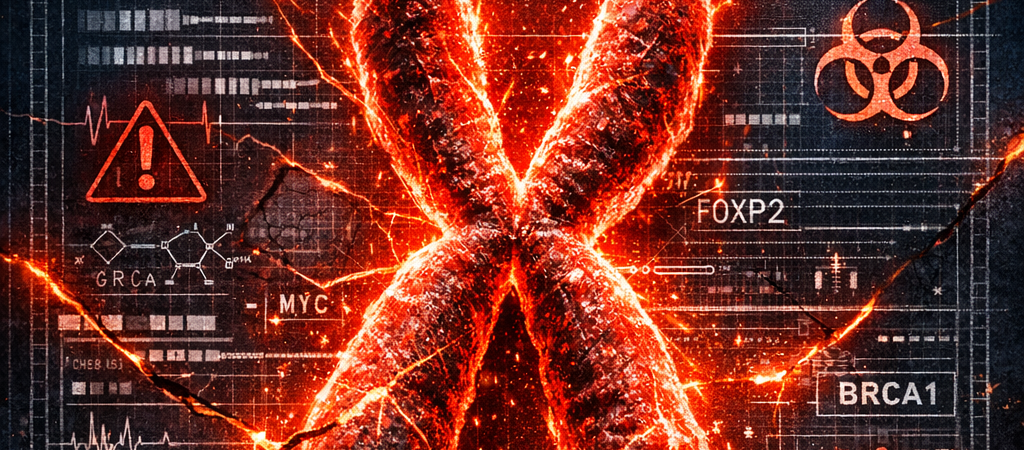
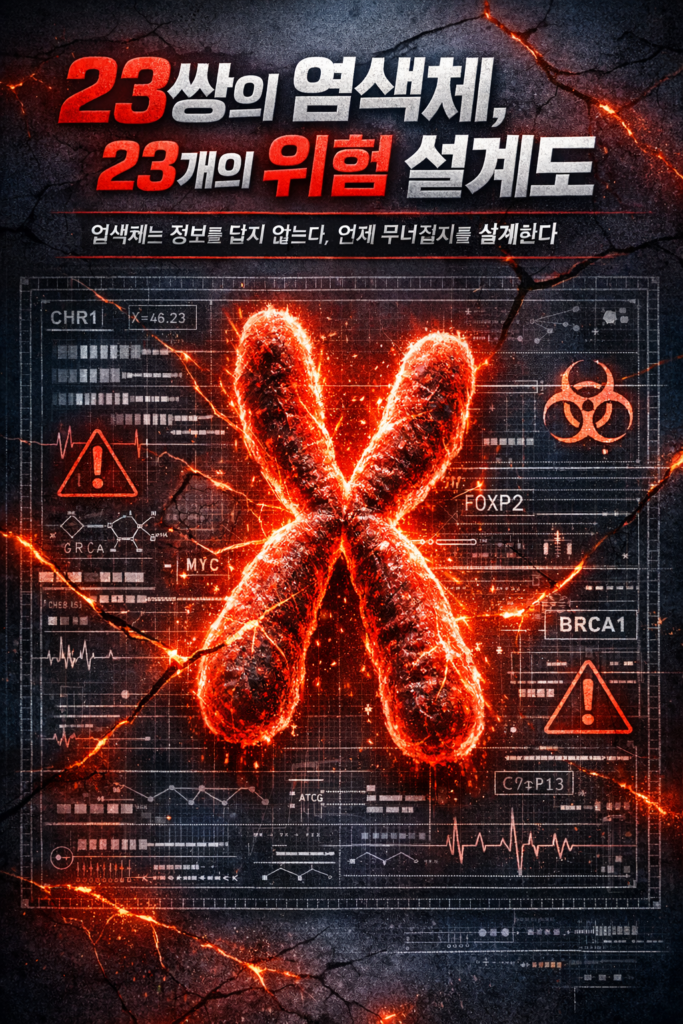
The human body is not a flawless, completed entity; rather, it is a delayed breakdown.
Medical textbooks routinely state that the human body comprises 23 pairs, or a total of 46 chromosomes. Legacies of education stop right there, implying that once you memorize the numbers, the lesson is complete. In the clinical reality of genetics, however, the truth is far more complex. These 23 pairs are not mere numbers; they represent 23 distinct biological crossroads where the entire trajectory of a human life diverges.
People frequently ask, “What exactly is packed inside a chromosome?” While it is a valid inquiry, it misses the absolute core of genetic pathology.
The primary consideration is not merely what information a chromosome houses, but precisely where the blueprint begins to fracture. A chromosome functions less as a standardized index of data and far more as a diagnostic map detailing exactly what systematic failure occurs when a specific section malfunctions.
🧬 The Structural and Functional Risks: Chromosomes 1 to 22
- Chromosome 1: As the largest structure, it houses the highest density of genetic data. The foundational regulatory rules governing cellular growth, division, and programmed senescence (cellular arrest) are hardwired here. When this intricate system fractures, the oncogenic risk of tumor development escalates. Its massive scale translates directly into an expansive radius of clinical impact.
- Chromosome 2: This pair is intimately bound to distinct human physiological capacities. For instance, the FOXP2 gene resides here, playing a non-negotiable role in linguistic architecture. Micro-deletions or mutations within this locus directly impair verbal execution and speech comprehension. The everyday act of communication relies entirely on this specific coordinate.
- Chromosome 3: This region maps out essential functions for localized immunity, pulmonary dynamics, and multiple tumor-suppressor sequences. While it operates quietly under homeostatic conditions, anomalies here are characteristically late-onset. By the time systemic degradation manifests, the pathology has frequently progressed to an advanced stage.
- Chromosome 4: This chromosome contains the HTT gene. A specific nucleotide expansion within this locus triggers Huntington’s disease—a neurodegenerative pathology that initiates silently but progresses irreversibly once activated. It operates as a biological circuit that starts covertly and advances with absolute certainty.
- Chromosome 5: Heavily involved in embryonic development and somatic growth. A structural deletion on the short arm of this chromosome results in Cri-du-chat syndrome. Though it appears as a minor structural loss on a karyotype, it inflicts profound disruptions on neurological development and structural maturation, proving that “minor omissions” in a chromosome carry immense clinical weight.
- Chromosome 6: The absolute epicenter of immunological governance. The Human Leukocyte Antigen (HLA) complex resides here, drawing the definitive baseline distinction between self and non-self entities. A disruption in this delicate equilibrium precipitates severe autoimmune pathologies, while hyper-sensitization drives clinical transplant rejection. Immunity is never a question of raw strength; it is a discipline of absolute accuracy.
- Chromosome 7: Houses the CFTR gene. Mutations within this specific sequence trigger cystic fibrosis, systematically compromising the respiratory tract and global exocrine mucus systems. This is not an isolated organ pathology, but a profound alteration of the body’s holistic fluid environment.
- Chromosome 8: Contains the MYC proto-oncogene. Under normal conditions, it strictly regulates somatic cell growth; however, aberrant activation accelerates unchecked, malignant cellular proliferation. Cancer is rarely a sudden, spontaneous event; it is the catastrophic hyper-activation of an pre-existing biological circuit.
- Chromosome 9: Holds the ABO blood group locus. While its variance appears minor in daily living, it serves as the definitive boundary of life and death during clinical blood transfusions and organ transplantations. Genetic data can shift its survival value dramatically depending on the clinical scenario.
- Chromosome 10: A domain dedicated to systematic regulation. Loci such as the RET proto-oncogene govern intracellular signaling cascades and cellular proliferation. Mutations here sharply elevate the risk of medullary thyroid carcinoma and multiple endocrine neoplasia. This region is governed not by structural anomalies, but by regulatory malfunctions—the outward appearance remains normal while the internal trajectory steadily shifts.
- Chromosome 11: Anchors the critical codes for insulin production and hemoglobin subunits. The core bioenergetic systems of glucose metabolism and oxygen transport—the very baselines of immediate physical survival—are deeply embedded within this sequence.
- Chromosome 12: A critical signaling and kinetic hub for cellular proliferation. The KRAS gene residing here is indispensable for baseline survival under normal conditions, yet specific somatic mutations transform it into a highly aggressive oncogenic driver. The overarching lesson is that pathology is often a shift in regulatory direction rather than a simple mechanical breakdown.
- Chromosome 13: Houses the RB1 tumor suppressor gene. A functional disruption of this single locus directly precipitates retinoblastoma, standing as a classic clinical model where a single genetic lesion dictates an immediate disease state.
- Chromosome 14: Includes vital gene segments responsible for immunoglobulin heavy chain synthesis. The fundamental biological methodology by which the human body recognizes, maps, and targets external pathogens is manufactured within this locus.
- Chromosome 15: The absolute domain of genomic imprinting. Depending entirely on the parental origin of the gene expression, identical micro-deletions within this region manifest as two starkly distinct clinical pathologies: Prader-Willi syndrome or Angelman syndrome. It establishes that “who expresses the gene” dictates the outcome far more than “what data is present.”
- Chromosome 16: Deeply involved in renal architecture and systemic metabolic pathing. Mutations within the PKD1 locus trigger polycystic kidney disease, causing the macroscopic architecture of the visceral organs to progressively degenerate over a longitudinal timeline.
- Chromosome 17: Houses the BRCA1 tumor suppressor gene. Inherited mutations within this sequence sharply escalate the lifetime risk of developing breast and ovarian malignancies. The clinical disease manifests much later in life, but the biological risk configuration is hardwired from inception.
- Chromosome 18: A clear clinical demonstration of numerical equilibrium. The presence of a third copy (Trisomy 18) results in Edwards syndrome. The underlying disruption is driven not by a functional gene mutation, but by a simple error in the absolute count of the structure.
- Chromosome 19: Possesses the highest gene density of the entire human genome. It houses the APOE locus, which is heavily implicated in the pathogenesis of late-onset Alzheimer’s disease. High informational density inherently introduces a higher statistical surface area for clinical variables.
- Chromosome 20: Primarily governs somatic metabolism and global bioenergetic homeostasis. Rather than manifesting as an isolated, singular pathology, anomalies here tend to exert a diffuse, systemic influence on a person’s global health profile.
- Chromosome 21: Universally recognized due to its association with Down syndrome (Trisomy 21). The presence of a single additional chromosome completely reconfigures the holistic somatic system, demonstrating that human biology is entirely sustained upon an “exact numerical count.”
- Chromosome 22: A domain highly sensitive to structural deletions. A micro-deletion within the 22q11.2 region precipitates DiGeorge syndrome, systematically impairing localized immunity, cardiac architecture, and neurodevelopmental pathways simultaneously.
🚻 The 23rd Pair: The Definitive Sexual Chromosomes
The final pair, the sex chromosomes, is superficially the simplest yet clinically the most decisive. Beneath the standard explanation that an XX configuration dictates a female profile and an XY dictates a male profile lies the ultimate master switch of human development.
The X chromosome is massive, packed with a vast array of essential genes unrelated to sex determination. Because females possess two X chromosomes, a functional defect on one strand can be comfortably mitigated by the healthy counterpart.
Conversely, males possess a single X chromosome paired with a significantly smaller Y chromosome. If a genetic lesion occurs on the male X chromosome, the system lacks a secondary backup to buffer the defect. This is the definitive biological reason why certain X-linked recessive genetic disorders manifest with vastly higher frequency within the male population.
While the Y chromosome is structurally minuscule, it houses the non-negotiable SRY (Sex-determining Region Y) gene. The exact millisecond this single master switch is activated, embryonic development is permanently steered toward a male phenotype. Biological sex is not determined by vast structural variations, but by the activation of a solitary molecular signal.
This intricate chromosomal architecture undergoes structural instability far more frequently than general public perception assumes. Numerical variations such as Klinefelter syndrome (XXY) or Turner syndrome (XO) directly alter sexual maturation and lifelong reproductive longevity—and these phenotypic changes are frequently diagnosed quite late in life.
In summary, the 23 pairs of chromosomes do not operate like 23 isolated mechanical components; they represent 23 distinct zones of continuous biological risk. For the vast majority of our lifespan, these circuits operate without a single visible glitch, leading us to hold onto the comforting illusion that our blueprint is completely flawless. Medicine, however, operates with an unyielding clinical awareness: the defining question is never whether a hidden genetic glitch exists, but precisely when it will choose to reveal itself.
📚 Medical References
- Thompson & Thompson Genetics in Medicine
- Significance: The gold standard academic reference mapping out the foundational molecular structures, numerical chromosomal anomalies, and clinical phenotypes of human genetic disorders.
- Robbins & Cotran Pathologic Basis of Disease
- Significance: The definitive pathology text detailing the systemic, cellular, and genetic mechanisms that govern chronic diseases, congenital syndromes, and oncogenic pathways across the human lifespan.
Editor’s Note: This content is an analytical commentary prepared by a specialized fertility journalist through the collection and evaluation of domestic and international reproductive medicine research, clinical policies, and statistical data. All medical diagnoses and treatment decisions must exclusively be established through direct consultation with a qualified medical professional.
Image Source: AI-generated (ChatGPT, OpenAI) / Provided solely as a supplemental visual aid for conceptual understanding.