
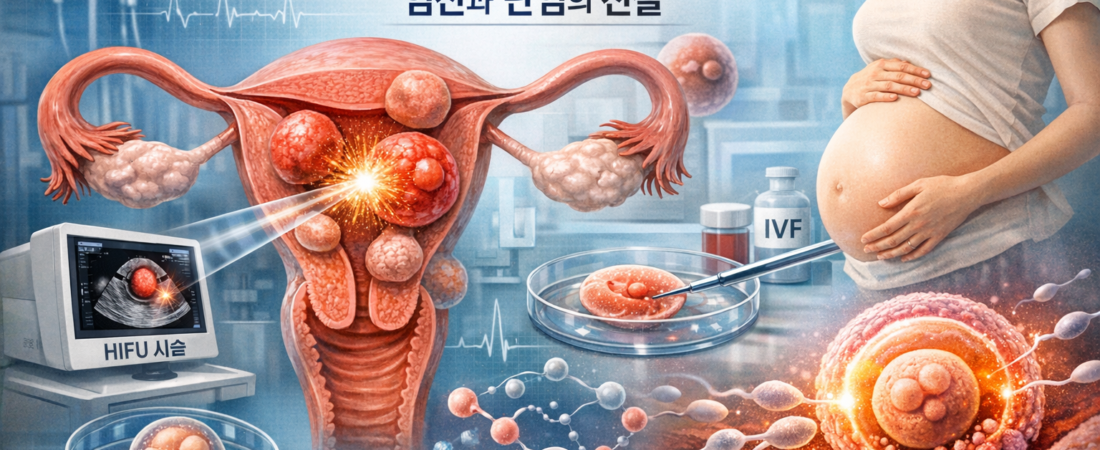
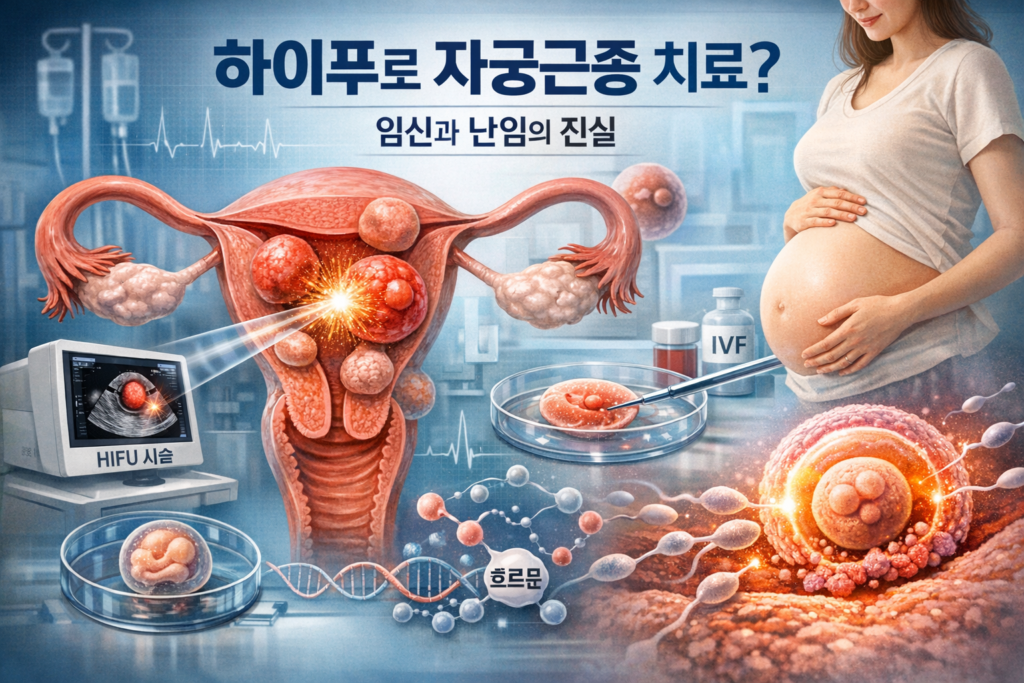
The uterus is an organ that fundamentally exists for pregnancy and childbirth. At the same time, it is a far more dynamic organ than most people realize, deeply involved in hormonal responses and localized vascular pathways. The critical issue is that this vital structure can silently deteriorate, with uterine fibroids standing as the most representative pathology.
Uterine fibroids are exceptionally prevalent, discovered in more than half of all women aged 35 and older. In their initial stages, they present as an accidental finding due to a lack of distinct symptoms. However, as they expand in size or multiply in number, the clinical reality shifts dramatically. They lead to debilitating symptoms that disrupt daily living, such as menorrhagia (excessive menstrual bleeding), severe dysmenorrhea, pelvic pain, and urinary frequency.
More importantly, the subsequent phase introduces severe reproductive hurdles. As the internal uterine architecture becomes distorted, embryo implantation becomes increasingly difficult, frequently culminating in infertility or recurrent early miscarriages.
At this juncture, many patients ask a straightforward question: “If I just get rid of the fibroids, will I be able to conceive easily?” In the clinical reality of reproductive medicine, the answer is never that simple. The biological impact of a uterine fibroid is entirely dictated by its specific anatomical location, size, and quantity. While certain fibroids have virtually zero impact on gestation, others—such as submucosal fibroids—directly disrupt the endometrial lining and actively prevent implantation. Ultimately, the decision to treat and the choice of modality must be governed not by the mere presence of a fibroid, but by its actual impact on the reproductive ecosystem.
Traditional interventions have historically centered around invasive surgery or pharmacological management. However, surgical removal can leave physical scars or structural damage on the uterine wall, while medications frequently yield only temporary, superficial relief. To overcome these distinct therapeutic limitations, High-Intensity Focused Ultrasound (HIFU) therapy was introduced. HIFU is a non-invasive thermal ablation technique that utilizes precisely targeted acoustic energy to induce coagulative necrosis in the fibroid tissue, shrinking the lesion without requiring a surgical incision.
The clinical advantages of HIFU are undeniable. It requires no abdominal incision, causes zero surgical bleeding, and boasts an exceptionally rapid recovery timeline. Because patients can return to their daily routines shortly after the procedure while completely preserving the physical uterus, it has emerged as a highly attractive option for women mapping out a future timeline for conception. Its ability to target localized lesions while minimizing structural trauma to the surrounding healthy uterine tissue sets it apart from traditional open or laparoscopic myomectomies.
However, this clinical popularity frequently gives rise to a profound misconception: the oversimplified formula that “undergoing HIFU directly equals a surge in pregnancy success rates.”
Biologically, this is inaccurate. HIFU is strictly a therapeutic tool designed to ablate or reduce the volume of a benign tumor; it is not an assisted reproductive technique that actively generates a pregnancy. Rather, by normalizing the mechanical distortion and improving the vascular environment of a compromised uterus, it successfully restores the baseline physiological conditions required for an embryo to implant.
Furthermore, HIFU is by no means an effortless or simple procedure. It demands an incredibly precise diagnostic assessment of the fibroid’s depth, its exact position relative to the endometrium, and its safe distance from adjacent vital organs like the bowel and bladder. Delivering the optimal thermal dose without damaging healthy tissues requires a high level of technical mastery. Consequently, clinical outcomes can vary significantly based on the longitudinal experience and technical skill of the operating specialist. This is the definitive reason why the exact same HIFU protocol can yield entirely different reproductive outcomes across different clinics.
Ultimately, the true cornerstone of successful management is not the technology itself, but patient selection. Not every uterine fibroid requires medical intervention, and HIFU is certainly not the universal answer for every fertility patient. For individuals proactively planning a family, the non-negotiable first step must be a meticulous expert evaluation to determine whether the fibroid is actively impeding implantation, and which preservation strategy offers the highest safety profile for the uterus.
To summarize, uterine fibroids are a common yet clinically significant condition, and while HIFU stands as an exceptionally effective non-invasive option, it is not a magical panacea. A successful pregnancy is never the result of an isolated procedure; it is a complex biological milestone achieved only when uterine architecture, localized blood flow, endocrine balance, and immunological tolerance are perfectly synchronized.
The clinical path to protecting the uterus and the reproductive strategy to prepare for a pregnancy may appear identical, but they require distinct approaches. The moment you accurately distinguish that nuance, the direction of your treatment fundamentally transforms.