
When you visit a fertility clinic to achieve a pregnancy, you will almost without exception hear the exact same phrase:
“We need to grow multiple eggs.”
And right away, the prescriptions follow.
Oral medications, followed by hormone injections.
At this juncture, most patients do not stop to ask.
They do not ask why they need to grow so many,
Whether it is truly necessary,
Or what exactly this intensive process is doing to their bodies.
Under natural conditions, the ovaries mature just a single egg each month.
This is by no means a biological coincidence.
It is an “optimal survival strategy” that the human body has carefully selected over millennia of evolution.
Yet, in fertility treatments, this foundational principle is directly countered.
The system forces multiple eggs to grow simultaneously.
Why?
The answer is remarkably straightforward:
“Probability.”
In In Vitro Fertilization (IVF), the probability of a single egg successfully fertilizing, culturing perfectly, and ultimately achieving implantation is not as high as one might hope.
Consequently, clinics aim to secure a larger pool of eggs.
The goal is to increase the chances of selecting the single most “viable-looking” embryo.
Up to this point, the logic sounds entirely reasonable.
However, the real question begins now:
How exactly are these numerous eggs being forced to grow?
When a woman’s menstrual cycle begins, the reproductive axis effectively resets.
The anterior pituitary gland in the brain begins to secrete FSH (Follicle-Stimulating Hormone).
As this FSH is delivered to the ovaries, follicles start their development.
Here lies the critical biological pivot point:
FSH is the explicit “growth signal” for eggs.
The higher the concentration of FSH in the system, the more follicles are stimulated to grow.
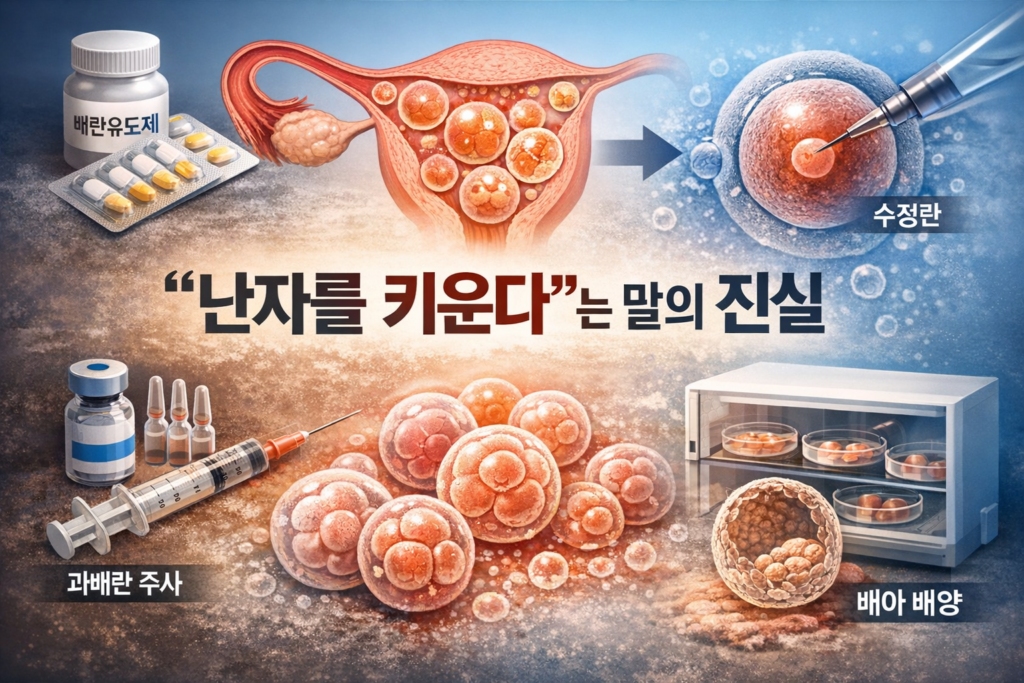
Modern fertility treatments exploit this simple feedback loop using two primary modalities.
Method 1: Oral Ovulation Induction Agents
Medications such as Clomiphene or Femara (Letrozole) work by partially blocking estrogen action or synthesis.
Fooled by this blockage, the brain mistakenly perceives that “follicles are failing to grow properly.”
In response, the pituitary gland compensates by pumping out a much larger surplus of endogenous FSH. It is a strategy of restriction designed to boost output.
Method 2: Gonadotropin Injections (Controlled Ovarian Hyperstimulation)
This approach is far more direct. Medications like Gonal-F or Puregon are pure, synthetic FSH.
There is no need to trick the brain; clinicians simply introduce the hormone directly into the bloodstream.
They manually flood the system with external FSH to force lagging follicles into growth.
Hearing this, one might naturally conclude:
“Well, if it results in more eggs, isn’t that inherently a good thing?”
In reality, the biological landscape is far more nuanced.
- First, quantity does not guarantee quality. Simply multiplying the number of retrieved eggs does not mean their cellular integrity improves. On the contrary, under excessive hormonal stimulation, the proportion of immature eggs or oocytes carrying chromosomal abnormalities can also rise.
- Second, this state is entirely non-physiological. A biological system designed to select and nurture only one dominant follicle is being artificially expanded to sustain dozens. To the female body, this represents a highly abnormal hormonal signal. This is precisely why complications like Ovarian Hyperstimulation Syndrome (OHSS) remain a serious clinical risk.
- Third, and most importantly, we must ask: “For whom is this necessary, and to what extent?” Not every patient requires the exact same aggressive protocol to yield a healthy pregnancy.
Yet, in many clinical settings, these high-dose ovarian stimulation paths are repeated almost like a standardized corporate protocol. At this intersection, fertility treatment shifts from personalized medicine into a volume-driven system: harvest in high numbers, fertilize in high numbers, and select from the remnants.
While undeniably efficient from a laboratory perspective, whether it represents the optimal path for an individual woman’s long-term health is an entirely separate matter.
What, then, should a patient keep in mind?
It comes down to a single, fundamental question:
“Why am I growing this many eggs?”
You must be empowered to ask this of yourself and your care team. Ovarian induction agents and gonadotropin injections are not inherently negative tools; they are the literal triumphs of modern reproductive medicine. However, a tool should never be confused with the ultimate destination. The clinical justification and the personalized manner in which these tools are deployed are what matter most.
The moment maximizing egg numbers becomes an end in itself, the treatment loses its true direction.
Ultimately, overcoming infertility is not a game of sheer volume.
It takes just one healthy egg,
One successful implantation,
And one healthy child.
That singular, profound truth is something we often forget far too easily.