

The Expression Pattern of Melatonin Receptors in Trophectoderm and Endometrial Tissues. (Photo courtesy of Kookmin University)
A pioneering study has revealed that melatonin may play a critical role in facilitating the process of embryo implantation into the maternal endometrium.
Melatonin is a natural hormone secreted by the pineal gland in the brain. Beyond its well-known function in regulating circadian rhythms (the body’s internal biological clock), melatonin has been documented to protect the fetal heart and prevent brain damage during gestation.
According to a report by the Financial News, this landmark research was led by a team under Professor Hwa Sun Lim of the Department of Food and Nutrition at Kookmin University.
Utilizing a porcine (pig) model, the researchers applied histological techniques to analyze tissues collected throughout pregnancy. The findings demonstrated that the expression of melatonin receptors steadily and progressively increased in both the trophectoderm (the outer layer of the blastocyst that develops into the placenta) and the endometrial tissues.
Furthermore, when the team treated trophectoderm and endometrial cells with melatonin, it significantly enhanced cellular proliferation and migration. This enhancement directly correlated with a potent implantation-promoting effect.
In addition to driving implantation, the study established that melatonin actively suppresses inflammatory responses and endoplasmic reticulum (ER) stress within both trophectoderm and endometrial cells.
This research breaks new ground by clarifying the precise cellular mechanism of melatonin, whose definitive role in sustaining early pregnancy had previously remained elusive. These insights are expected to yield wide-ranging clinical applications in reproductive medicine.
Professor Hwa Sun Lim of Kookmin University stated:
“We discovered that melatonin not only facilitates crucial maternal-embryonic cross-talk mediated by the SIRT1 gene, but also exerts a powerful protective shield against inflammation and cellular stress. This serves to maintain a healthy uterine environment for gestation. This study holds profound clinical significance as it presents melatonin as a viable candidate for promoting successful implantation and supporting long-term pregnancy maintenance.”
Commenting on the study’s impact, Dr. Jeong-hyun Cho, a leading fertility specialist and medical director at Sarangi Fertility Center, explained:
“This biological pathway perfectly explains why adequate, high-quality sleep is so critical for successful embryo implantation. Melatonin acts as the body’s natural sleep aid. When an individual’s circadian rhythm is disrupted, systemic melatonin levels plummet, leading to chronic insomnia. We now have the molecular data showing exactly why this hormonal drop translates to a decline in pregnancy rates.”
This collaborative study was conducted alongside a research team led by Professor Fuller W. Bazer at Texas A&M University and a team led by Professor Kwonho Hong at Korea University’s Department of Biotechnology. The findings were published online on the 18th in the Journal of Pineal Research, a highly prestigious peer-reviewed journal specializing in endocrinology, physiology, and neurobiology.
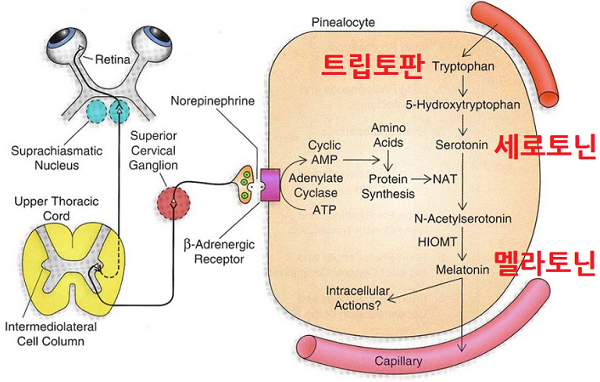
The Melatonin Biosynthesis Pathway: Melatonin is synthesized from tryptophan, an essential amino acid, through a multi-step enzymatic process following the sequential cascade: Tryptophan → Serotonin → Melatonin. (Image source: Pharmacist Yang’s Blog)